
Mosquee Koutoubia and the Almohad skyline of Marrakesh
Published on 09/17/2026 at 22:56 | Editorial responsibility: Rafael Müller, Editor-in-Chief AD HOC NEWS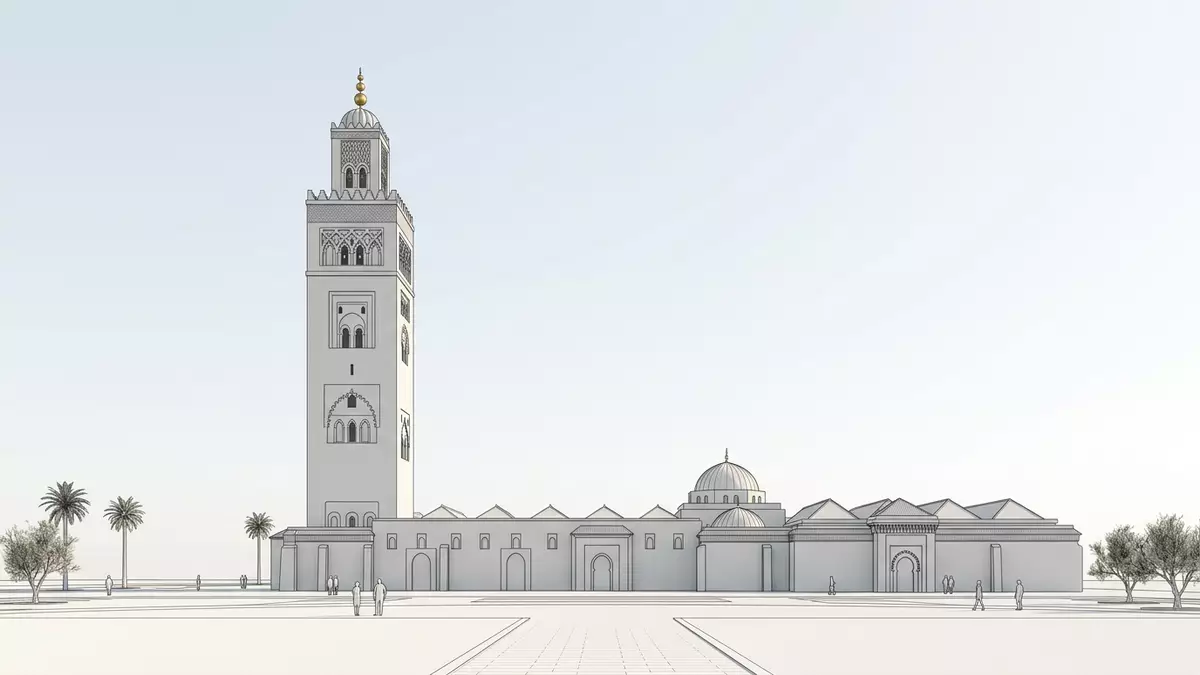
Mosquee Koutoubia rises in the southwest medina of Marrakesh, near Jemaa el-Fnaa and the gardens that frame it. Its 77-metre minaret makes the mosque easy to pick out, while the building itself belongs to the 12th century and the Almohad world. The most arresting thing here is the tower’s square mass and its layered brick-and-sandstone surface.
The Almohad mosque in Marrakesh
The mosque is commonly linked with the caliph Abd al-Mu’min, and its present form reflects the religious and political language of the Almohad dynasty. The prayer complex was built in the second half of the twelfth century, and its current outline preserves that period’s severe, measured style.
Its minaret is the feature that carries the whole composition. Square in plan and topped by a finial, it rises above the medina with geometric bands and recessed panels that break up the surface without crowding it.
How the mosque is organised
The mosque contains a hypostyle prayer hall and a courtyard, with aisles arranged around a central axis. The sanctuary uses a T-shaped plan, and the courtyard is edged by arcades that keep the geometry clear and legible.
Inside the minaret, the structure rises through a sequence of rooms and a broad internal ramp. That arrangement is part of what gives the tower its unusual sense of scale, even when seen from the street.
The minaret and its later influence
The tower is the element most people recognise first. It is built from masonry, sandstone and brick, and its surface combines blind arches, bands of decoration and a strong vertical silhouette.
The minaret’s form became influential across the western Islamic world, and it stands among the best-known Almohad towers in Morocco. The mosque’s name refers to booksellers, a reminder of the trade that once gathered near its walls.
Visiting Mosquee Koutoubia: what travellers from Western Europe should know
- The mosque stands in the southwest medina of Marrakesh, close to Jemaa el-Fnaa and the open garden spaces around it.
- The tower dominates the skyline, and the surrounding streets give repeated views of the minaret from different angles.
- The official language is Arabic and the currency is the Moroccan dirham.
- The mosque is a working religious site, and the exterior, gardens and nearby square provide the main public setting.
Searching for Mosquee Koutoubia on social platforms
These links open searches for Mosquee Koutoubia on each platform.
Frequently asked questions about Mosquee Koutoubia
Where is Mosquee Koutoubia?
It stands in the southwest medina of Marrakesh, near Jemaa el-Fnaa. The mosque’s minaret rises above the surrounding streets and garden spaces.
What can be expected on a visit?
The mosque is a functioning religious site, so the exterior is the main part visible from outside. The gardens and nearby square provide the clearest setting for seeing the tower and its masonry.
What makes it distinctive?
The square Almohad minaret is the defining feature, especially at 77 metres. Its twelfth-century form, geometric surface treatment and visible relationship to the rest of the complex give Mosquee Koutoubia its character.


