
Mosquee Koutoubia and the square tower of Marrakesch
Published on 09/22/2026 at 09:35 | Editorial responsibility: Rafael Müller, Editor-in-Chief AD HOC NEWS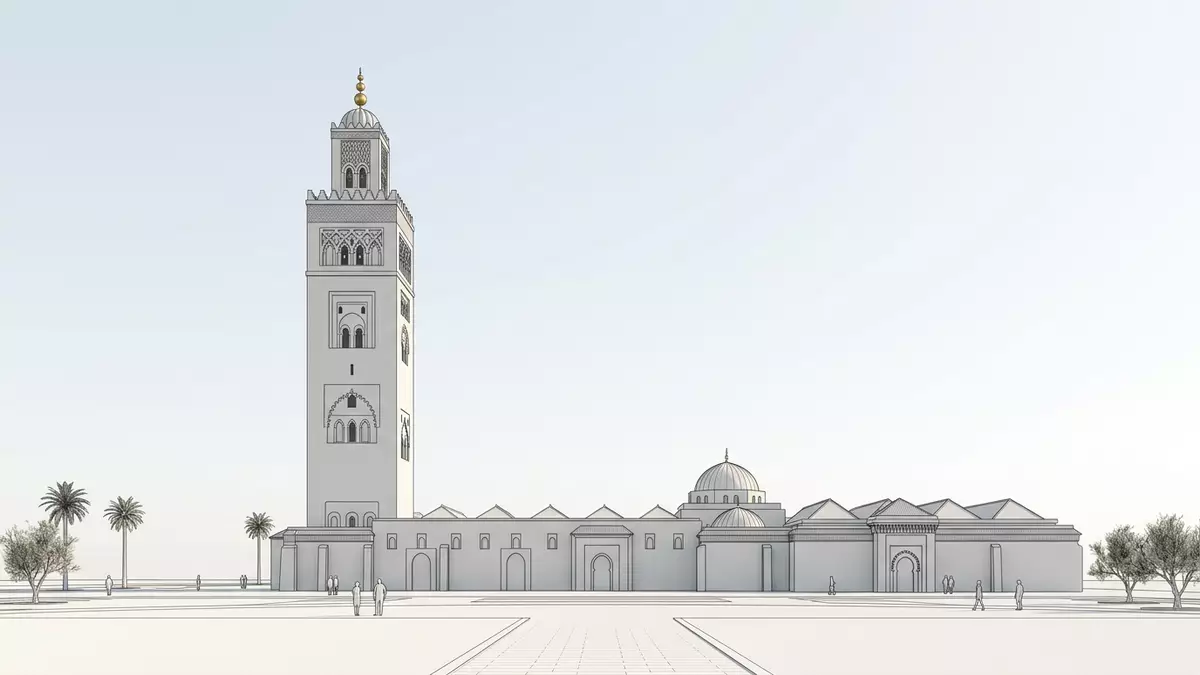
Mosquee Koutoubia rises beside the medina of Marrakesch as a long, low prayer complex crowned by a square minaret. Built under the Almohad caliph Abd al-Mu'min in the twelfth century, it combines brick, sandstone, geometric decoration and a tower measuring 77 metres.
The minaret supplies the clearest view of the mosque’s character. Its broad shaft, upper lantern and metal finial form a carefully ordered landmark, while the surrounding palms, walls and ochre buildings place the monument within Marrakesch’s historic urban landscape.
Mosquee Koutoubia: an Almohad monument in Marrakesch
Mosquee Koutoubia belongs to the period when the Almohads made Marrakesch their capital. The dynasty ruled a broad western Islamic realm, and its architecture appeared across North Africa and parts of Iberia. The mosque is a major surviving expression of that period.
The Medina of Marrakesh was founded by the Almoravids between 1070 and 1072, then became an Almohad capital from 1147. Mosquee Koutoubia belongs to this succession of dynasties and urban forms.
The mosque’s name comes from booksellers associated with the surrounding area. Its Arabic name, Kutubiyya, is connected with books, giving the religious monument a link to the learned and commercial life of the medina.
The 77-metre minaret and its geometric language
The minaret is built around a square shaft of sandstone, with a total height of 77 metres. Its surfaces carry combinations of blind arches, recessed panels and arched openings, arranged in patterns that remain legible from the city streets.
The square minaret includes an internal ramp leading towards an upper gallery. Above the main shaft sits a smaller tower, followed by a lantern and metal finial.
The design belongs to the Almohad tradition of monumental square minarets. Its architectural family includes the Giralda in Seville and the Hassan Tower in Rabat, although each tower has its own history and details.
At ground level, sandstone gives the tower a warm, dense surface. Higher sections introduce more intricate visual divisions, including green ceramic tilework beneath the merlons. The contrast is visible without relying on painted decoration across the whole façade.
Prayer hall, courtyard and the second mosque
Mosquee Koutoubia is associated with two successive mosque buildings from the twelfth century. The first began after Abd al-Mu'min captured Marrakesch in 1147, while the second was under construction by September 1158.
The surviving complex follows a broad rectangular plan with a courtyard beside the prayer hall. Parallel naves organise the interior, and a wider transverse nave near the qibla wall gives the plan its T-shaped emphasis.
Brick forms the columns, arcades, central qibla wall and mihrab niche. Sandstone appears in the exterior walls, giving the mosque a material palette shared by other Almohad monuments.
The first mosque contained an elaborate wooden minbar linked with Andalusian craftsmanship. The object was made in Córdoba for the Almoravid ruler Ali bin Yusuf and was later associated with Mosquee Koutoubia before moving to another Marrakesch monument.
The mosque’s historical form therefore combines worship, dynastic architecture, craftsmanship and urban memory. Its significance lies in the surviving relationship between the prayer complex, the minaret and the medina around them.
Visiting Mosquee Koutoubia: what travellers from Western Europe should know
- Mosquee Koutoubia stands beside Marrakesch’s medina and near Jemaa el-Fnaa. The mosque is reached through the city’s central historic districts.
- The exterior, minaret and surrounding gardens form the principal visual setting. The prayer hall is an active religious space.
- The monument is part of the Medina of Marrakesh, whose lanes, walls, gates, gardens and historic buildings surround the mosque.
- The official language is Arabic and the currency is the Moroccan dirham.
Searching for Mosquee Koutoubia on social platforms
These links open searches for Mosquee Koutoubia on each platform.
Frequently asked questions about Mosquee Koutoubia
Where is Mosquee Koutoubia?
Mosquee Koutoubia stands beside the medina of Marrakesch, near Jemaa el-Fnaa and the historic centre’s walls, lanes and gardens.
What can visitors expect?
The exterior, minaret and surrounding gardens provide the main visual experience. The building remains a religious mosque and should be approached with respect.
What makes the mosque distinctive?
Its 77-metre sandstone minaret has a square Almohad form, geometric decoration, an upper lantern and a metal finial above the Marrakesch skyline.


