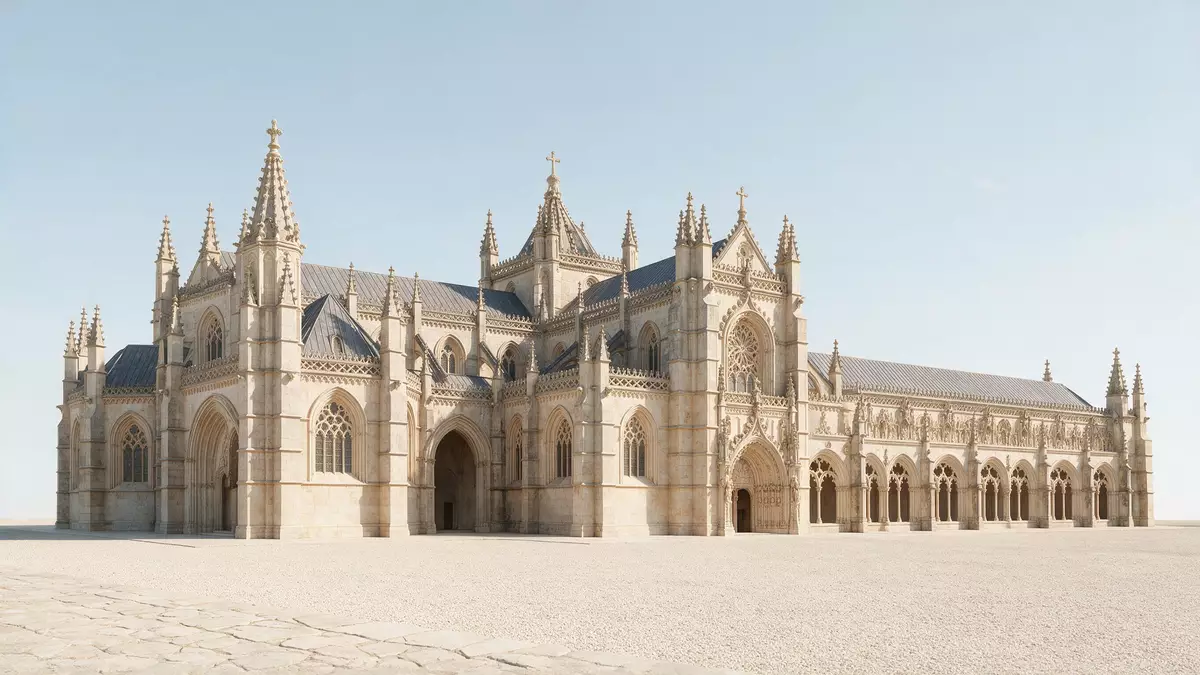
Mosteiro da Batalha and its lace-like stonework
Published on 08/09/2026 at 15:19 | Editorial responsibility: Rafael Müller, Editor-in-Chief AD HOC NEWS
Mosteiro da Batalha in Batalha is a late medieval Dominican monastery whose stone tracery and royal chapel dominate the complex. Built after the Battle of Aljubarrota and associated with King João I, it remains one of Portugal’s clearest Gothic monuments.
Stone, vaults and royal memory
The monastery’s cloisters, church and chapter house show the discipline of Portuguese Gothic at its most refined. Thin shafts, pointed arches and carved detail give the interior a measured, vertical character.
The Royal Cloister and the unfinished chapels add a strong contrast in material and finish. Limestone carving, open arcades and exposed structural edges let the building’s different phases read at a glance.
The monastery of João I
João I commissioned the monastery in the late fourteenth century after the 1385 victory at Aljubarrota. The site became a royal memorial as well as a Dominican house, and that double identity still defines it.
The Founder’s Chapel holds the tombs of João I and Philippa of Lancaster. Their placement under a domed crossing gives the space a clear dynastic centre without losing the calm geometry of the surrounding masonry.
Late Gothic detail in Portugal
Mosteiro da Batalha also matters as a bridge between Gothic restraint and the richer decorative language that followed. The Manueline touches in some later additions sit beside older forms rather than replacing them.
That layering makes the complex easier to read than many grand monastic sites. One can move from austere church space to elaborate stonework and then to the unfinished royal chapels in a single visit.
Visiting Mosteiro da Batalha: what travellers from Western Europe should know
- The monastery is in Batalha, in central Portugal, and is reached by road from nearby towns and Lisbon.
- Admission arrangements and opening hours are set by the site's operator and change with the season; the official website is the only binding source.
- Spring and early autumn are comfortable times for a visit, while bright daylight makes the carved detail easier to read.
- The site includes stone floors, steps and large interior spaces, so comfortable footwear is sensible.
- Portuguese is the local language, and card payment is widely used in the area.
- Entry requirements depend on your nationality. UK travellers should check the FCDO travel advice at gov.uk/foreign-travel-advice; Irish travellers the Department of Foreign Affairs at ireland.ie; EU and EEA citizens their own national foreign ministry.
Searching for Mosteiro da Batalha on social platforms
These links open searches for Mosteiro da Batalha on each platform.
Frequently asked questions about Mosteiro da Batalha
Where is Mosteiro da Batalha?
It stands in Batalha, in central Portugal, within reach of Lisbon by road. The monastery forms the heart of the town’s historic identity.
What should visitors expect inside?
Expect a church, cloisters, chapels and royal tombs, all expressed in carved limestone. The complex rewards slow walking and attention to detail.
What makes it distinctive?
Its combination of royal memorial, Dominican monastery and refined Gothic stonework gives it a strong identity. The unfinished chapels and the Founder’s Chapel are especially memorable.