
Mosteiro da Batalha and the lacework stone of Portugal’s gothic age
Published on 09/21/2026 at 13:28 | Editorial responsibility: Rafael Müller, Editor-in-Chief AD HOC NEWS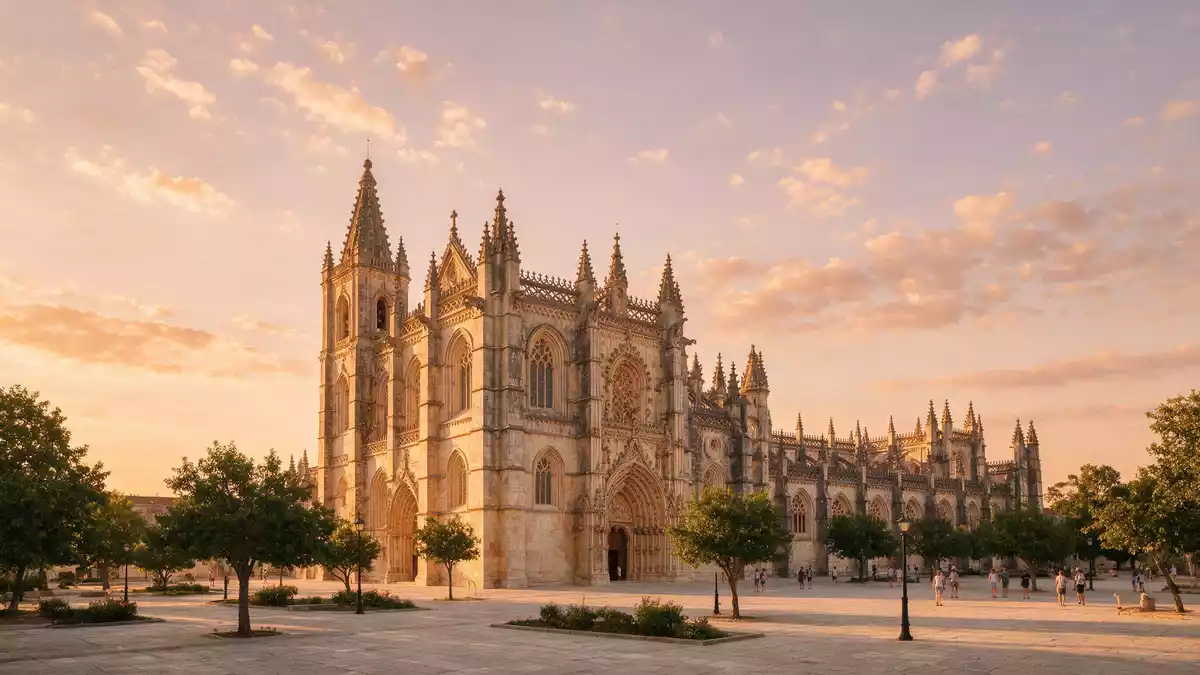
Mosteiro da Batalha dominates the small town of Batalha with a long spine of pale limestone walls, delicate buttresses and intricately carved stonework. Built as the Monastery of Saint Mary of the Victory for King João I after the Battle of Aljubarrota in 1385, it brings together late medieval Portuguese Gothic and the highly ornate Manueline style within a single vast complex.Monastery of Saint Mary of the Victory
A limestone monument to a medieval battle
The full name of Mosteiro da Batalha, Monastery of Saint Mary of the Victory, anchors it directly to the Portuguese victory over Castile at Aljubarrota on 14 August 1385.victory over the Castilians at Aljubarrota in 1385 The complex stands in the centre of Batalha, in Portugal’s Centro region, and takes its popular name from the town itself.centre of the town of Batalha
Construction began in the late fourteenth century under King João I of the Aviz dynasty, and the monastery became a royal pantheon for his line.construction began at the end of the fourteenth century with the patronage of King João I For about two centuries, work continued in phases that tracked the changing tastes of Portuguese architecture, leaving a vast complex that reads almost like a stone chronicle of late medieval and early modern Portugal.main building project for the Portuguese monarchy for two centuries
Gothic structure and Manueline detail
The core of Mosteiro da Batalha is a Dominican church with a high nave and flying buttresses, a textbook example of Portuguese Gothic in its proportions and structural clarity.Dominican convent that is a masterpiece of Gothic and Manueline art Slender columns rise to meet ribbed vaults, and large openings in the walls bring daylight onto the limestone surfaces, so that the interior feels both monumental and finely grained.
Around this church stretches a sequence of cloisters and chapels whose detail grows more ornate the further one walks from the main nave. The principal cloister, sometimes called the Royal Cloister, frames a central courtyard with arcades whose arches are filled with lace-like stone tracery, an early sign of the Manueline taste for intricate carved ornament that would later reach its full expression in the unfinished chapels.highly original national Gothic style influenced by Manueline art
Royal memory and unfinished stonework
Mosteiro da Batalha served as the burial place for King João I and his descendants of the Aviz dynasty, binding the building tightly to the story of Portuguese royal power in the fifteenth century.burial church of the fifteenth-century Aviz dynasty In dedicated chapels, stone tombs line the walls, with recumbent effigies carved in the same limestone as the surrounding architecture.
At one edge of the complex stands a group of chapels known as the Capelas Imperfeitas, or Unfinished Chapels. These open-sided structures are richly carved with Manueline motifs such as twisted columns, botanical forms and armillary spheres, yet they never received their planned vaults, leaving the upper stonework exposed against the sky and giving this part of the monastery an arresting mixture of grand ambition and permanent incompletion.Capelas Imperfeitas or Unfinished Chapels with Manueline style
Visiting Mosteiro da Batalha: what travellers from Western Europe should know
- Mosteiro da Batalha stands in the town of Batalha in central Portugal, in the Leiria district, inland from the Atlantic coast and north of Lisbon.
- The complex is largely level at ground level, but different wings are linked by stone steps and long cloister walks that require a fair amount of walking.
- The monastery is in Portugal, where the official language is Portuguese and the currency is the euro.
Searching for Mosteiro da Batalha on social platforms
These links open searches for Mosteiro da Batalha on each platform.
Frequently asked questions about Mosteiro da Batalha
Where is Mosteiro da Batalha?
Mosteiro da Batalha stands in the town of Batalha in central Portugal, in the Leiria district, between the Atlantic coast and the interior.
What can visitors expect inside the monastery?
Visitors enter a large Gothic church with high limestone vaults, then move through cloisters, chapels and courtyards where the stone carving grows more intricate.
What makes Mosteiro da Batalha distinctive among Iberian monasteries?
The monastery combines a structurally clear Gothic church with highly ornate Manueline stonework, especially in the Royal Cloister and the Unfinished Chapels, and serves as a royal pantheon.


