
Mosteiro dos Jeronimos and the stone lace of Lisbon’s Age of Discoveries
Published on 09/09/2026 at 18:11 | Editorial responsibility: Rafael Müller, Editor-in-Chief AD HOC NEWS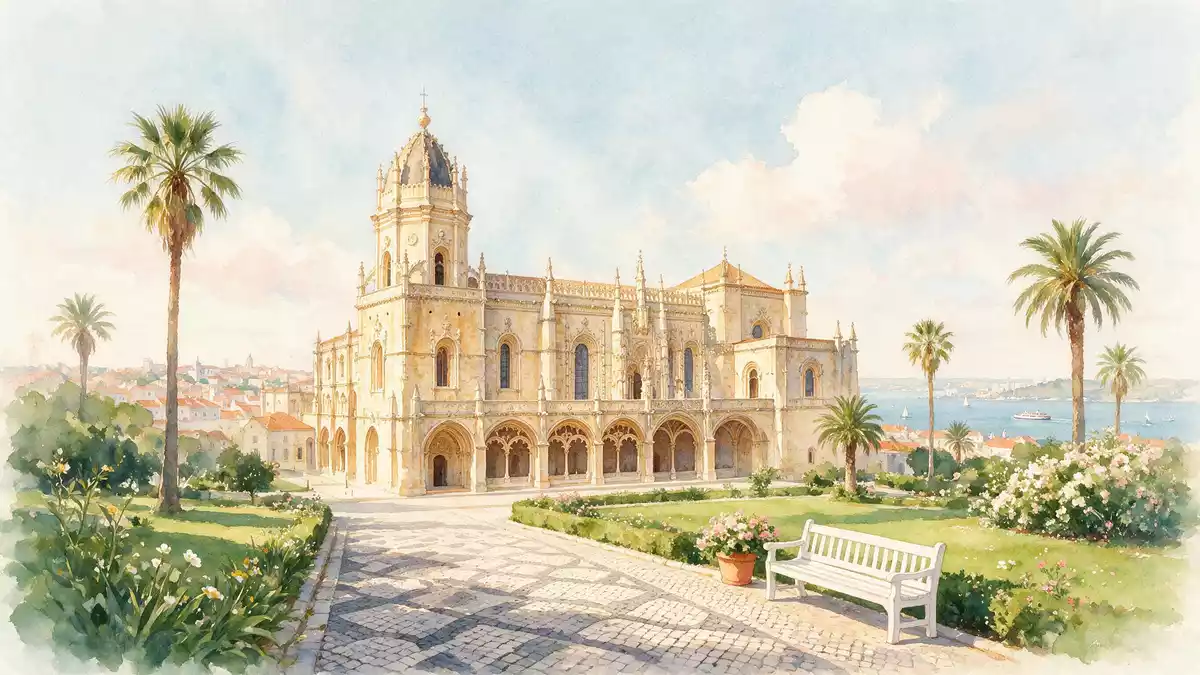
Mosteiro dos Jeronimos in Lissabon is a monastery turned national symbol, a long limestone complex whose carved facades and cloisters read like stone lace from the Age of Discoveries. Commissioned by King Manuel I in the early sixteenth century and now recognised as a UNESCO World Heritage Site, it anchors the Belém waterfront beside the Tagus River as a physical record of Portugal’s ocean?bound ambitions.
Manueline power in carved limestone
The Jeronimos Monastery, formally the Royal Monastery of Santa Maria de Belém, was ordered by King Manuel I, whose reign ran from 1495 to 1521, at the threshold of Portugal’s global expansion. Construction began around 1501 in the Belém district on the western edge of Lisbon, close to the point from which Vasco da Gama sailed on his pioneering voyage to India in 1497.King Manuel I built a large monastery The building was entrusted to the Order of Saint Jerome, whose monks occupied the complex for centuries and gave it the Portuguese name Mosteiro dos Jeronimos.The Monastery of the Hieronymites is a royal foundation
The architecture belongs to the Manueline style, a Portuguese variation of late Gothic that folds maritime and royal symbols into elaborate stone carving. Facades and portals carry armillary spheres, ropes, botanical motifs and dynastic emblems, all cut into pale limestone so dense with detail that entire surfaces look embroidered. The long southern front stretches parallel to the river, punctuated by windows and a richly worked main portal, while the church rises from the same structural mass, forming a continuous volume with the monastic ranges.The Jerónimos Monastery is one of the most prominent examples of the late Portuguese Gothic Manueline style
Cloisters and church: a stone harbour for memory
Inside, the cloister is the heart of Mosteiro dos Jeronimos, laid out as a square court surrounded by two storeys of arcaded galleries whose balustrades and supports are carved almost continuously. Each level frames the central courtyard with arches and traceried parapets, while delicate sculptural work runs along columns, capitals and even the underside of walkways. The result is a calm, enclosed space where stone takes over the role of textiles, turning structural elements into ornamental screens.Construction on it began in 1501, lasted for a hundred years The cloister links the practical life of the former monastery with its ceremonial areas, and today it remains one of the clearest places to read the Manueline vocabulary at close range.
The adjoining church of Santa Maria de Belém stretches lengthwise from the river side towards the interior of the site, with a nave carried on slender supports and a high vault decorated with ribs that spread in complex patterns. Near the entrance, carved nineteenth?century Neo?Manueline tombs honour navigator Vasco da Gama and poet Luís de Camões, binding the building to national narratives of exploration and literature.the monastery's church is the final resting place of several prominent figures in Portuguese history, including explorer Vasco da Gama and poet Luís de Camões Further inside, chapels along the sides and the choir area form a sequence of spaces where royal and religious iconography share the same stone surfaces.
From royal foundation to UNESCO World Heritage
Mosteiro dos Jeronimos was financed through revenues linked to Portugal’s overseas trade, channelled under King Manuel I to create a monument at the water’s edge that matched the scale of the kingdom’s ambitions. Over the course of roughly a century of building campaigns, successive master builders extended and refined the complex, adding ranges and completing the church so that monastery and sanctuary formed a single composition in stone.King Manuel I founded it in 1501 The Hieronymite community lived here until the nineteenth century, after which the complex passed through different uses, including functions as museum space and state ceremonial setting.The Hieronymites lived in the monastery until 1834
Its status as a National Monument was formalised in the early twentieth century, and in 1983 Mosteiro dos Jeronimos, together with the nearby Tower of Belém, entered the UNESCO World Heritage List as a single property recognising both monuments as masterpieces of Portuguese art tied to the maritime discoveries of the fifteenth and sixteenth centuries.inscribed on the UNESCO World Heritage List in 1983 The monastery’s Manueline vocabulary, its closeness to the Tagus and its direct association with Vasco da Gama’s voyage make it central to how Portugal presents the Age of Discoveries in stone and space.This serial World Heritage property comprises the Monastery of the Hieronymites and the Tower of Belém
Visiting Mosteiro dos Jeronimos: what travellers from Western Europe should know
- Mosteiro dos Jeronimos stands in the Belém district of Lissabon, west of the historic centre, beside the Tagus River and near the Tower of Belém.
- The complex extends over a broad, level riverside plot, with long interior corridors and staircases linking the cloister levels and the church, so a visit involves substantial walking indoors.
- The surrounding Belém area includes other major sites, such as the Torre de Belém and the Padrão dos Descobrimentos, which are within walking distance along the riverfront.
- The official language is Portuguese and the currency is the euro, and transport connections link Belém with central Lisbon by urban rail and road.
Searching for Mosteiro dos Jeronimos on social platforms
These links open searches for Mosteiro dos Jeronimos on each platform.
Frequently asked questions about Mosteiro dos Jeronimos
Where is Mosteiro dos Jeronimos located?
Mosteiro dos Jeronimos stands in the Belém district of Lissabon, on the northern bank of the Tagus River, west of the city centre and close to the Torre de Belém.
What should visitors expect inside the monastery?
A visit reveals a Manueline cloister with richly carved arcades, a long church with ribbed vaulting and chapels, and stone details filled with maritime and royal motifs.
What makes Mosteiro dos Jeronimos distinctive among Portuguese sites?
Its combination of Manueline architecture, association with Vasco da Gama’s voyage and status as a joint UNESCO World Heritage Site with the Tower of Belém makes it central to Portugal’s portrayal of the Age of Discoveries.


