
Mosteiro dos Jeronimos and the stone lace of Portugal’s Manueline age
Published on 09/19/2026 at 20:19 | Editorial responsibility: Rafael Müller, Editor-in-Chief AD HOC NEWS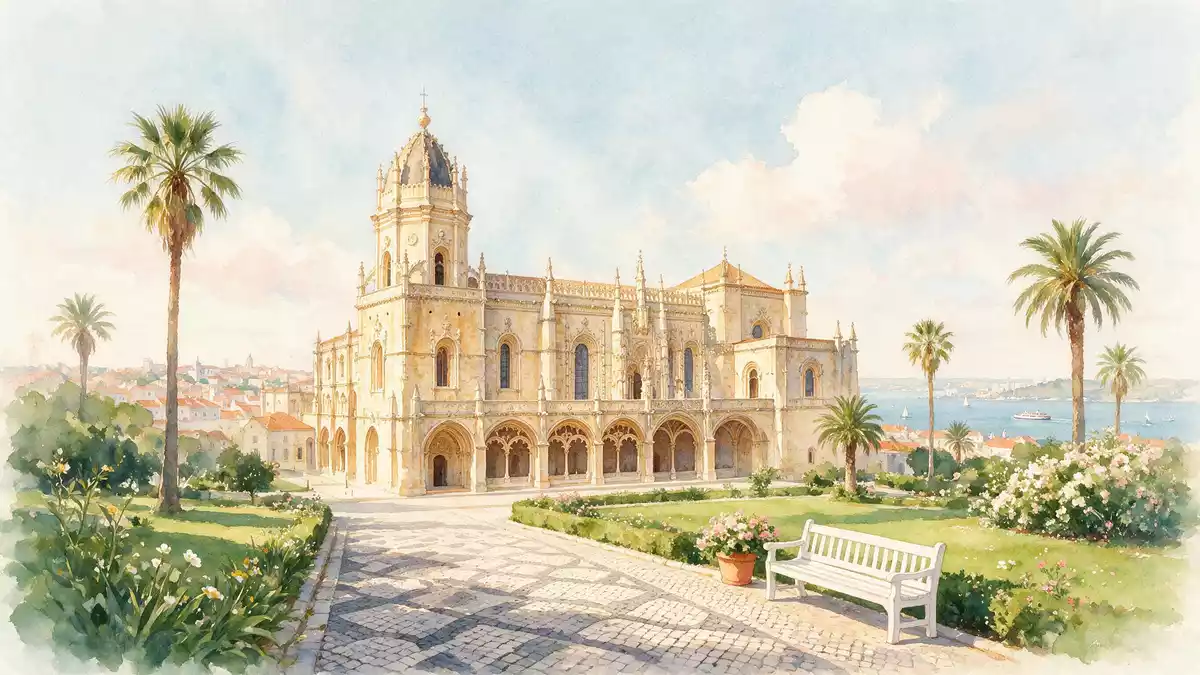
Mosteiro dos Jeronimos in Lissabon is a vast limestone monastery where Portugal’s Manueline architecture gathers into one complex of church, cloister and riverside façade. Rising in the Belém district near the Tagus, it was commissioned by King Manuel I around the turn of the sixteenth century and became a royal foundation closely tied to the Portuguese voyages of the Age of Discoveries.
A Manueline monument beside the Tagus
Mosteiro dos Jeronimos stands in Belém, west of central Lissabon, facing the broad estuary of the Tagus river where ocean-going ships once departed towards Africa and Asia. The complex forms a long frontage of pale limestone, with a church on one side and extended convent wings running along a major avenue, creating an almost continuous architectural wall between the riverfront and the inland streets. The Royal Monastery of Santa Maria de Belém, as it is formally named, was founded in the late fifteenth century and began to be built in the early 1500s under the patronage of Manuel I, whose reign lasted from 1495 to 1521.Founded in 1496 and begun around 1501–1502 The building was given to the Hieronymite Order, a community of monks associated with Saint Jerome, and its Portuguese name Mosteiro dos Jeronimos reflects that dedication.Royal Monastery of Santa Maria de Belém for the Order of São Jerónimo
The monastery’s position beside the river places it in the historical landscape of the Age of Discoveries, when Vasco da Gama sailed from Lisbon towards India at the end of the fifteenth century. Construction was funded by taxes levied on profits from overseas trade, binding the fabric of the building to the economics of maritime expansion.Construction began in 1501 and was funded by a levy on the spice trade Over the course of roughly a century, successive architects developed the ensemble into one of the clearest expressions of Manueline architecture in Portugal, with a church, cloister and ancillary spaces aligned along a unified plan.Around one hundred years of building under several master builders
Manueline stonework and the Hieronymite cloister
The core identity of Mosteiro dos Jeronimos lies in its Manueline architecture, a Portuguese variant of late Gothic that integrates maritime motifs and royal emblems into a dense sculptural surface. The church interior rests on tall columns carrying a vaulted ceiling, while arcades of the cloister are carved with ropes, botanical forms and small figurative details that pick out the themes of exploration and Christian devotion. Manueline style emerged during the reign of Manuel I and combines the verticality of late Gothic with sculptural exuberance linked to Portugal’s overseas voyages.Manueline style blending late Gothic with discoveries iconography In this monastery the style extends across portals, cloister arcades and balustrades, making the building a sustained study in carved limestone.
The cloister forms a two-level courtyard surrounded by galleries, each with arches resting on richly carved supports. It offers views into the church and towards the convent ranges, tying the spiritual spaces of prayer to the wider monastic complex. The monastery’s fabric reflects the work of several named architects: Diogo de Boitaca established the Manueline design in the early sixteenth century, and João de Castilho, Diogo de Torralva and Jerónimo de Ruão continued and completed the project during later decades.Diogo de Boitaca and later masters including João de Castilho and Jerónimo de Ruão Their combined work produced a monastery that is widely recognised as a masterpiece of Portuguese architecture and a principal example of Manueline art in Lisbon.Described as the masterpiece of Portugal’s Manueline style
Royal tombs and World Heritage status
Beyond its architectural language, Mosteiro dos Jeronimos functions as a royal and national monument. In the sixteenth century it became closely associated with the Portuguese royal dynasty of Aviz, housing tombs and ceremonial spaces that marked it as a dynastic pantheon.Necropolis of the Aviz dynasty in the sixteenth century Over time it also became the resting place of figures tied to navigation and culture, including Vasco da Gama and members of the Portuguese royal family, underlining the monastery’s link to both political power and maritime history.Burial of Vasco da Gama and King Manuel I
Mosteiro dos Jeronimos has been recognised formally as heritage of national and international importance. In Portugal it was classified as a National Monument in 1907, acknowledging its artistic and historical significance.Classified National Monument in 1907 In 1983 the Monastery of the Hieronymites, together with the nearby Tower of Belém, was inscribed on the UNESCO World Heritage List as an outstanding example of Portuguese art associated with the Age of Discoveries.UNESCO World Heritage inscription in 1983 Standing beside the Tagus, the complex thus serves both as a working monument of Manueline architecture and as a preserved record of Portugal’s maritime and royal history.
Visiting Mosteiro dos Jeronimos: what travellers from Western Europe should know
- Mosteiro dos Jeronimos stands in the Belém district of Lissabon, west of the historic centre, near the Tagus river and along a major riverside avenue served by urban transport.
- The monastery complex includes a large church, extended cloister wings and broad exterior terraces; a visit involves moving through stone interiors, staircases and open courtyards on solid paving.
- The official language is Portuguese and the currency is the euro.
- Within sight of Mosteiro dos Jeronimos are other major riverside landmarks in Belém, including the historic Tower of Belém further along the waterfront.
Searching for Mosteiro dos Jeronimos on social platforms
These links open searches for Mosteiro dos Jeronimos on each platform.
Frequently asked questions about Mosteiro dos Jeronimos
Where is Mosteiro dos Jeronimos located?
Mosteiro dos Jeronimos stands in the Belém district of Lissabon, beside the Tagus river on the city’s western waterfront.
What can visitors expect inside the monastery?
Visitors encounter a Manueline church with tall columns, a two-level cloister with carved limestone arcades and extended convent ranges connected by galleries and staircases.
What makes Mosteiro dos Jeronimos distinctive among Lissabon’s landmarks?
Its Manueline stonework, royal tombs, riverside situation and recognition as both a Portuguese National Monument and a UNESCO World Heritage site give the monastery a distinctive profile.


