
Mount Cameroon and its volcanic trail above Buea
Published on 09/24/2026 at 05:05 | Editorial responsibility: Rafael Müller, Editor-in-Chief AD HOC NEWS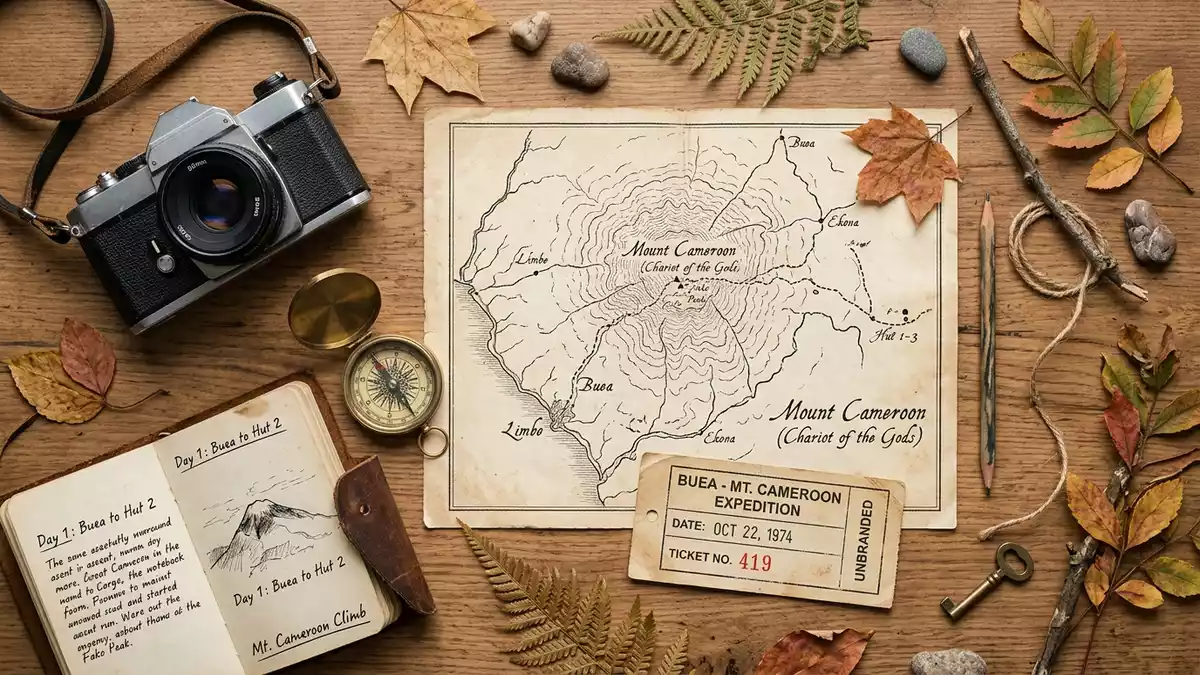
Mount Cameroon rises above Buea as a broad volcanic massif, with vegetation changing from humid lowland forest to montane grassland and dark upper slopes. Its summit reaches about 4,095 m (13,435 ft), making the mountain a dominant feature of Cameroon’s Gulf of Guinea coast.
Mount Cameroon: a volcano rising from forest to grassland
Mount Cameroon belongs to the Cameroon Volcanic Line, a chain of volcanic formations stretching through the Gulf of Guinea region. The mountain is an active stratovolcano, with lava fields, volcanic cones and broad slopes forming its visible landscape.
The massif extends inland from the coast, between Buea and Limbe. Its western and southern slopes face the Gulf of Guinea, where humid air brings heavy rainfall. The resulting landscape changes with altitude, from evergreen rainforest through upland forest to open grassland and sparse vegetation near the summit.
From Buea to the summit of Mount Cameroon
Buea lies on the south-eastern slope and serves as the principal starting point for ascents. Routes from the town cross forested ground before reaching higher grassland, volcanic ash and rough black rock. The climb is a long mountain journey rather than a short viewpoint walk.
The upper mountain contains volcanic terrain shaped by lava flows and eruptions. The summit region has no permanent ice cap, and its surfaces are exposed to wind, rain and rapid changes in cloud. The mountain’s height and its position near the coast create a striking transition between tropical vegetation and high-altitude terrain.
Rainforest, volcanic soil and Bakweri heritage
Volcanic soils support plantations and cultivated landscapes around the lower slopes, including bananas, tea, cacao, oil palms and rubber. Higher ground carries montane vegetation, with shrubs, grasses and lichens adapted to cooler conditions.
The Bakweri people have long used the mountain’s local names, including Fako and Mongo ma Ndemi. A documented European ascent reached the summit in 1861, when Richard Francis Burton, Gustav Mann and Atilano Calvo travelled with Krumen porters. The mountain’s recorded history therefore includes exploration, botanical study and the continuing cultural presence of communities around Buea.
Visiting Mount Cameroon: what travellers from Western Europe should know
- Mount Cameroon rises beside Buea in Cameroon’s South-West Region, above the Gulf of Guinea. Road travel from the regional urban centres reaches Buea and the mountain’s lower approaches.
- The route crosses forest, open upland vegetation, volcanic ash and dark rock. A summit ascent involves major changes in altitude and demanding mountain terrain.
- Mount Cameroon National Park covers parts of the massif and includes rainforest, montane forest and high grassland. The protected landscape extends beyond the summit route.
- The official language is English and French, and the currency is the Central African CFA franc.
- Entry requirements depend on your nationality; UK travellers can check the FCDO travel advice at gov.uk/foreign-travel-advice, Irish travellers the Department of Foreign Affairs at ireland.ie.
- Conditions on the mountain change with the seasons; the local cable-car operators and alpine clubs provide information.
Searching for Mount Cameroon on social platforms
These links open searches for Mount Cameroon on each platform.
Frequently asked questions about Mount Cameroon
Where is Mount Cameroon?
Mount Cameroon lies in Cameroon’s South-West Region, beside Buea and near the Gulf of Guinea. The massif extends inland from the coast.
What can a visit involve?
A visit can involve a demanding ascent through rainforest, upland grassland, volcanic ash and dark rock. The route reaches high mountain terrain near the summit.
What makes Mount Cameroon distinctive?
Mount Cameroon combines an active volcanic massif with a continuous landscape of tropical forest, montane vegetation and summit grassland. Its cultural connections include the Bakweri communities around Buea and the recorded 1861 ascent.


