
Mount Kenya National Park’s afro?alpine world above Nanyuki
Published on 09/18/2026 at 09:53 | Editorial responsibility: Rafael Müller, Editor-in-Chief AD HOC NEWS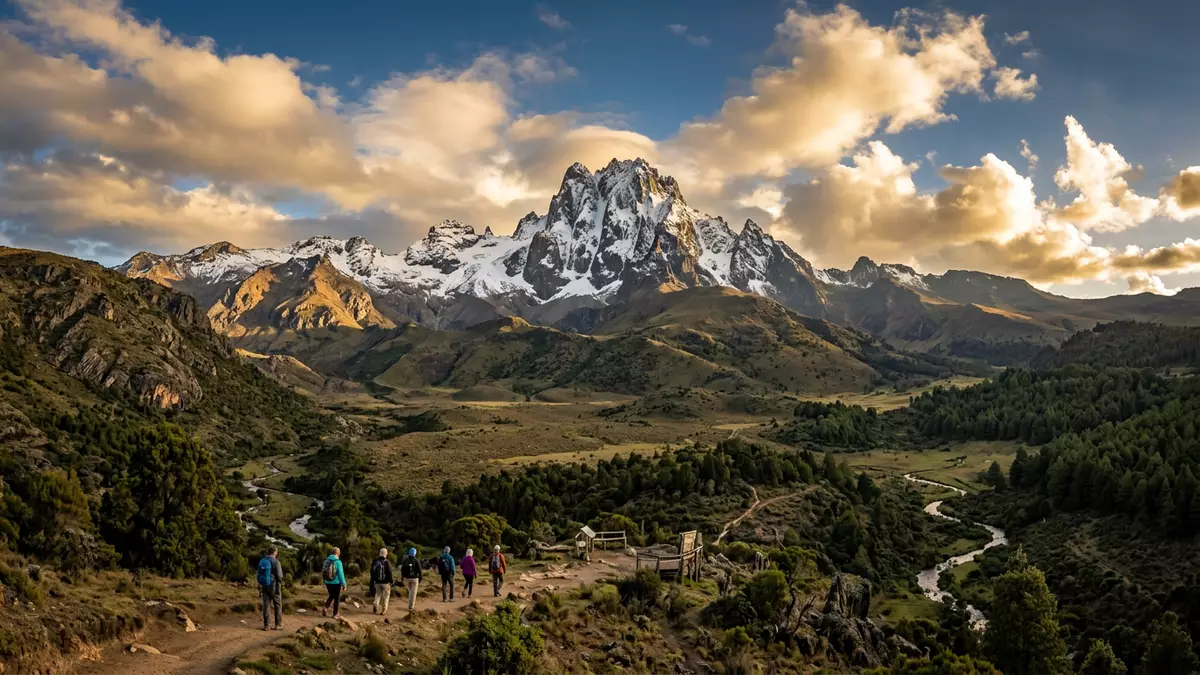
Mount Kenya National Park rises above Nanyuki in central Kenya, wrapping the upper slopes of Mount Kenya in protected forest and afro?alpine terrain. Established as a national park in 1949 and later recognised as a UNESCO World Heritage Site, it preserves the volcanic massif, its glaciers and high?altitude ecosystems at the centre of Kenya’s uplands.
An extinct volcano turned protected mountain sanctuary
Mount Kenya is an ancient extinct volcano whose central peaks still reach 5,199 m (17,058 ft), making it the second?highest mountain in Africa after Kilimanjaro. The highest summit, Batian, stands among a cluster of steep pinnacles that rise above ridges and valleys cut into the old volcanic cone.The highest peaks and extinct volcano Around this summit area the terrain grades from rock and remnant glaciers down through bare scree to afro?alpine moorland.
The national park was officially gazetted in 1949 to protect the mountain and its surrounding environment, and it encloses land largely above the 3,000 m (9,800 ft) contour. Within this band the slopes carry afro?alpine vegetation, tarns and glacial valleys, while lower elevations merge into dense montane forest that is managed together with the surrounding natural forest reserves.The park’s creation in 1949 and altitude The volcano’s age and long erosion have left a broad massif rather than a single conical peak, so approaches to the park rise through successive belts of vegetation rather than a simple uniform slope.
Forests, afro?alpine flora and glaciers on the equator
Mount Kenya straddles the equator in central Kenya, yet its upper slopes support afro?alpine flora adapted to cold, high?altitude conditions. Above the forest belt, the mountain carries open moorland dotted with giant senecios and lobelias, species that illustrate distinctive ecological and biological processes in tropical high mountains.Afro?alpine flora and equatorial location These plants grow among shallow tarns and bogs where water from the glaciers and snowmelt collects.
The World Heritage inscription under natural criteria (vii) and (ix) highlights both the scenery and the ecological value of Mount Kenya’s habitats. The listed property combines Mount Kenya National Park with parts of the surrounding natural forest and, through later extension, the Lewa Wildlife Conservancy and Ngare Ndare Forest Reserve in the foothills.World Heritage designation and extended property Together these areas span elevations from semi?arid savanna and dry forest up to glacier?clad summits, creating a vertical slice of East African mountain environments.
Nanyuki and the northern approaches to the park
Nanyuki lies on the north?western side of Mount Kenya and serves as a base town for the Sirimon route into the national park. From the outskirts of Nanyuki, the road towards Sirimon Gate climbs through cultivated land into montane forest before reaching the park boundary.Nanyuki as a base for the Sirimon route At these elevations, forest gives way gradually to bamboo and then to open moorland, with views back to the plains around the town.
Within the World Heritage property, the Lewa Wildlife Conservancy and Ngare Ndare Forest Reserve lie in the lower foothills to the north, connected to the national park through wildlife corridors used by elephants and other species.Lewa and Ngare Ndare in the Mount Kenya system This setting means that from Nanyuki travellers move quickly from dry savanna and conservancy land into increasingly cool, forested slopes and then the high?altitude landscapes that define Mount Kenya National Park.
Visiting Mount Kenya National Park: what travellers from Western Europe should know
- Mount Kenya National Park lies in central Kenya, north?east of Nairobi, with Nanyuki and Naro Moru acting as recognised base towns on the north?western and western sides.
- The approach into the park from Nanyuki towards Sirimon Gate gains altitude over forested slopes, and paths within the park cross steep ground and high?altitude moorland above 3,000 m (9,800 ft).
- The official language is English and Swahili, and the currency is the Kenyan shilling.
- Entry requirements depend on your nationality; UK travellers can check the FCDO travel advice at gov.uk/foreign-travel-advice, Irish travellers the Department of Foreign Affairs at ireland.ie.
Searching for Mount Kenya National Park on social platforms
These links open searches for Mount Kenya National Park on each platform.
Frequently asked questions about Mount Kenya National Park
Where is Mount Kenya National Park in relation to Nanyuki?
Mount Kenya National Park lies above Nanyuki on the north?western side of Mount Kenya, with the Sirimon approach starting near the town and climbing towards the park boundary.
What kind of landscape should visitors expect inside the park?
The park protects high?altitude volcanic terrain, including steep peaks, remnant glaciers, tarns, afro?alpine moorland and dense montane forest on the middle slopes.
What makes Mount Kenya National Park distinctive among African mountain parks?
It combines an extinct volcano with glacier?clad summits, afro?alpine flora on the equator and a World Heritage?listed continuum from savanna foothills to high mountain habitats.


