Murano, Venice’s island of glass furnaces and canals
Published on 08/29/2026 at 13:41 | Editorial responsibility: Rafael Müller, Editor-in-Chief AD HOC NEWS
Murano is a low-lying island in the Venice Lagoon, north of Venedig, shaped as much by glass furnaces as by its canals and bridges. The island became the main centre of Venetian glassmaking after the furnaces were relocated there in 1291, turning a cluster of lagoon settlements into an industrial and artistic landscape built around molten silica, fuel and trade.
An island rebuilt around glass
Murano lies in the Laguna Veneta, separated from the historic centre of Venice by stretches of tidal water and mudflats that once kept the city’s outskirts at arm’s length.Laguna Veneta Its area is recorded as around 459 hectares, enough space for several neighbourhoods linked by narrow canals and footbridges rather than wide streets.459 hectares The island’s settlement history reaches back to between the fifth and seventh centuries, when the lagoon began to fill with communities escaping upheavals on the mainland and reorganising life on piles, embankments and artificial quays.
Murano’s decisive transformation came in 1291, when the Venetian Republic ordered that all glass furnaces be moved from the central islands of Venice to this outlying cluster, concentrating one of the city’s most hazardous trades away from its predominantly wooden buildings.furnaces were moved From that point, Murano developed as the manufacturing centre for Venetian glass, shipping elaborately worked vessels, beads and mirrors across Europe while its canals accommodated cargo boats laden with raw materials, fuel and finished objects.manufacturing centre for Venetian glass
Glassmaking traditions in the Venetian Lagoon
Venetian glass refers to glassware made in Venice and especially on Murano, where workshops refined soda–lime mixtures into clear and coloured glass and developed a repertoire of decorative techniques that spread across Europe.Venetian glass The furnaces on Murano specialise in hot-working methods: blowing, casting and shaping glass while it is still viscous, then finishing with enamel, gilding or engraving. Over time, Murano glassmakers created exceptionally clear glass known as cristallo, which earned its name from its resemblance to rock crystal and became a prized material for vessels and mirrors.Murano glass reached such a degree of purity
Among the techniques associated with Murano are filigrana, in which fine canes of opaque glass run through a clear body like threads, and millefiori, where patterned rods are sliced in cross-section and fused into surfaces that read like mosaics of tiny flowers.Murano glass history & techniques Avventurina suspends copper crystals in glass to create a glittering field, while murrine builds images and patterns inside the material itself. These methods demand precise control of temperature and timing, making the architecture of the furnace halls—long workbenches, multiple kilns and storage areas for raw materials—part of the island’s distinctive urban fabric.
Murano’s churches, museum and everyday landscape
Beyond its furnaces, Murano is marked by religious and civic buildings that record the island’s long history in stone and brick. One of the most important is the basilica of Santa Maria e San Donato, a Byzantine-style church whose mosaic floor and apse reflect Venice’s connections with the eastern Mediterranean and the wealth generated in part by lagoon crafts.Santa Maria e San Donato Nearby, the Glass Museum occupies the former Palace of the Bishops of Torcello, presenting collections that span several centuries and trace the development of Murano glass from early utilitarian objects to elaborately worked pieces from its so-called Golden Age.Glass Museum located in the historical Palace
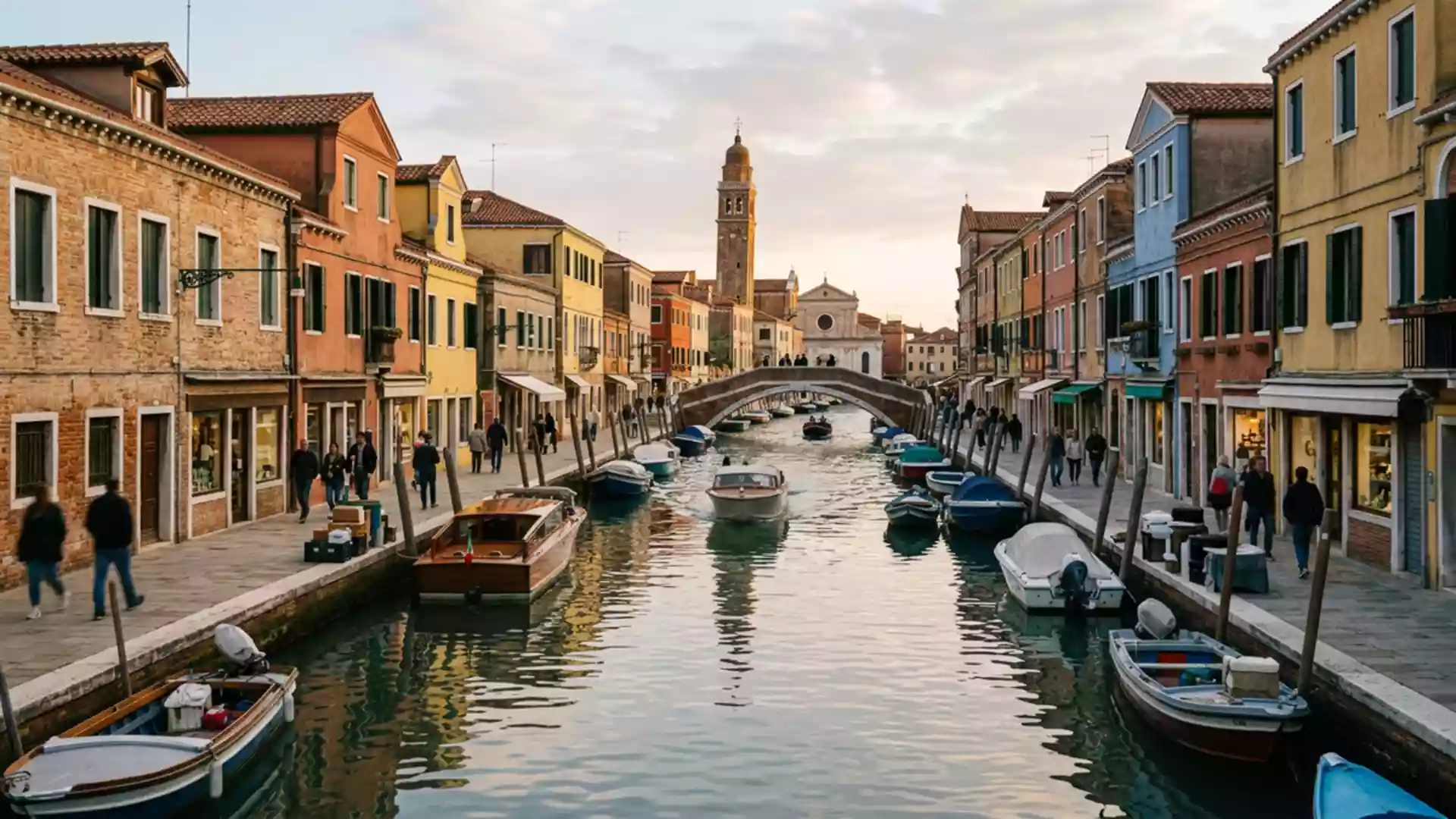
The island’s everyday landscape combines workshops, showrooms and residential buildings along quays lined with moored boats. Canals cut through the settlement, crossed by footbridges that link narrow streets and squares, and the skyline is broken by chimneys from working furnaces and by the campanile of churches rather than by high-rise structures.The Island of Murano, Venice: what to see Glassmaking continues on a smaller scale than in the height of the sixteenth century, but the craft still shapes daily rhythms as workers tend kilns, transport pieces by boat and arrange displays that bring the island’s production into contact with visitors from across Europe.
Visiting Murano: what travellers from Western Europe should know
- Murano lies north-east of the historic centre of Venedig in the Venice Lagoon and is reached by waterbuses and private boats that run between the city and the island’s quays.
- The island’s terrain is flat, but movement relies on walking along paved quays and crossing bridges over canals, with steps leading up and down from each bridge.
- Murano forms part of Italy, where the official language is Italian and the currency is the euro.
- Entry requirements depend on your nationality; UK travellers can check the FCDO travel advice at gov.uk/foreign-travel-advice, Irish travellers the Department of Foreign Affairs at ireland.ie.
Searching for Murano on social platforms
These links open searches for Murano on each platform.
Frequently asked questions about Murano
Where is Murano in relation to Venice?
Murano is an island in the Venice Lagoon, lying north of the historic centre of Venedig and separated from it by navigable stretches of tidal water.
What can visitors expect when walking around Murano?
Visitors find canals lined with quays, bridges with steps linking neighbourhoods, working glass furnaces, showrooms, churches and a museum dedicated to Murano’s glassmaking history.
What makes Murano distinctive among lagoon islands?
Murano stands out for its concentration of glass workshops, its long association with Venetian glassmaking since the 1291 relocation of furnaces, and the presence of a dedicated Glass Museum.