
Musee du Louvre: a palace shaped by eight centuries
Published on 09/22/2026 at 16:51 | Editorial responsibility: Rafael Müller, Editor-in-Chief AD HOC NEWS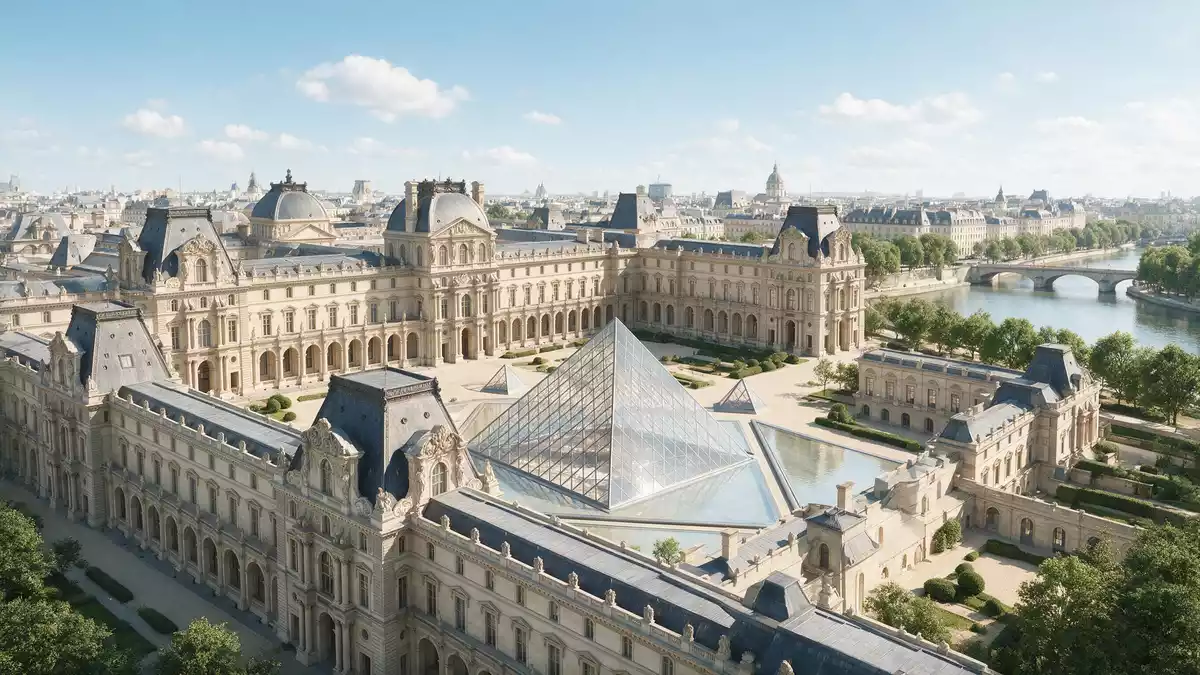
Musee du Louvre occupies a palace whose visible form gathers more than eight centuries of French history. Medieval masonry, Renaissance façades, royal galleries and I. M. Pei’s glass Pyramid meet within one Parisian complex.
A fortress beneath the Louvre palace
The Louvre began as a fortress in the late twelfth century, associated with Philip II and the defensive works around Paris. Remnants of the medieval structure survive beneath the palace, where stone foundations and surviving walls mark the earliest phase of the site.
The fortress became a royal residence during the sixteenth century. Francis I commissioned Pierre Lescot to reshape the complex, introducing Renaissance architecture to a building that had begun as a military stronghold. Subsequent monarchs enlarged the palace with courts, wings and formal façades.
Francis I, Pierre Lescot and the Renaissance palace
Francis I began the transformation of the Louvre into a Renaissance residence in 1546. the Renaissance transformation belongs to the palace’s long architectural sequence.
Louis XIV continued the enlargement of the complex before moving the royal court to Versailles in 1682. The Louvre then retained its connection with royal collections and palace administration, while its galleries provided an expanding setting for paintings, antiquities and decorative arts.
From royal collection to public museum
The Louvre became a public museum in 1793 during the French Revolution. Its opening established a new civic use for the former royal palace, with the collections displayed in spaces that had belonged to the French monarchy.
The museum’s holdings span Egyptian, Greek, Roman, Near Eastern and Islamic antiquities, European paintings, sculpture, prints, drawings and decorative arts. Leonardo da Vinci’s Mona Lisa, the Winged Victory of Samothrace and the Venus de Milo are among the best-known works associated with its galleries.
The palace remains an architectural object as well as a container for art. The Cour Napoléon presents the contrast between historic stone façades and the transparent geometry of the Pyramid, completed in 1989.
Visiting Musee du Louvre: what travellers from Western Europe should know
- Musee du Louvre is in Paris’s first arrondissement, beside the Seine and the Tuileries Garden. Metro stations include Palais Royal–Musée du Louvre and Louvre–Rivoli.
- The museum occupies a large palace complex. A visit involves extensive galleries, staircases, underground archaeological remains and long indoor routes between departments.
- The official language is French and the currency is the euro.
- The Pyramid stands in the Cour Napoléon, while the historic palace façades extend towards the Rue de Rivoli and the Seine.
Searching for Musee du Louvre on social platforms
These links open searches for Musee du Louvre on each platform.Frequently asked questions about Musee du Louvre
Where is Musee du Louvre?
Musee du Louvre is in central Paris’s first arrondissement, beside the Seine and the Tuileries Garden.
What can visitors expect inside?
The museum combines extensive art collections with palace interiors, archaeological remains, monumental galleries and several architectural periods.
What makes the museum distinctive?
Its identity rests on the visible combination of a medieval fortress, a Renaissance royal palace, a public museum founded in 1793 and I. M. Pei’s Pyramid.


