
Musee du Louvre: a royal palace turned global art museum
Published on 09/17/2026 at 12:04 | Editorial responsibility: Rafael Müller, Editor-in-Chief AD HOC NEWS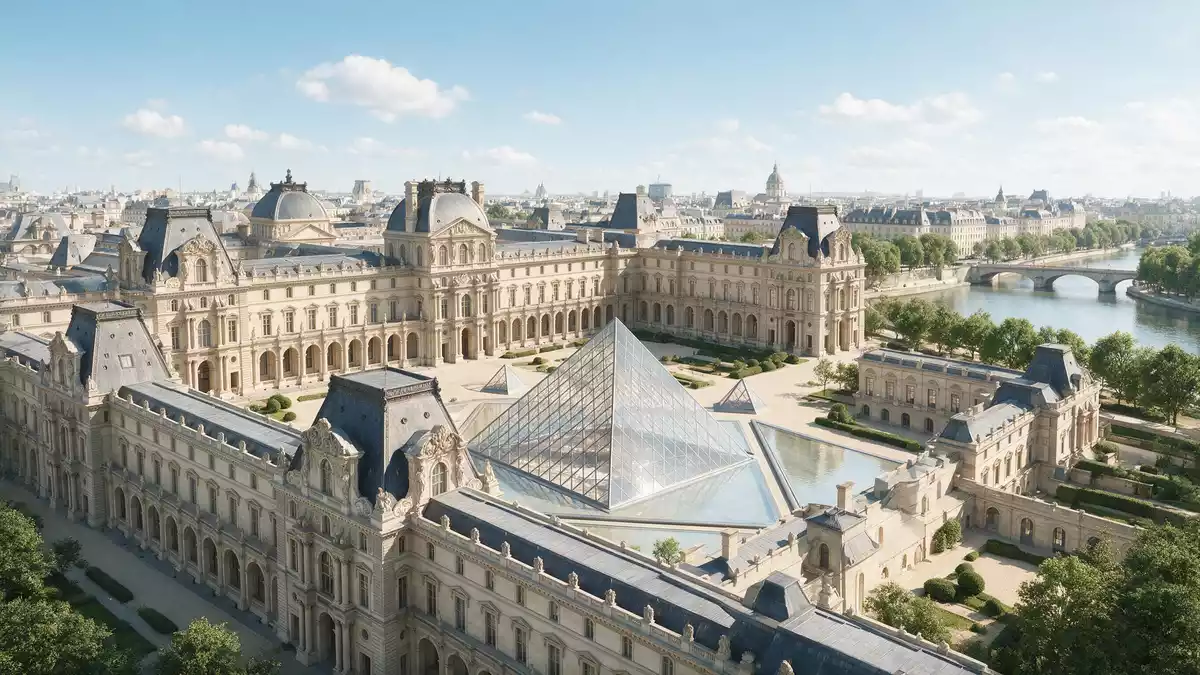
Musee du Louvre in Paris occupies a former royal palace on the right bank of the Seine, where France’s kings once lived before the court moved to Versailles in 1682.The Louvre was originally a royal residence The museum in its present form brings together this long architectural history with a vast collection of artworks that trace human creativity from ancient civilisations to the nineteenth century.
From medieval fortress to a palace of the arts
The story of Musee du Louvre begins in the late twelfth century, when King Philip II, also known as Philippe Auguste, ordered a fortress to protect the western approaches to Paris.The palace occupies the site of a twelfth-century fortress The remains of this medieval structure can still be traced in the foundations beneath the palace, where thick stone walls and the base of the keep mark the earliest layer of the site’s history.The Louvre began its life as a fortress in the twelfth century
In the sixteenth century, King Francis I began transforming the medieval stronghold into a Renaissance palace, commissioning new wings and courtyards that aligned the Louvre with contemporary Italian-inspired architecture.François I declared the Louvre his residence in the sixteenth century Successive rulers, including kings of the Bourbon dynasty, extended the complex along the Seine, creating the long ranges and courtyards that visitors cross today on their way from one gallery to another.
The museum and its vast collections
Musee du Louvre opened to the public as an art museum in 1793, during the French Revolution, when revolutionary authorities established the Musée Central des Arts in the former royal palace.The Louvre became a public museum in 1793 Over time its holdings grew through royal collections, revolutionary seizures and later acquisitions, creating a panorama of art and artefacts that covers millennia.
The museum’s collections are arranged in several departments that span fields such as Egyptian antiquities, Greek, Etruscan and Roman works, Islamic art, sculpture, decorative arts, paintings, and prints and drawings.The collection is divided into curatorial departments Works range from ancient objects to nineteenth-century canvases, with highlights including Leonardo da Vinci’s “Mona Lisa” and classical sculptures such as the “Venus de Milo”, set within historic galleries that still carry the proportions and decoration of the former palace.Masterpieces such as Mona Lisa and Venus de Milo form part of the collection
I. M. Pei’s glass pyramid in the Cour Napoléon
Outside, the most recognisable contemporary feature of Musee du Louvre is the glass-and-metal pyramid at the centre of the Cour Napoléon, designed by the Chinese-American architect I. M. Pei.The Louvre Pyramid is a glass-and-metal structure by I. M. Pei Completed in 1989 as part of the Grand Louvre project, the pyramid serves as a prominent entrance and a skylight to the underground concourse beneath the courtyard.The pyramid was completed in 1989
The contrast between Pei’s geometric glass surfaces and the sculpted stone façades of the surrounding wings defines the first impression of the museum complex for many visitors.The pyramid has become a symbol of the Louvre Museum From the courtyard, views extend along the palace towards the Arc de Triomphe du Carrousel and onwards along the historic axis of central Paris, underlining how closely the museum is woven into the city’s urban fabric.The former palace of the kings of France stands between the Seine and Rue de Rivoli
Visiting Musee du Louvre: what travellers from Western Europe should know
- Musee du Louvre stands in the 1st arrondissement of Paris, on the right bank of the Seine, between the river and Rue de Rivoli and close to central metro and rail hubs.
- The museum occupies an extensive former palace, and a visit involves covering long corridors and staircases, with lifts and escalators concentrated near the main circulation routes.
- The surrounding district includes the Tuileries Garden to the west and the Seine embankment to the south, so it is easy to combine gallery time with walks outdoors.
- The official language is French and the currency is the euro.
Searching for Musee du Louvre on social platforms
These links open searches for Musee du Louvre on each platform.Frequently asked questions about Musee du Louvre
Where is Musee du Louvre located?
Musee du Louvre stands in central Paris on the right bank of the Seine, in the 1st arrondissement, between the river and Rue de Rivoli.
What can visitors expect inside Musee du Louvre?
Visitors encounter artworks and artefacts from ancient civilisations through to the nineteenth century, arranged in departments across extensive palace galleries.
What makes Musee du Louvre distinctive among museums?
The combination of a former royal palace, masterpieces such as Leonardo da Vinci’s “Mona Lisa”, and I. M. Pei’s glass pyramid in the courtyard gives the museum a distinctive character.


