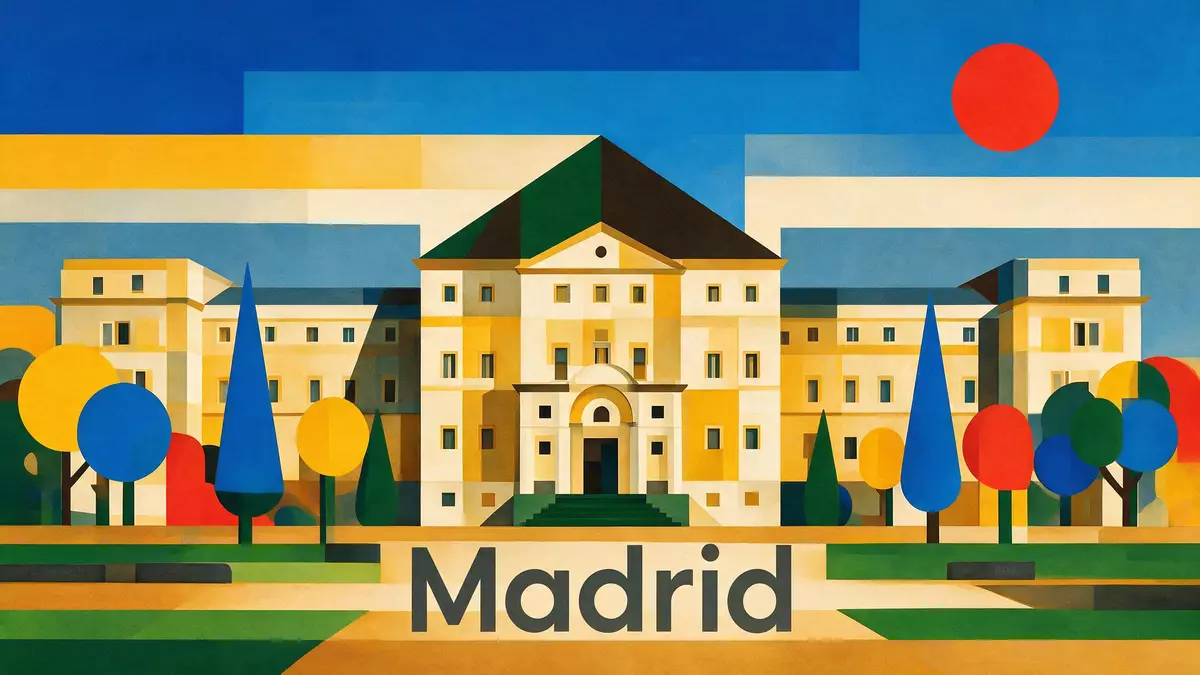
Museo del Prado and its painted galleries in Madrid
Published on 08/09/2026 at 15:09 | Editorial responsibility: Rafael Müller, Editor-in-Chief AD HOC NEWS
Museo del Prado in Madrid is a neoclassical museum whose long galleries hold one of Europe’s great painting collections. The building opened in 1819 under the sponsorship of Ferdinand VII, and its stone facade still reads as measured and formal rather than theatrical.
A neoclassical museum on the Paseo del Prado
The museum stands on the Paseo del Prado, among one of Madrid’s best-known cultural axes. Juan de Villanueva designed the building in the late eighteenth century, and the structure has the calm symmetry associated with Spanish neoclassicism.
Its exterior gives little away compared with the density inside. The long, controlled facade and the sequence of galleries create a setting for paintings by Velázquez, Goya, El Greco, Titian, Rubens and Bosch.
Paintings, royal collecting and the Spanish school
The Prado began life as a museum for royal collections, and that origin still shapes the selection on display. Spanish painting forms the core of the experience, especially works from the Habsburg and Bourbon courts and the wider European exchanges around them.
Visitors move from dark, courtly portraits to religious painting, mythological scenes and large historical canvases. The gallery sequence makes the museum feel less like a single hall of trophies and more like a sustained study of painting across centuries.
Rooms, scale and the rhythm of a visit
The building is large, but the most memorable feature is not size alone. It is the alternating rhythm of broad rooms, tighter passages and framed views along the walls, with major works often hung among closely related pictures.
That layout rewards stopping, retracing steps and comparing canvases by eye. The Prado is especially strong for readers who want a museum that feels anchored in a building with historical weight rather than a neutral white box.
Visiting Museo del Prado: what travellers from Western Europe should know
- The museum is in central Madrid, and it is reached easily by metro, bus or on foot from the nearby cultural district.
- Admission arrangements and opening hours are set by the site's operator and change with the season; the official website is the only binding source.
- Madrid is pleasant for museum visits in the cooler months, and early visits are often the most comfortable for longer viewing.
- The site itself is urban and level, with a straightforward approach from surrounding streets rather than a demanding walk.
- Spanish is the main language on site, and card payment is widely used in Madrid’s museum district.
- Entry requirements depend on your nationality. UK travellers should check the FCDO travel advice at gov.uk/foreign-travel-advice; Irish travellers the Department of Foreign Affairs at ireland.ie; EU and EEA citizens their own national foreign ministry.
Searching for Museo del Prado on social platforms
These links open searches for Museo del Prado on each platform.
Frequently asked questions about Museo del Prado
Where is Museo del Prado?
It stands in central Madrid on the Paseo del Prado, close to the city’s main museum landscape and easy to reach by public transport.
What should visitors expect inside?
Expect a major painting museum with long galleries, dense hangings and a strong focus on Spanish art alongside other European schools.
What makes Museo del Prado distinctive?
Its combination of a historic neoclassical building, royal collecting history and masterworks by artists such as Velázquez, Goya and Bosch gives it a clear identity.