
Museumsinsel and the making of Berlin’s museum quarter
Published on 09/23/2026 at 02:46 | Editorial responsibility: Rafael Müller, Editor-in-Chief AD HOC NEWS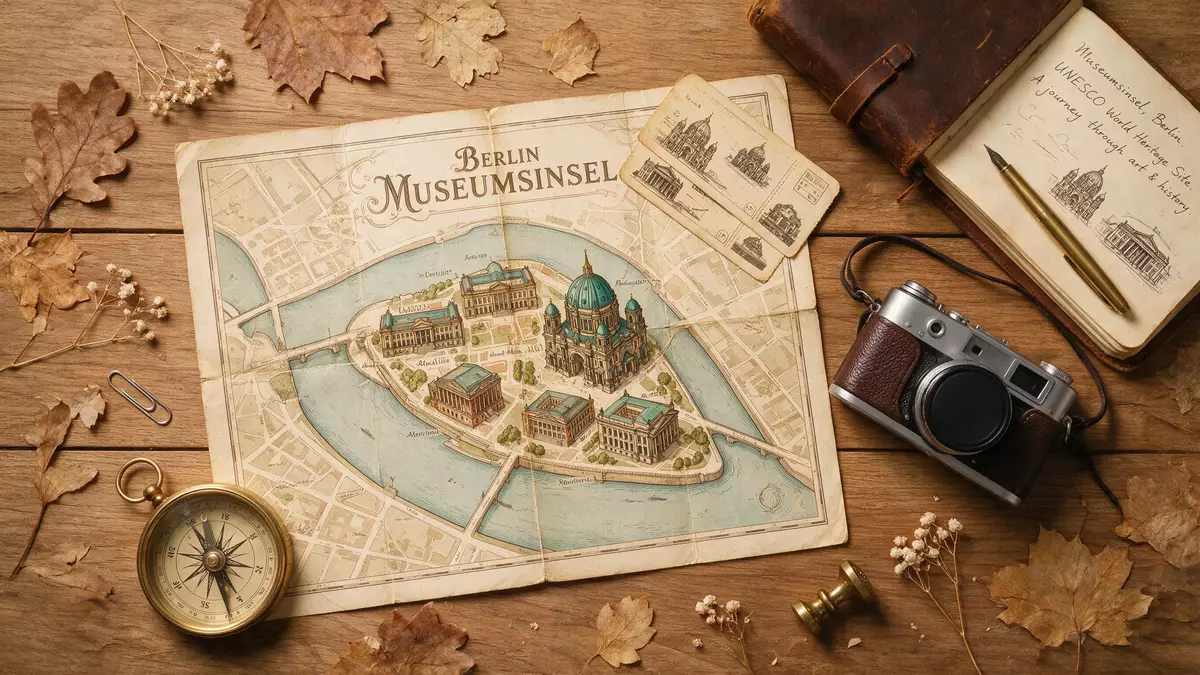
Museumsinsel is a group of historic museums on the northern part of Spree Island in central Berlin. Its buildings form a cultural landscape of domes, colonnades, stairways and monumental façades, with collections spanning antiquity, prehistory and European art.
The ensemble began with the Altes Museum, designed by Karl Friedrich Schinkel and opened in 1830. Museumsinsel grew through the nineteenth and early twentieth centuries, becoming a UNESCO World Heritage Site in 1999.
Schinkel’s Altes Museum begins the island ensemble
The Altes Museum faces the Lustgarten with a long Ionic colonnade. Karl Friedrich Schinkel designed the building between 1823 and 1830, establishing a public museum architecture based on ordered classical forms.
Its broad entrance staircase, portico and rotunda give the building a ceremonial character. The museum holds collections of Greek and Roman antiquities, while the surrounding Lustgarten connects the museum front with Berlin Cathedral and the wider historic centre.
Five museum buildings, several architectural periods
The Neues Museum followed Schinkel’s building. Friedrich August Stüler designed it between 1843 and 1855, using classical proportions alongside brick, iron and structural details associated with nineteenth-century construction.
The museum buildings and collections include the Egyptian Museum and Papyrus Collection, the Museum of Prehistory and Early History, and the Collection of Classical Antiquities. The Neues Museum also contains the bust of Nefertiti, one of the best-known objects associated with Berlin’s museum collections.
The Alte Nationalgalerie was completed and opened in 1876. Its raised position above a broad flight of steps gives it the appearance of a temple, while its galleries present nineteenth-century painting and sculpture.
The Bode-Museum occupies the northern tip of the island. Its domed entrance and curving river frontage contain sculpture, Byzantine art, paintings and the Numismatic Collection.
The Pergamon Museum completed the original group of major exhibition buildings in 1930. Its galleries became associated with monumental archaeological architecture, including the Pergamon Altar, the Ishtar Gate and the Market Gate of Miletus.
Collections from prehistory to nineteenth-century art
Museumsinsel brings several fields of European and Mediterranean culture into one compact urban setting. Objects from ancient Egypt, Greece, Rome, the ancient Near East and medieval Europe appear alongside paintings and sculpture from the nineteenth century.
The buildings are part of the subject. Their staircases, courtyards, columns, domes and exhibition halls record changing ideas about public museums. The ensemble’s UNESCO World Heritage status dates from 1999.
The James-Simon-Galerie provides a later architectural addition on the western edge of the island. Its limestone colonnade and broad steps stand beside the Kupfergraben, linking the museum quarter with the riverfront.
Museumsinsel is therefore both a collection of museums and a sequence of architectural periods. Schinkel’s classicism, Stüler’s nineteenth-century expansion, the monumental museum buildings of the German Empire and the later entrance structure share the same island.
Visiting Museumsinsel: what travellers from Western Europe should know
- Museumsinsel occupies the northern part of Spree Island in Berlin’s historic centre. U5 serves Museumsinsel station, and buses 100 and 200 stop at Lustgarten.
- The museums stand beside the Spree and the Kupfergraben. Approaches include broad exterior stairways, paved squares and substantial museum interiors.
- The main buildings are the Altes Museum, Neues Museum, Alte Nationalgalerie, Bode-Museum and Pergamonmuseum. The James-Simon-Galerie is also part of the museum quarter.
- The official language is German and the currency is the euro.
Searching for Museumsinsel on social platforms
These links open searches for Museumsinsel on each platform.
Frequently asked questions about Museumsinsel
Where is Museumsinsel?
Museumsinsel occupies the northern part of Spree Island in central Berlin. It lies beside the Spree and Kupfergraben, near Berlin Cathedral and the Lustgarten.
What can visitors expect there?
Visitors encounter historic museum buildings, archaeological collections, Egyptian artefacts, classical antiquities, paintings, sculpture and coins. The architecture forms an essential part of the setting.
What makes Museumsinsel distinctive?
Its museums were built across the nineteenth and early twentieth centuries as a connected urban ensemble. UNESCO added Museumsinsel to the World Heritage List in 1999.


