
Myeongdong, Seoul’s dense tangle of streets and stories
Published on 09/21/2026 at 17:38 | Editorial responsibility: Rafael Müller, Editor-in-Chief AD HOC NEWS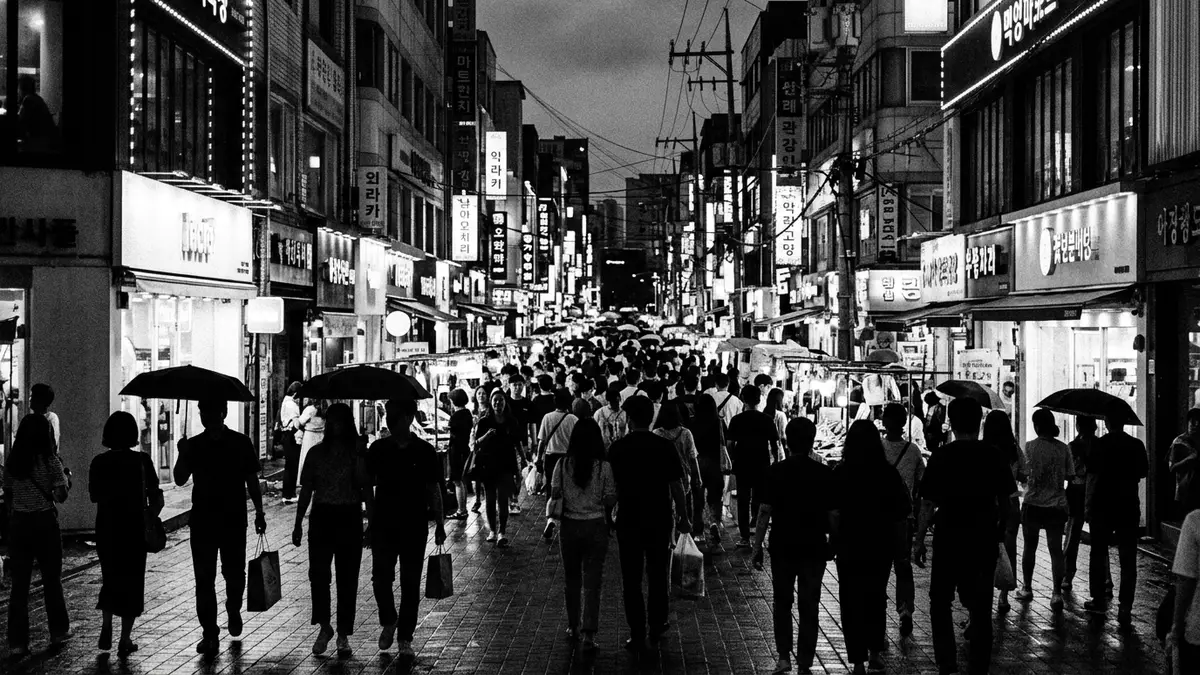
Myeongdong in central Seoul is a compact urban district where dense shopping streets, office towers and a landmark cathedral press closely against one another, creating a layered portrait of South Korean city life shaped since the late nineteenth century.
A dense district between Namsan and the city’s avenues
Myeongdong lies within Jung District, in the older commercial centre of Seoul, between major thoroughfares such as Eulji-ro and Namdaemun-ro and below the slopes of Namsan Mountain.Myeongdong in Jung-gu The streets form a tight grid, with narrow lanes running off larger roads and multistorey buildings filling most available plots. Many blocks combine retail spaces at ground level with offices or accommodation in the upper floors, adding vertical density to the already crowded ground.
Historically, the area belonged to the southern part of Hanseong, the Joseon-era name for Seoul, and carried older neighbourhood names such as Myeongryebang and Chonghyeon.Joseon-period names for the area During the Japanese colonial period the district was renamed Meiji-cho, reflecting a shift towards commercial and financial activity that has remained a defining characteristic. After independence in 1945, the name Myeongdong became official in 1946 and the district evolved further as modern high-rise buildings and wider roads reshaped central Seoul.
From scholars’ houses to shopping streets and finance towers
In the Joseon Dynasty, Myeongdong was a residential neighbourhood associated with scholars and officials living on slopes below Namsan, with smaller houses and quieter lanes than the markets elsewhere in the capital.Myeongdong as a residential area in Joseon The twentieth century brought a marked change as infrastructure improved and commercial activity expanded, especially under Japanese rule when department stores and other modern facilities were introduced. After the Korean War, the financial sector from streets such as Namdaemun-ro and Euljiro extended into Myeongdong, adding banks and corporate offices to the growing retail scene.Expansion of finance into Myeongdong
The result is a district where shopping and finance share the same blocks. One of its best-known thoroughfares, Myeongdong Shopping Street, runs through Jung-gu and is lined with cosmetics shops, fashion brands and food outlets aimed at both local residents and international visitors.Myeongdong Shopping Street in Jung-gu Nearby streets carry securities firms and other financial institutions, continuing the role the area took on in the mid twentieth century. This mixture of everyday retail and corporate activity gives Myeongdong a particular rhythm, with office workers, shoppers and worshippers crossing paths throughout the day.
Myeongdong Cathedral and the beginnings of Korean Catholicism
Rising above the surrounding buildings, Myeongdong Cathedral stands as a prominent landmark within the district and a major site in Korean religious history. Officially named the Cathedral Church of Our Lady of the Immaculate Conception, it serves as the national cathedral of the Archdiocese of Seoul and the seat of the Archbishop of Seoul.Cathedral Church of Our Lady of the Immaculate Conception The building was constructed between 1892 and 1898 in a Gothic style and was among the earliest large red-brick churches in Korea.Construction of the cathedral completed in 1898
The cathedral’s significance reaches beyond architecture. The area around Myeongdong became one of the starting points of Korean Catholicism, with Catholic communities forming there in the late Joseon period, and the cathedral’s crypt now houses relics of Korean martyrs associated with the early history of the faith.Relics of Korean martyrs In the late twentieth century, Myeongdong Cathedral also served as an important gathering place during pro-democracy movements, and the surrounding streets saw demonstrations that linked the district’s religious role with wider political life.Demonstrations centred on Myeongdong Cathedral
Visiting Myeongdong: what travellers from Western Europe should know
- Myeongdong forms part of Jung District in central Seoul and is reached by Seoul Metro lines that stop at stations such as Myeongdong Station on Line 4 and nearby Euljiro stations on other lines.
- The streets are busy and closely built, with narrow pedestrian lanes and frequent kerbs, so walking in the area involves negotiating uneven surfaces and short flights of steps.
- Myeongdong Cathedral stands on a rise above the surrounding streets, and reaching its main entrance involves an uphill walk from nearby roads and plazas.
- The official language is Korean and the currency is the South Korean won.
- Entry requirements depend on your nationality; UK travellers can check the FCDO travel advice at gov.uk/foreign-travel-advice, Irish travellers the Department of Foreign Affairs at ireland.ie.
Searching for Myeongdong on social platforms
These links open searches for Myeongdong on each platform.
Frequently asked questions about Myeongdong
Where is Myeongdong in Seoul?
Myeongdong is a district within Jung-gu, the central ward of Seoul, bordered by major roads such as Namdaemun-ro and Eulji-ro and lying below Namsan Mountain.
What should visitors expect in Myeongdong?
Visitors encounter compact shopping streets lined with cosmetics and fashion shops, office buildings tied to the financial sector and the prominent presence of Myeongdong Cathedral above the commercial blocks.
What makes Myeongdong distinctive among central Seoul districts?
Myeongdong brings together historical Catholic sites, twentieth-century finance and dense contemporary retail in a small area, so religious architecture, banks and shopping streets share the same urban fabric.


