
Namaqualand’s granite hills and seasonal flowers
Published on 09/23/2026 at 15:51 | Editorial responsibility: Rafael Müller, Editor-in-Chief AD HOC NEWS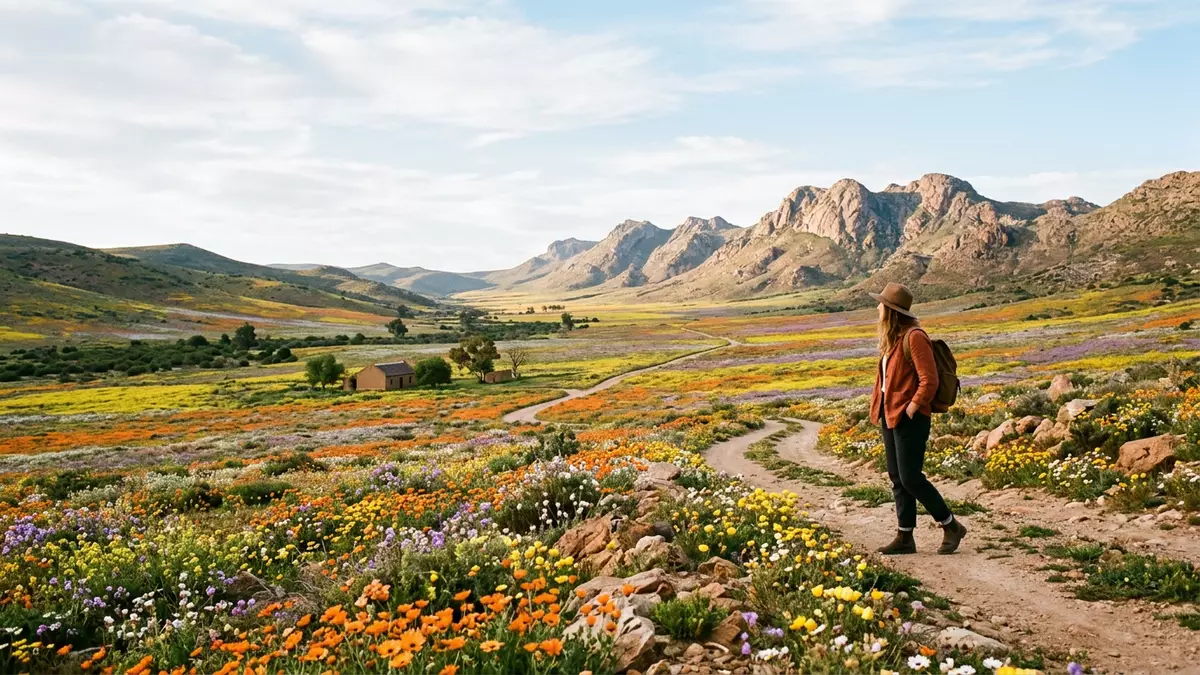
Namaqualand is a dry region of granite hills, open plains and seasonal flowers in South Africa’s Northern Cape. Springbok, founded as Springbokfontein in 1862, sits at the centre of the South African landscape, where copper-country history meets the Succulent Karoo.
Namaqualand between granite and open plain
Namaqualand stretches along the western side of southern Africa, across parts of South Africa and Namibia. The South African section lies in the Northern Cape, with Springbok as its chief town and an important road centre.
The landscape changes between rocky inland hills, gravel plains and lower coastal country. The Namaqualand Metamorphic Complex supplies much of the region’s gneiss and quartzite bedrock, visible in rounded boulders, ridges and granite domes. Namaqualand’s bedrock gives the country a strongly geological character.
Springbok and the copper-country landscape
Springbok lies among the Klein Koperberge, a group of rugged hills associated with the town’s mining history. Copper mining began in the surrounding area during the nineteenth century, and nearby Okiep and Nababeep form part of the same regional story.
The town developed under the name Springbokfontein before becoming Springbok. Its central hill carries a stone church, while granite domes and koppies surround the settlement. The N7 passes through the region on its northward route towards Namibia, linking Springbok with smaller settlements and the wider Namaqualand road network. Springbok’s 1862 foundation anchors the town in the history of the South African Namaqualand.
Flowers in the Succulent Karoo
Namaqualand belongs to the Succulent Karoo, a dry biome with a rich concentration of succulent plants. More than 3,500 plant species occur across the region, including daisies, vygies and other drought-adapted flowers.
The flowering landscape is seasonal, appearing across normally dry ground after winter rain. Around Springbok, colour can be found along roads, in town gardens and within protected areas. Skilpad Wild Flower Reserve lies near Kamieskroon, while Namaqua National Park protects hills, plains and coastal terrain farther south. Goegap Nature Reserve lies close to Springbok and contains rocky valleys and native vegetation. Namaqua National Park forms part of the wider floral landscape associated with Namaqualand.
Visiting Namaqualand: what travellers from Western Europe should know
- Namaqualand lies in the Northern Cape, with Springbok reached by road on the N7, the main northbound route towards Namibia.
- The terrain includes granite domes, koppies, quartzite ridges and gravel plains. Walks can involve uneven ground and short, steep sections.
- Namaqua National Park and Goegap Nature Reserve are among the protected areas associated with the Springbok region. Some approaches include gravel roads.
- South Africa’s official languages include English and Afrikaans. The national currency is the South African rand.
- Entry requirements depend on your nationality; UK travellers can check the FCDO travel advice at gov.uk/foreign-travel-advice, Irish travellers the Department of Foreign Affairs at ireland.ie.
Searching for Namaqualand on social platforms
These links open searches for Namaqualand on each platform.
Frequently asked questions about Namaqualand
Where is Namaqualand?
Namaqualand lies along the western side of southern Africa, across South Africa and Namibia. Springbok is the chief town in the South African section, within the Northern Cape.
What does a visit to Namaqualand involve?
A visit involves road travel through rocky hills, gravel plains, small settlements and protected areas. The landscape combines dry terrain with seasonal flowers and succulent vegetation.
What makes Namaqualand distinctive?
Namaqualand combines ancient-looking rock formations, copper-mining history and a rich Succulent Karoo flora. Around Springbok, seasonal flowers appear across an otherwise dry landscape.


