
Naos tou Olympiou Dios: a forest of marble columns in Athen
Published on 08/16/2026 at 14:49 | Editorial responsibility: Rafael Müller, Editor-in-Chief AD HOC NEWS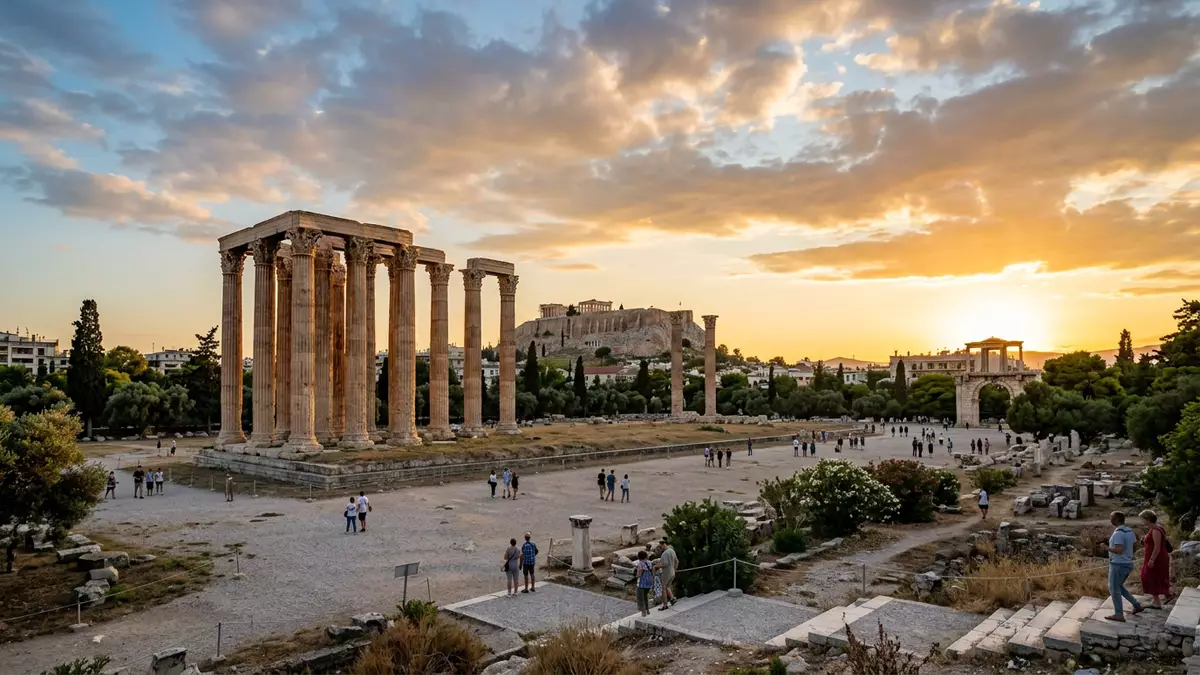
Naos tou Olympiou Dios, better known in English as the Temple of Olympian Zeus, occupies a broad open enclosure in central Athen where tall marble columns rise over the modern cityscape. Built across the Hellenistic and Roman periods and completed under Emperor Hadrian in the second century AD, it turns a stretch of ground south-east of the Acropolis into a monumental frame for the sky.Temple of Olympian Zeus, Athens
A colossal temple in the landscape of Athens
The site of Naos tou Olympiou Dios lies a short distance south-east of the Acropolis rock and roughly south of Syntagma Square, on ground that slopes gently towards the Ilissos river.south-east of the Acropolis From here the remaining columns stand with the Acropolis visible behind them, linking the sanctuary visually to the older heart of classical Athens.
The temple itself was one of the largest ever constructed in the ancient Greek world, laid out as a peripteral temple with rows of columns running along its long sides and across the ends.largest temple in Athens The remains sit within a fenced archaeological zone that preserves both the colonnade and traces of the temple’s foundations, giving a sense of the footprint that once filled the space.
From Pisistratus to Hadrian: a temple built over centuries
Work on Naos tou Olympiou Dios began in the sixth century BC under the Athenian tyrant Pisistratus, when an earlier attempt to raise a grand Doric temple on the site was started but left unfinished.foundations laid under Pisistratus Centuries later, in the second century BC, Antiochus IV Epiphanes resumed construction and introduced the Corinthian order, bringing an elaborate column style that contrasted with the plainer Doric buildings of earlier Athens.Antiochus IV and Corinthian columns
The temple reached completion under the Roman emperor Hadrian, who dedicated it in the second century AD after more than six centuries of intermittent building.completed by Hadrian in 131 CE This long history left the building with a mixed character: a Greek sanctuary with Hellenistic and Roman architectural layers, dedicated to Zeus yet set within a city that by Hadrian’s time carried many imperial monuments.
Columns, marble and the remaining ruins
Originally Naos tou Olympiou Dios carried over a hundred Corinthian columns of Pentelic marble, each rising to around 17 m (56 ft) and crowned with acanthus capitals.104 Corinthian columns about 17 metres tall These columns supported an entablature and pediments that have long since vanished, but their scale is still legible in the surviving row and the solitary column drums scattered around the precinct.
Today a group of columns remains standing at one side of the temple platform, with another fallen column lying where it collapsed in the nineteenth century.15 of the original columns remain Around them, cut stone blocks mark the outline of the cella and the outer colonnades, while views across to the Acropolis and towards the Panathenaic Stadium place the ruins within a wider circuit of Athenian monuments.
Visiting Naos tou Olympiou Dios: what travellers from Western Europe should know
- Naos tou Olympiou Dios stands in central Athen south-east of the Acropolis, close to major streets and within walking distance of Syntagma Square and the Acropolis Museum.
- The archaeological zone is level overall but the ground is uneven in places, with low steps and stretches of compacted earth around the columns that require steady footing.
- The sanctuary lies near the course of the Ilissos river and the Panathenaic Stadium, making it easy to combine a walk between these historic sites within the same part of the city.
- The official language is Greek and the currency is the euro.
Searching for Naos tou Olympiou Dios on social platforms
These links open searches for Naos tou Olympiou Dios on each platform.Frequently asked questions about Naos tou Olympiou Dios
Where is Naos tou Olympiou Dios in Athen?
Naos tou Olympiou Dios stands in central Athen south-east of the Acropolis and roughly south of Syntagma Square, near the course of the Ilissos river.
What can visitors expect when entering the sanctuary?
Visitors enter an open archaeological precinct with surviving Corinthian columns of Pentelic marble, low remains of the temple plan and wide views towards other Athenian landmarks.
What makes Naos tou Olympiou Dios distinctive among ancient sites in Athens?
Its distinction lies in its sheer scale as a former temple of Olympian Zeus, its long construction history from Pisistratus to Hadrian and its forest of Corinthian columns rising above the modern city.


