
Naos tou Olympiou Dios and its forest of marble columns
Published on 09/23/2026 at 19:22 | Editorial responsibility: Rafael Müller, Editor-in-Chief AD HOC NEWS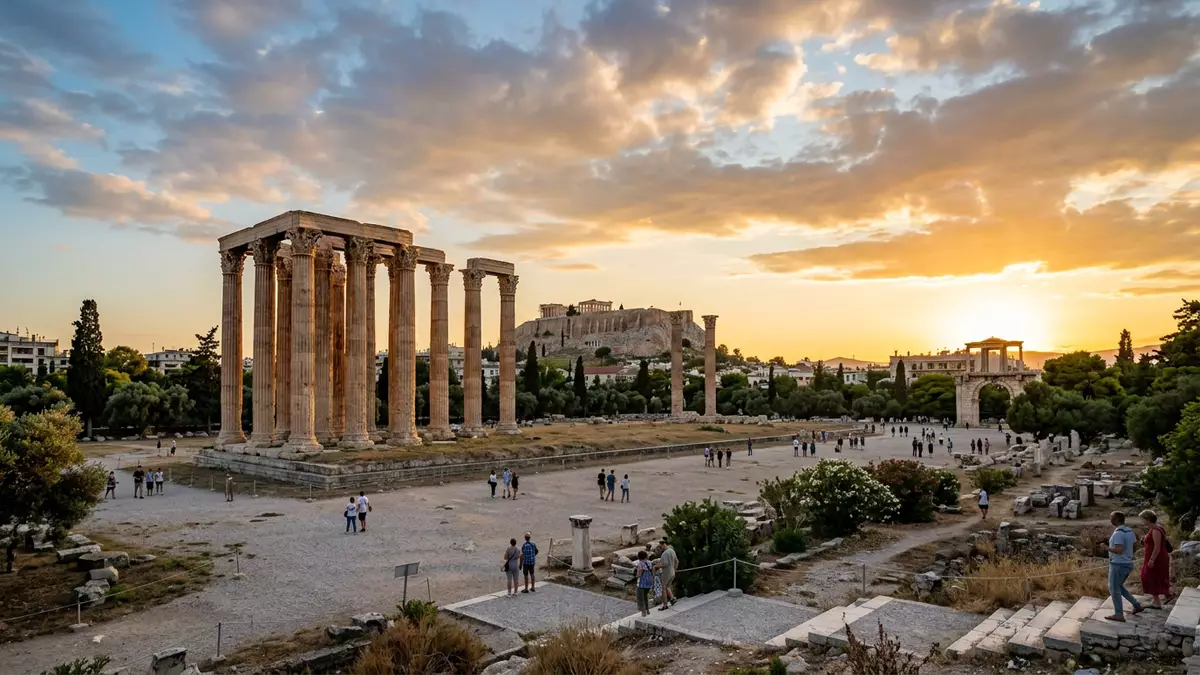
Naos tou Olympiou Dios rises beside the Ilissos in central Athen as an open field of towering marble columns. Begun in the sixth century BC and completed under the Roman emperor Hadrian in AD 131, the temple survives as a powerful outline rather than an intact building.
Naos tou Olympiou Dios: a temple measured in columns
The sanctuary stands between the Acropolis and Ardittos Hill, near Hadrian’s Arch and the National Garden. Its position places the ruined temple within a dense sequence of Athenian landmarks, while the columns remain visible across the archaeological enclosure.
The completed building followed the Corinthian order and used Pentelic marble. It measured about 107.89 m (354 ft) in length and 41.11 m (135 ft) in width, giving the surviving fragments a scale that remains legible from the surrounding streets. Pentelic marble dimensions record the temple as a substantial rectangular structure, not merely a row of isolated ruins.
From Athenian sanctuary to Roman temple
Construction began around 515 BC under the Peisistratids, the ruling family associated with the early Athenian project. The work continued across long historical phases before the Roman emperor Hadrian completed the temple and inaugurated it in AD 131.
Hadrian’s connection gives Naos tou Olympiou Dios a distinctly Roman chapter within an Athenian setting. The temple honoured Olympian Zeus, the supreme god of the sanctuary, and its Corinthian columns represented the final form of a project that had crossed the classical and Hellenistic eras. Hadrian’s inauguration in AD 131 fixes the completed temple within the second century AD.
What remains around the Olympieion
The surviving columns stand in a broad archaeological landscape beside modern avenues. Their fluted shafts rise from large bases, while fallen drums and fragments mark the vanished parts of the colonnade. The open arrangement makes the temple’s plan easier to read than an enclosed ruin.
Hadrian’s Arch stands beside the site, linking the temple area with the city’s Roman-era landmarks. The Ilissos, named in ancient descriptions of the sanctuary’s setting, runs through the historical geography of the district. the Ilissos setting places the temple southeast of the Acropolis, where its columns form a direct visual counterpart to the hilltop monuments.
Visiting Naos tou Olympiou Dios: what travellers from Western Europe should know
- Naos tou Olympiou Dios is on Vasilissis Olgas Avenue, beside Hadrian’s Arch and the National Garden. Akropoli station on Athens Metro Line 2 provides a nearby rail connection.
- The archaeological site is an open-air enclosure with uneven ground, exposed ancient masonry and fallen marble fragments. Comfortable walking footwear suits the stone surfaces.
- The official language is Greek and the currency is the euro.
- Entry requirements depend on your nationality; UK travellers can check the FCDO travel advice at gov.uk/foreign-travel-advice, Irish travellers the Department of Foreign Affairs at ireland.ie.
Searching for Naos tou Olympiou Dios on social platforms
These links open searches for Naos tou Olympiou Dios on each platform.Frequently asked questions about Naos tou Olympiou Dios
Where is Naos tou Olympiou Dios?
The temple stands on Vasilissis Olgas Avenue in central Athen, beside Hadrian’s Arch, the National Garden and the route between the Acropolis and Ardittos Hill.
What can visitors expect at the site?
Visitors see an open-air archaeological enclosure with standing Pentelic marble columns, fallen architectural pieces and broad views across the temple’s former footprint.
What makes the temple distinctive?
Its distinctive feature is the contrast between immense Corinthian columns and the absent walls, combined with a history extending from the sixth century BC to Hadrian’s AD 131 completion.


