
Naos tou Olympiou Dios and the ruins of imperial Athens
Published on 09/05/2026 at 13:59 | Editorial responsibility: Rafael Müller, Editor-in-Chief AD HOC NEWS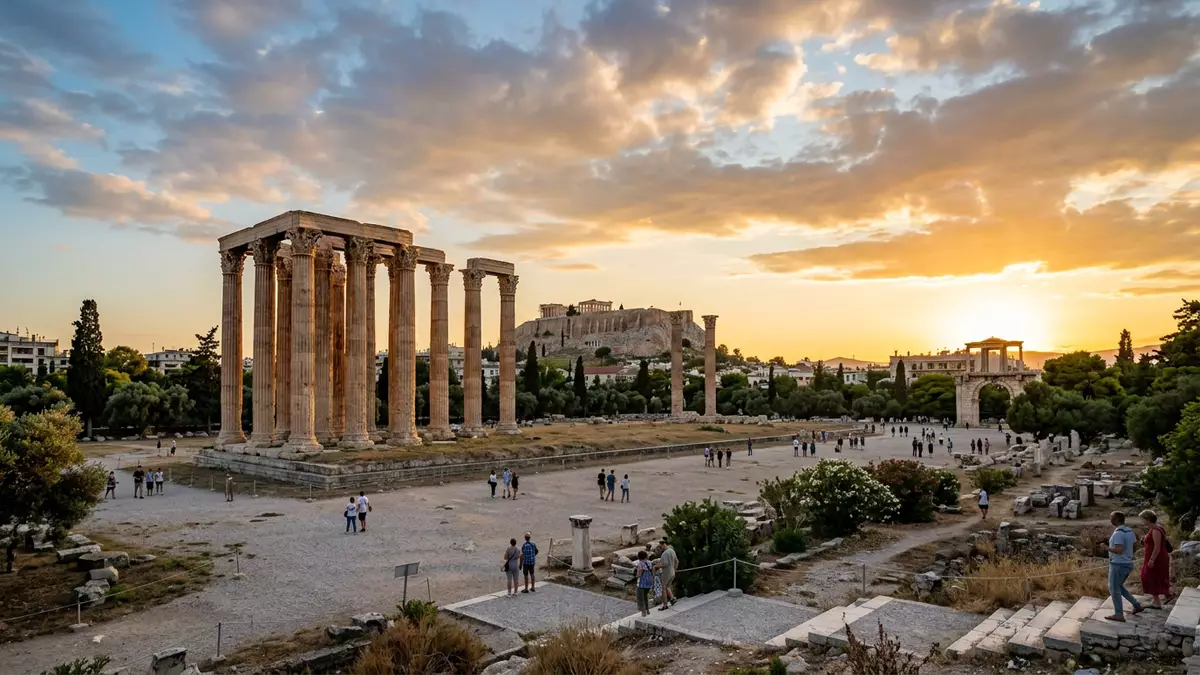
Naos tou Olympiou Dios in Athen is the ruined Temple of Olympian Zeus, a vast Corinthian sanctuary that still marks the city’s centre with surviving columns and open ground. Begun under Hadrian’s completion it belongs to a project that moved from Archaic Athens into the Roman imperial age.
The temple between Athen and the Acropolis
The sanctuary stands in central Athen, south-east of the Acropolis and near the River Ilissos. Its remains belong to the ancient Olympieion, the Greek name that survives in modern usage for the site and its temple.south-east of the Acropolis
The temple is linked with Peisistratos, the Athenian tyrant, whose age saw the first building campaign in the sixth century BC. That early start gives the ruin a long historical span even before the Roman phase is considered.the sixth century BC
Hadrian, Corinthian columns and a long building history
The completed monument belongs to the reign of the Roman emperor Hadrian, who finished the temple in AD 131 or 132. That date matters because the building visible today is the result of an ancient project that spanned centuries, not a single campaign.
The surviving structure is Corinthian, and its columns remain the most striking feature on the site. Their height and the breadth of the plan give the ruin its unusual sense of scale, even though most of the original temple has gone.
Ancient writers associated the temple with the god Zeus Olympios, and the name Naos tou Olympiou Dios preserves that dedication. The site also sits within the wider archaeological landscape of Hadrian’s Athens, where imperial additions and classical ruins stand close together.completed in AD 131
What survives at the Olympieion site
The temple survives as a colonnaded fragment rather than a complete building. What remains is enough to show the scale of the original sanctuary and the marble character of its Roman form.the Roman form
The ruin stands in an open archaeological setting, with Hadrian’s Arch nearby and the Acropolis within the same city view. That combination gives the place its strongest appeal: an unfinished ancient project turned into a fragment of the imperial city.Hadrian’s Arch nearby
Visiting Naos tou Olympiou Dios: what travellers from Western Europe should know
- The temple stands in central Athen, within walking reach of the Acropolis and Syntagma Square. Akropoli station on the metro line serves the area.
- The site is an open-air ruin on level ground. The surviving columns and broken masonry need no special indoor route.
- The wider area includes Hadrian’s Arch and the archaeological landscape around Vasilissis Olgas Avenue. The temple forms part of a dense historic quarter rather than an isolated monument.
- The official language is Greek and the currency is the euro.
- Entry requirements depend on your nationality; UK travellers can check the FCDO travel advice at gov.uk/foreign-travel-advice, Irish travellers the Department of Foreign Affairs at ireland.ie.
Searching for Naos tou Olympiou Dios on social platforms
These links open searches for Naos tou Olympiou Dios on each platform.
Frequently asked questions about Naos tou Olympiou Dios
Where is Naos tou Olympiou Dios?
It stands in central Athen, south-east of the Acropolis and close to the River Ilissos. The site sits on the edge of the city’s dense archaeological core.
What does a visit involve?
It is an open-air ruin with standing columns, fallen fragments and broad space around the remains. The monument is read as much through its scale as through its surviving detail.
What makes it distinctive?
The temple links Archaic beginnings with a Roman completion under Hadrian. Its surviving Corinthian columns give Athen one of its most recognisable ancient silhouettes.


