
Naos tou Olympiou Dios in Athen: marble columns facing the Acropolis
Published on 09/18/2026 at 21:00 | Editorial responsibility: Rafael Müller, Editor-in-Chief AD HOC NEWS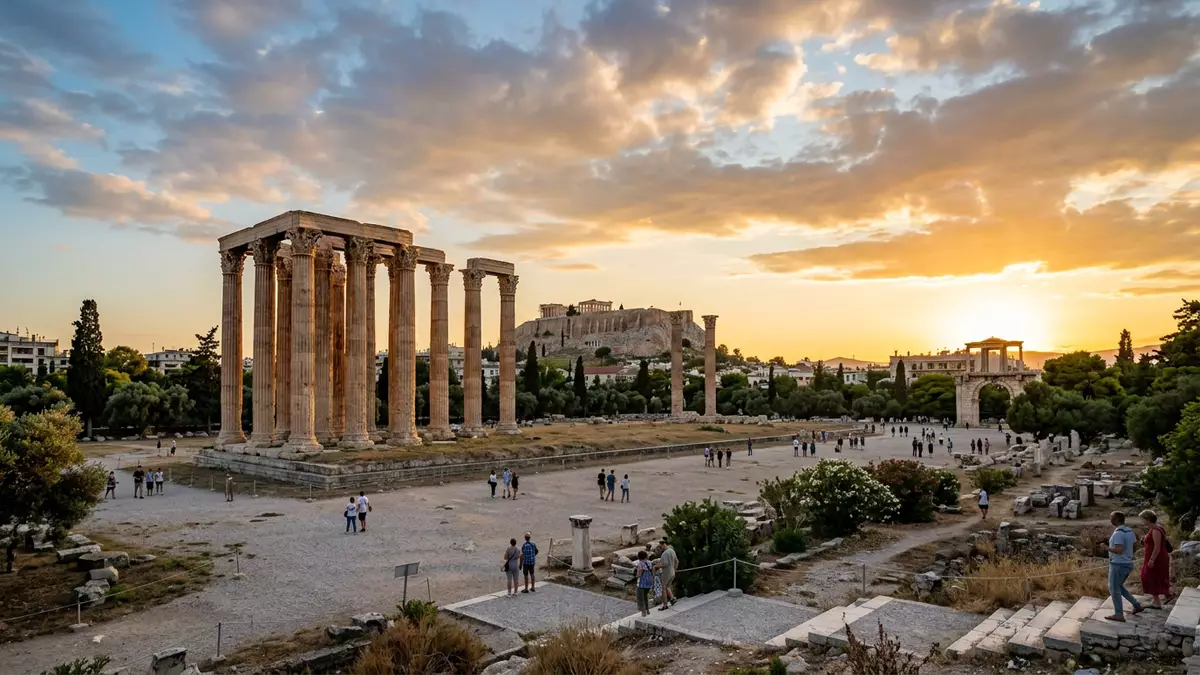
Naos tou Olympiou Dios, better known in English as the Temple of Olympian Zeus, is a vast open sanctuary in Athen where tall marble columns rise against the Attic sky. In its present form it preserves part of a colossal Corinthian temple completed under Emperor Hadrian in the second century AD, on ground south-east of the Acropolis and close to the course of the Ilissos river.
A colossal Corinthian temple over many centuries
The origins of Naos tou Olympiou Dios lie in the sixth century BC, when the Peisistratid tyrants began turning a sanctuary of Zeus south-east of the Acropolis into a monumental temple precinct in stone. Work on a grand temple stalled and resumed under different regimes, and the project stretched across the Hellenistic and Roman periods until Hadrian finally saw the building completed around 131–132 AD as a vast Corinthian temple in Pentelic marble.Temple of Olympian Zeus, Athens This long construction history, involving figures such as Peisistratos, Antiochus IV Epiphanes and the Roman architect Cossutius, gives the Olympieion a layered character in which Archaic ambition meets Roman-scale execution.origins of the Temple of Olympian Zeus
At its completion under Hadrian, Naos tou Olympiou Dios stood as one of the largest temples of its time, laid out in a long rectangular plan with an outer colonnade in the Corinthian order.built over several centuries Ancient authors and modern studies alike note that the building carried more than one hundred marble columns, forming a forest of uprights around the cella and defining a footprint that dwarfed many other sacred structures in classical Greece.originally, the temple had a total of 104 columns
Marble columns and an open sanctuary in the modern city
What visitors encounter at Naos tou Olympiou Dios is an open archaeological enclosure where surviving columns mark the outline of the ancient temple against the surrounding cityscape. Within the walled precinct, a group of standing Corinthian columns in Pentelic marble rises from a broad stylobate, while a fallen column lies in segments on the ground, showing the fluted drums and internal metal connections that once supported the entablature.Olympieion situated southeast of the Acropolis The emptiness around these elements turns the ruin into a frame for sky and city, with long sightlines running between the columns and towards the Acropolis rock.
The sanctuary occupies a large open area south-east of the Acropolis and roughly south of Syntagma Square, on terrain that slopes gently down towards the course of the Ilissos.location of the Temple of Olympian Zeus From within the enclosure the Acropolis and its monuments are visible beyond the columns, tying Naos tou Olympiou Dios into a broader ensemble of Athenian classical sites that also includes the nearby Arch of Hadrian and the remains of other sanctuaries along the former riverbank.situated near the Ilissos river
From imperial cult to archaeological landmark
In antiquity the Olympieion formed part of a wider sacred landscape in Athen dedicated to Zeus Olympios, and inscriptions suggest that cult statues and altars once stood within its enclosure alongside the temple itself.dedicated to Olympian Zeus Hadrian’s completion of the complex in the second century AD linked it to imperial patronage and large-scale benefactions to the city, reflected in structures such as the Arch of Hadrian near the sanctuary boundary.completed by Roman emperor Hadrian
In later centuries the temple suffered damage and spoliation, and many of its columns and architectural members were removed or collapsed, leaving the partial colonnade that defines the site today.only 15 of its original 104 columns remain today Systematic excavations in the late nineteenth century by archaeologists such as Francis Penrose cleared the area around the columns and brought the ground plan of the temple back into focus, turning Naos tou Olympiou Dios into a recognisable archaeological landmark within the expanding modern city of Athen.first excavated in 1889–96 by Francis Penrose
Visiting Naos tou Olympiou Dios: what travellers from Western Europe should know
- Naos tou Olympiou Dios stands in central Athen south-east of the Acropolis and roughly south of Syntagma Square, on ground close to the former course of the Ilissos river.
- The sanctuary consists largely of open ground with exposed archaeological remains, and reaching the surviving columns involves walking across uneven surfaces and low steps on historic stone.
- The site lies within walking distance of other major landmarks in central Athen, including the Acropolis, the Acropolis Museum and the Arch of Hadrian along Amalias Avenue.
- The official language is Greek and the currency is the euro.
Searching for Naos tou Olympiou Dios on social platforms
These links open searches for Naos tou Olympiou Dios on each platform.
Frequently asked questions about Naos tou Olympiou Dios
Where is Naos tou Olympiou Dios in Athen?
Naos tou Olympiou Dios stands in central Athen south-east of the Acropolis and roughly south of Syntagma Square, close to the former course of the Ilissos river.
What should visitors expect on a visit to Naos tou Olympiou Dios?
Visitors encounter an open archaeological enclosure with surviving Corinthian marble columns, a fallen column on the ground and wide views towards the Acropolis and surrounding city.
What makes Naos tou Olympiou Dios distinctive among ancient sites in Athen?
Its scale as a colossal Corinthian temple completed under Hadrian, the long multi-century construction history and the way its tall columns stand against the modern skyline give the Olympieion a distinctive presence.


