
Nara Koen and the deer among Nara’s temples
Published on 09/19/2026 at 07:21 | Editorial responsibility: Rafael Müller, Editor-in-Chief AD HOC NEWS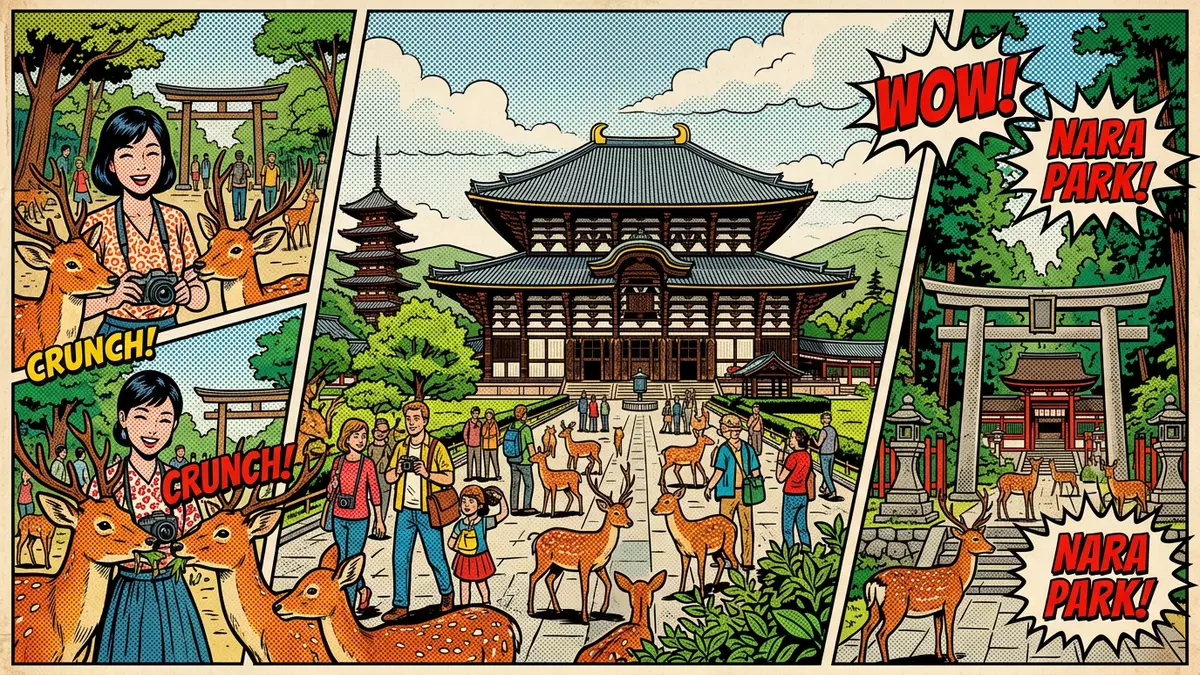
Nara Koen in Nara is a broad green landscape where sika deer wander between temple precincts, shrine forests and museum buildings in the former capital of Japan. The park in its present form dates from the late nineteenth century, and it gathers together sites such as T?dai-ji, K?fuku-ji and Kasuga Taisha that carry the long history of Nara into a single walkable area.
Deer, lawns and a spread-out historic landscape
Nara Koen is a large urban park in central Nara, extending from the lower slopes of Mount Wakakusa towards the city streets.large urban park in central Nara Broad lawns, clusters of trees and ponds sit between the temple complexes and the approach roads, so that the historic buildings stand within open parkland rather than behind walls. The official park area defined under Japanese urban park regulations covers about 502 hectares (1,240 acres), while the wider zone including the temple grounds and museum precincts reaches roughly 660 hectares (1,630 acres).wider zone including the temple grounds
Sika deer move freely through this landscape and have become a symbol of Nara Koen and of the city itself.Sika deer move freely They are classified under Japanese law as a natural treasure, a formal status that protects them as part of the park’s heritage.natural treasure The animals mix with visitors on the grass, along the paths and beside the ponds in daylight hours, so that encounters with deer become part of a visit as naturally as views of temple roofs or stone lanterns.
Temples, shrines and museums within the park
The open lawns of Nara Koen sit among some of the most significant religious sites of Nara. On the northern side of the park lies T?dai-ji, the Buddhist temple known for its Daibutsuden hall housing the Great Buddha of Nara.T?dai-ji temple and Great Buddha Its wooden hall and gate stand along gravel approaches that pass through areas where deer graze or rest. To the west, the precincts of K?fuku-ji rise on slightly higher ground, with pagodas and halls visible from the surrounding parkland.K?fuku-ji precincts
At the eastern edge of Nara Koen, paths lead towards Kasuga Taisha, a Shinto shrine framed by the Kasugayama Primeval Forest.Kasuga Taisha in the east of Nara Park The shrine and the forest form part of the UNESCO World Heritage listing “Historic Monuments of Ancient Nara”, a designation that also includes sites within the wider park area.Historic Monuments of Ancient Nara Close to the central lawns stands the Nara National Museum, a cultural institution with buildings set among trees and low hedges that look out towards the deer and the ponds.Nara National Museum
A park shaped in the Meiji era
The consolidation of Nara Koen as a public park belongs to the early Meiji period, when Japan was redefining many urban spaces. The park was established in 1880, giving Nara a designated area that formally incorporated landscapes and religious precincts around the former imperial capital.established in 1880 Over time, the designation under Japanese law as a prefectural urban park, combined with national recognition as a “Place of Scenic Beauty”, has fixed Nara Koen’s role as both recreational space and cultural landscape.Place of Scenic Beauty
Within this framework, individual elements of the park have received layered protection. The Kasugayama Primeval Forest is recognised as a Special Natural Monument, and the deer, together with specific trees and habitats, are registered as Natural Monuments under Japanese heritage law.Special Natural Monument As a result, a walk through Nara Koen passes not only temples and shrines but also protected woodland and long-established groves that reflect centuries of religious and civic care.
Visiting Nara Koen: what travellers from Western Europe should know
- Nara Koen stretches east of central Nara, with approaches leading from Kintetsu Nara Station and JR Nara Station through city streets into parkland.
- The parkland is extensive, and visiting its temples and shrines involves walking on gravel paths, grass and gentle slopes, with some stairways in the religious precincts.
- Nara Koen lies in Japan, where the official language is Japanese and the currency is the yen.
- Entry requirements depend on your nationality; UK travellers can check the FCDO travel advice at gov.uk/foreign-travel-advice, Irish travellers the Department of Foreign Affairs at ireland.ie.
Searching for Nara Koen on social platforms
These links open searches for Nara Koen on each platform.
Frequently asked questions about Nara Koen
Where is Nara Koen located?
Nara Koen is a public park in the city of Nara in Japan, lying east of the main commercial streets and close to Mount Wakakusa.
What can visitors expect during a walk in Nara Koen?
A visit combines open lawns, ponds, temple and shrine precincts, and encounters with free-roaming sika deer that move through the parkland.
What makes Nara Koen distinctive among Japanese historic sites?
Nara Koen brings together UNESCO-listed temples and shrine forests within one continuous park where protected deer and civic green space share the same landscape.


