
Naritasan Shinshoji and its layered temple city in Narita
Published on 09/22/2026 at 18:25 | Editorial responsibility: Rafael Müller, Editor-in-Chief AD HOC NEWS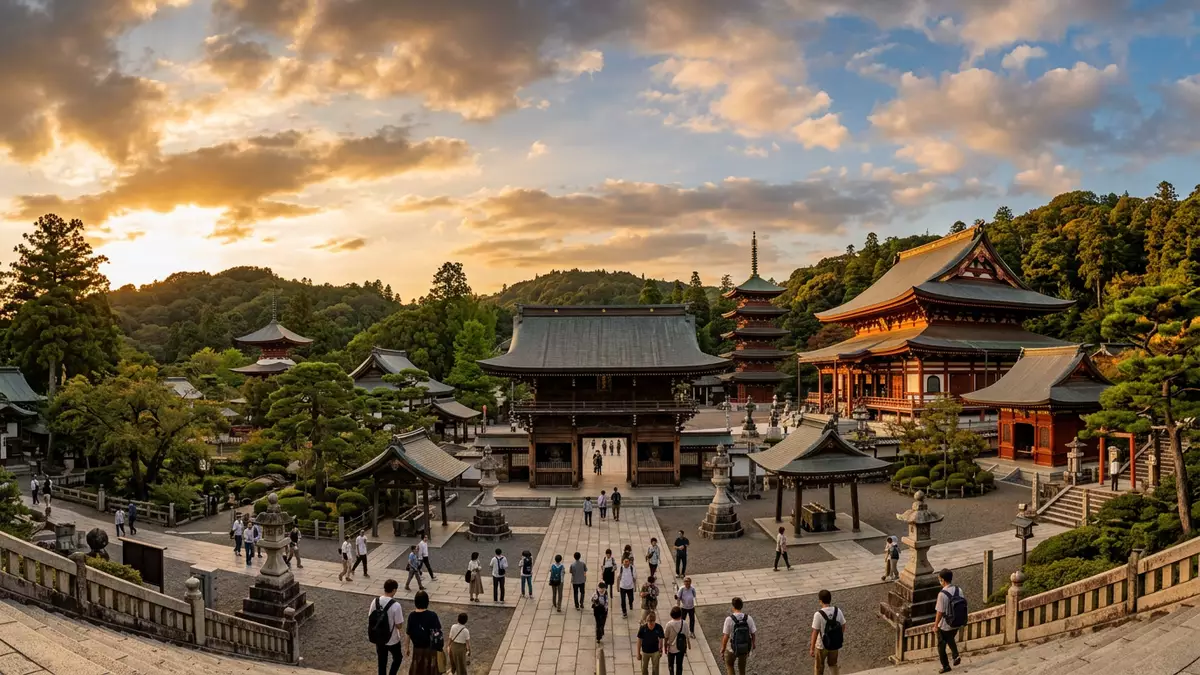
Naritasan Shinshoji rises above Narita as a Shingon Buddhist complex where halls, pagodas, stairways and parkland occupy a broad hillside. Founded in 940 during Japan’s Heian period, the temple is dedicated to Fudo Myoo, the Wisdom King whose image remains central to its religious identity.
Naritasan Shinshoji: a temple complex arranged in layers
The approach begins along Narita’s historic Omotesando street, a route lined with traditional shops and restaurants. From there, the temple grounds pass through the Somon Gate and Niomon Gate before opening onto the principal worship area.
The buildings do not form a single hall surrounded by empty space. They create a sequence of terraces, plazas and paths on rising ground. The Daihondo Main Hall houses the image of Fudo Myoo, while the nearby Sanju-no-to is a richly decorated three-storey pagoda completed in 1712. Its painted surfaces and tiled roofs belong to the older architectural layer of the complex.the three-storey pagoda
From Heian foundations to Edo-period culture
Naritasan Shinshoji was founded by Kanch? Dais?j?, a disciple of K?kai, the monk who established the Shingon tradition in Japan. The temple’s principal image is Fudo Myoo, a Buddhist protector associated with fire, immovability and determined wisdom.
The foundation belongs to the political and religious world of the tenth-century Heian period. The temple’s origin is connected with a campaign against Taira no Masakado, a powerful warrior in the eastern provinces. Kanch? performed goma fire rites before the image, and the temple was established at Narita in 940.
Naritasan gained a strong public presence during the Edo period, when Narita was connected with Edo by pilgrimage routes and religious travel. Its cultural history also includes the Ichikawa family of Kabuki actors. Ichikawa Danj?r? I became associated with Fudo Myoo, and the name Naritaya links the theatre tradition with the temple and its city.the Kabuki connection
Historic halls beside the Great Peace Pagoda
The main precinct contains buildings from different periods. Shakado Hall was completed in 1858 and served as the principal hall before the Daihondo. Komyodo Hall dates from 1701 and belongs to an earlier phase of the temple’s religious architecture.
Above the older halls stands the Great Peace Pagoda, completed in 1984. The five-level structure rises about 58 m (190 ft) and contains spaces associated with sutra writing and Buddhist worship. Its scale and concrete construction contrast with the painted timber buildings lower on the hillside.the Great Peace Pagoda
Narita-san Park extends behind and around the temple buildings. Ponds, bridges, trees and paths continue the complex beyond the concentrated worship halls. The result is a place that combines a working Buddhist precinct with landscaped grounds, rather than separating architecture and garden into unrelated areas.
Visiting Naritasan Shinshoji: what travellers from Western Europe should know
- Naritasan Shinshoji stands in Narita City, Chiba Prefecture, east of Tokyo. It is reached on foot from JR Narita Station or Keisei Narita Station.
- The complex occupies a hillside above Omotesando street. Exploring it involves staircases, raised terraces and paths across both built and landscaped areas.
- Narita-san Park contains ponds, bridges and wooded paths behind the principal temple buildings. The grounds extend beyond the central halls and pagodas.
- The official language is Japanese and the currency is the Japanese yen.
- Entry requirements depend on your nationality; UK travellers can check the FCDO travel advice at gov.uk/foreign-travel-advice, Irish travellers the Department of Foreign Affairs at ireland.ie.
Searching for Naritasan Shinshoji on social platforms
These links open searches for Naritasan Shinshoji on each platform.
Frequently asked questions about Naritasan Shinshoji
Where is Naritasan Shinshoji?
Naritasan Shinshoji is in Narita City, Chiba Prefecture, east of Tokyo. The temple stands within walking distance of JR Narita Station and Keisei Narita Station.
What can visitors see at the temple?
The grounds contain the Daihondo Main Hall, Shakado Hall, Komyodo Hall, the Sanju-no-to pagoda and the Great Peace Pagoda. Narita-san Park adds ponds, bridges, trees and paths beyond the main precinct.
What makes Naritasan Shinshoji distinctive?
Its identity combines a foundation in 940, Fudo Myoo worship, Shingon Buddhism, Edo-period pilgrimage culture and buildings spread across a landscaped hillside.


