
Naritasan Shinshoji and its temple city above Narita
Published on 09/23/2026 at 19:43 | Editorial responsibility: Rafael Müller, Editor-in-Chief AD HOC NEWS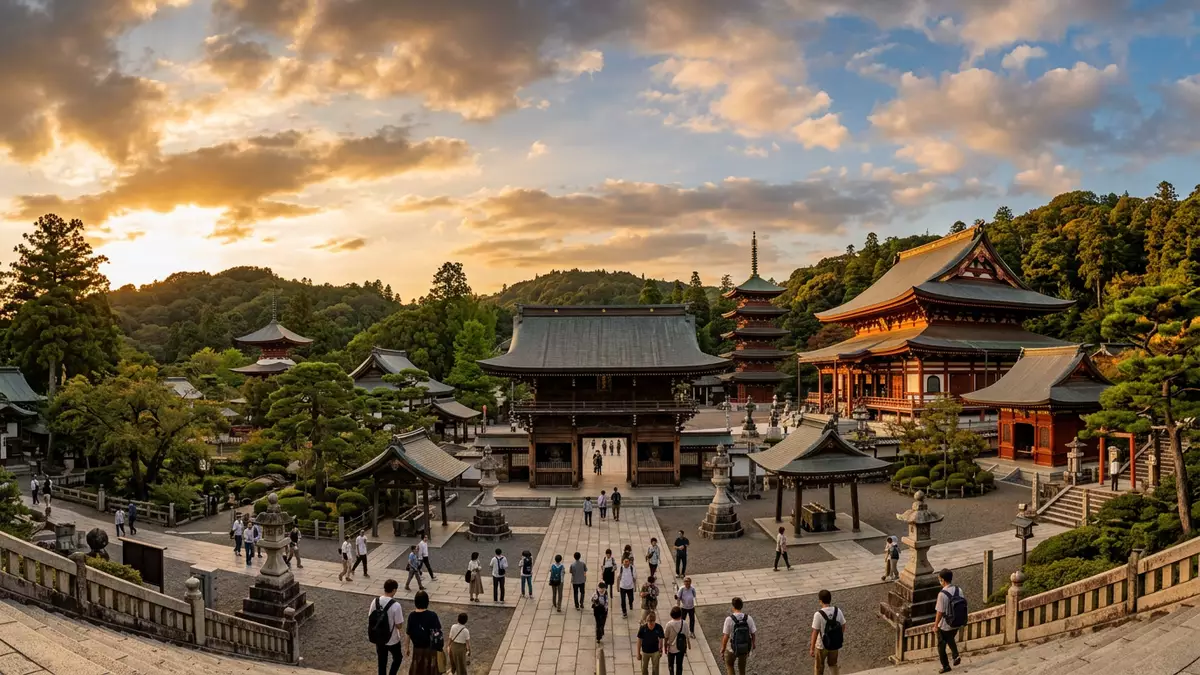
Naritasan Shinshoji is a Buddhist temple complex in Narita, Japan, where gates, halls, pagodas and a park form a broad sacred landscape. Founded in 940 during the Heian period, it remains centred on Fudo Myoo, the Buddhist Wisdom King associated with fire.
Naritasan Shinshoji: a complex shaped by gates and courtyards
The approach begins along Narita Omotesando, a traditional shopping street leading towards the temple precinct. Wooden gates mark the entrance, including the Somon Gate and the Niomon Gate, whose large lantern gives the passage a strong visual focus.
Beyond the gates, the route reaches an elevated plaza beside the three-storied pagoda. Its painted details sit beneath layered roofs, while carved wooden buildings frame the spaces around it. The Daihondo Great Main Hall forms the principal centre of the complex.
The architecture belongs to several periods. Naritasan’s historic buildings include structures recognised as Important Cultural Properties of Japan. Their woodwork, painted ornament and rooflines create a sequence of distinct architectural views.
Fudo Myoo and the temple’s Heian foundation
Naritasan Shinshoji was founded in 940 by Kanch? Dais?j?, a Shingon Buddhist priest and disciple of K?kai. K?kai, also known as K?b? Daishi, founded the Shingon school of Buddhism in Japan.
The temple’s principal object of worship is Fudo Myoo, also called Acala or the Unmoving Wisdom King. The deity appears with a sword, a rope and a fierce expression, surrounded by flames in temple imagery.
The foundation belongs to the Heian period, when the imperial court governed from Heian-ky?, present-day Kyoto. The temple’s Heian origins are connected with Kanch? and an image of Fudo Myoo brought from Kyoto.
Naritasan’s religious identity remains visible in its halls, statues and goma fire rituals. These ceremonies use a sacred fire before which Buddhist priests recite prayers, linking the complex’s daily religious life with its central deity.
Historic halls beside Naritasan Park
The temple precinct contains buildings from different stages of its history. Komyodo was built in 1701, the three-storied pagoda in 1712, Niomon in 1830, Shakado in 1858 and Gakudo in 1861.
These buildings show the changing expression of Buddhist architecture during the Edo period. The pagoda carries elaborate decoration, while the older halls present darker timber, broad roofs and detailed carvings. Their arrangement makes the complex readable as a succession of courts and thresholds.
Behind the principal buildings, Naritasan Park covers 165,000 square metres. Ponds, wooded slopes, paths and statues of Buddhist monks extend the temple landscape beyond the formal courtyards.
The Great Pagoda of Peace rises within the upper part of the precinct. Built in 1984, it contains a large image of Fudo Myoo and adds a twentieth-century structure to the historic sequence of halls and pagodas.
Naritasan’s historic structures include the three-storied pagoda and halls connected with the temple’s Buddhist heritage. The result is a precinct where religious use, timber architecture and parkland occupy one continuous setting.
Visiting Naritasan Shinshoji: what travellers from Western Europe should know
- Naritasan Shinshoji is in central Narita, Chiba Prefecture. It is reached by walking along Narita Omotesando from JR Narita Station or Keisei Narita Station.
- The approach includes gates, steps, raised plazas and sloping paths. Naritasan Park continues through wooded ground beside ponds and temple buildings.
- The official language is Japanese and the currency is the Japanese yen.
- Narita International Airport lies near the city, while Narita Omotesando provides the named approach from the railway stations.
Searching for Naritasan Shinshoji on social platforms
These links open searches for Naritasan Shinshoji on each platform.
Frequently asked questions about Naritasan Shinshoji
Where is Naritasan Shinshoji?
Naritasan Shinshoji is in Narita, Chiba Prefecture, Japan. The temple lies near Narita International Airport and is approached through Narita Omotesando.
What can visitors see there?
The precinct contains Buddhist halls, wooden gates, a decorated three-storied pagoda, the Great Pagoda of Peace and Naritasan Park with ponds and wooded paths.
What makes the temple distinctive?
Its identity combines a foundation in 940, Shingon Buddhist practice and devotion to Fudo Myoo. Historic timber buildings stand beside later structures and an extensive temple park.


