
National Mall as a grand axis of monuments and museums
Published on 09/17/2026 at 20:38 | Editorial responsibility: Rafael Müller, Editor-in-Chief AD HOC NEWS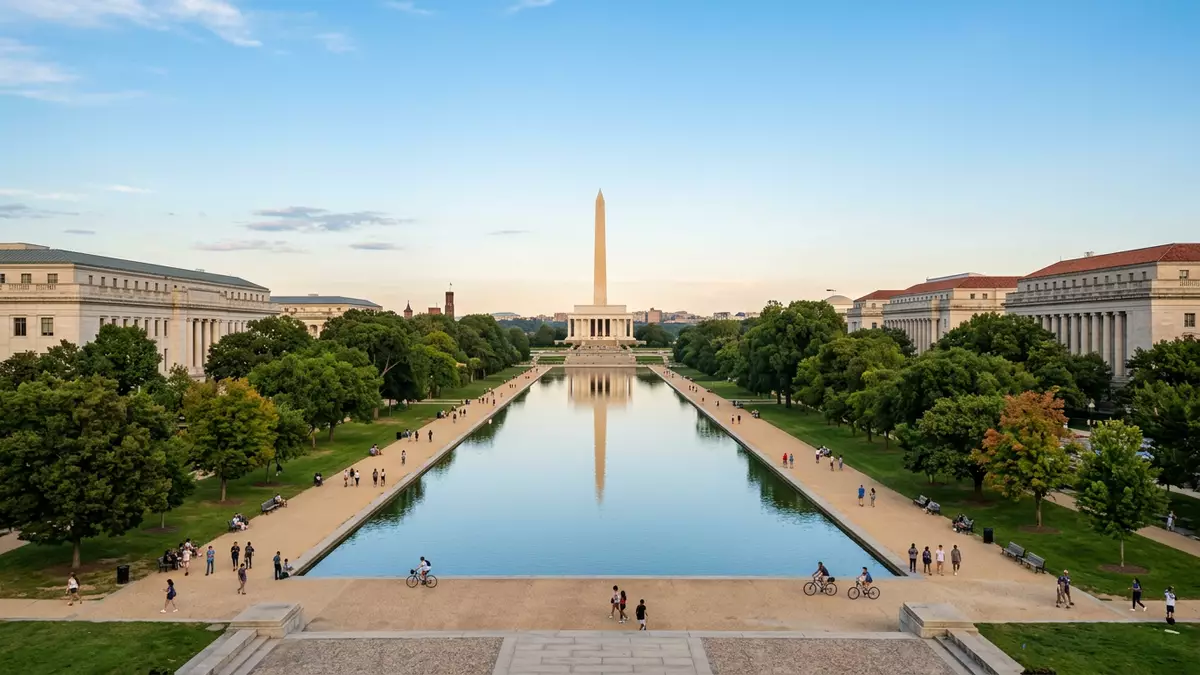
National Mall in Washington, D.C. forms a long, formal strip of parkland linking the United States Capitol to the Lincoln Memorial, with the Washington Monument rising on its central axis. It is laid out as a broad greensward framed by avenues, museums and federal buildings, and has become the capital’s signature landscape for national monuments and large civic gatherings.
The long green corridor between Capitol and Lincoln
At its simplest, National Mall is a straight east–west park aligned between the legislative and commemorative ends of the city: the U.S. Capitol to the east and the Lincoln Memorial beside the Potomac River to the west.broad promenade and greensward The stretch between the Capitol steps and the Lincoln Memorial runs for about 3 km (1.9 miles), a walk that passes some of the best-known monuments in the United States.the Mall spans 1.9 miles
The park’s core is a sequence of open lawns bounded by Constitution Avenue to the north and Independence Avenue to the south, with cross streets dividing the grass into long rectangular panels. Rows of trees define the outer edges and reinforce the simple linear form described in historic planning documents.landscaped grass lawn extending one mile west from the U.S. Capitol Standing on the central axis, the perspective runs uninterrupted from the white dome of the Capitol across the lawns and the obelisk of the Washington Monument to the classical colonnade of the Lincoln Memorial.
From L’Enfant’s “Grand Avenue” to a planned mall
The idea of a ceremonial open space at this location dates back to Pierre Charles L’Enfant’s 1791 plan for the federal city, which set out a “Grand Avenue” connecting the Congress House on the hill with a statue of George Washington near the river.400-foot-wide, mile-long avenue anchored by the Congress House L’Enfant’s broad boulevard was later reinterpreted through subsequent plans, notably the early twentieth-century McMillan Plan, which reaffirmed the Mall as a formal axis flanked by museums and government buildings.
During the nineteenth century the area did not yet resemble the coherent park known today. Contemporary accounts describe uses ranging from gardens and rail lines to market spaces and grazing land, before twentieth-century planning consolidated it into a continuous greensward intended as a symbolic heart of the capital.reflects the evolving vision of the nation’s capital Key elements arrived in stages: the Washington Monument on the western part of the Mall was completed in the late nineteenth century, and the Ulysses S. Grant Memorial at the eastern end followed in the 1920s, anchoring the axis with major stone landmarks.Washington Monument was completed on the mall’s western edge
Museums, memorials and water along the axis
National Mall today is defined as much by what lines it as by the lawns themselves. On the museum side between the Capitol and the Washington Monument, the park is edged by a dense row of Smithsonian Institution museums and galleries, including the National Museum of American History, the National Museum of Natural History, the National Museum of African American History and Culture, the National Air and Space Museum, the National Gallery of Art and several others.numerous institutions set within the Mall or flanking it Their stone and brick facades form a continuous architectural backdrop to the open turf.
West of the Washington Monument the character shifts from museums to memorials and water. The World War II Memorial, the long Reflecting Pool, the Vietnam Veterans Memorial, the Korean War Veterans Memorial, the Martin Luther King, Jr. National Memorial and the Franklin Delano Roosevelt Memorial all stand within the broader National Mall and West Potomac Park area, leading towards the Lincoln Memorial at the western terminus.memorials and Reflecting Pool near the Lincoln Memorial Viewed in sequence, they turn the walk along the Mall into a continuous encounter with the country’s twentieth-century history, framed by water, trees and stone.
Visiting National Mall: what travellers from Western Europe should know
- National Mall lies in central Washington, D.C., between Constitution Avenue and Independence Avenue and stretching from the United States Capitol on Capitol Hill to the Lincoln Memorial near the Potomac River. It is easily reached by public transport, including the Washington Metro, with several stations close to different sections of the Mall.
- The terrain consists of level lawns, gravel paths and paved walkways, with long distances on foot between major monuments; a visit involves extended walking on mostly flat ground with occasional steps and ramps around memorials and museum entrances.
- National Mall forms the setting for many of Washington’s major museums, particularly Smithsonian museums, so a day there combines outdoor walking between monuments with time inside large exhibition buildings that stand directly along the park’s north and south edges.
- The official language is English and the currency is the United States dollar (USD).
- Entry requirements depend on your nationality; UK travellers can check the FCDO travel advice at gov.uk/foreign-travel-advice, Irish travellers the Department of Foreign Affairs at ireland.ie.
Searching for National Mall on social platforms
These links open searches for National Mall on each platform.
Frequently asked questions about National Mall
Where is National Mall located within Washington, D.C.?
National Mall runs through central Washington, D.C., between Constitution Avenue and Independence Avenue, from the United States Capitol on Capitol Hill to the Lincoln Memorial beside the Potomac River.
What can visitors expect on a walk along National Mall?
A walk along National Mall follows long lawns and paths past the Washington Monument, Smithsonian museums, major war memorials, the Reflecting Pool and the Lincoln Memorial, with extended distances on foot between these sites.
What makes National Mall distinctive among city parks?
National Mall combines a simple linear park layout with an exceptional concentration of national museums and memorials along one axis, linking the seat of Congress and an important presidential memorial in a single planned landscape.


