
National Mall as a long green axis of American history
Published on 08/25/2026 at 13:44 | Editorial responsibility: Rafael Müller, Editor-in-Chief AD HOC NEWS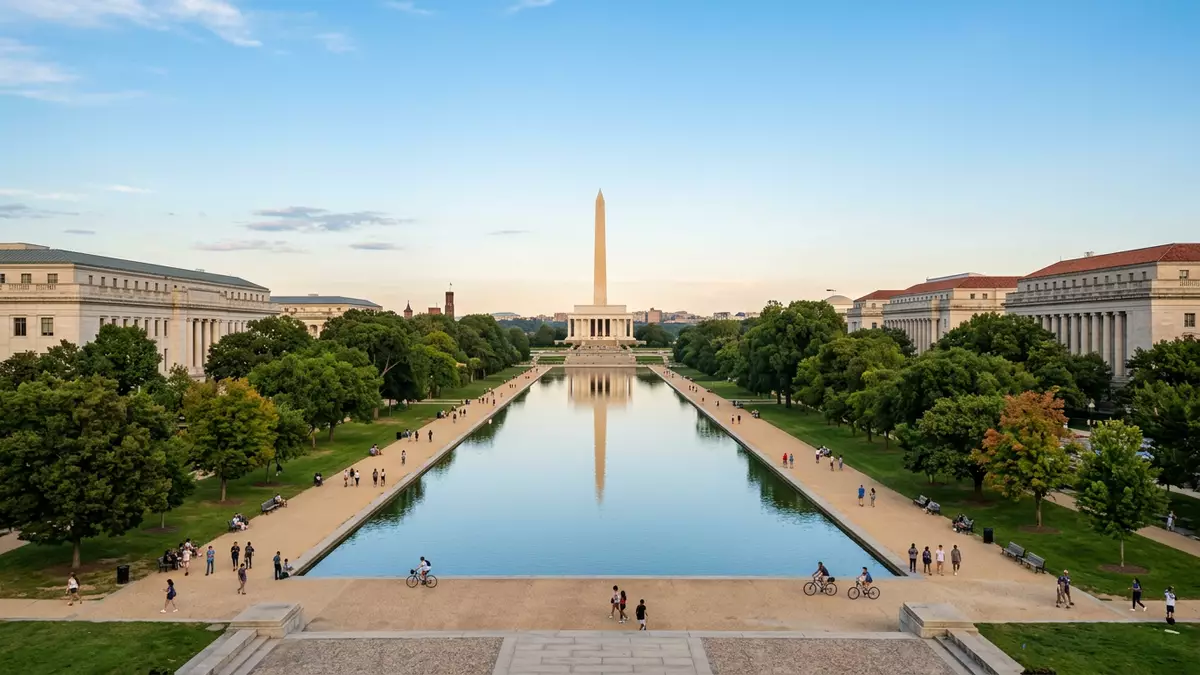
The National Mall in Washington, D.C. is a long green axis that links the United States Capitol, the Washington Monument and the Lincoln Memorial in one vast open landscape. Laid out within the capital city planned in 1791 by Pierre Charles L’Enfant, it runs as a formal park flanked by museums, memorials and federal buildings that turn abstract national history into a walkable sequence of spaces.
A grand east–west promenade in the capital
The National Mall forms a broad promenade that extends westward from the grounds of the United States Capitol towards the Potomac River. Its core stretch lies between the Capitol and the Washington Monument, with the wider Mall area continuing on to the Lincoln Memorial in West Potomac Park.broad promenade and greensward Constitution Avenue runs along its northern edge and Independence Avenue along its southern edge, so the lawns sit as a defined strip in the centre of central Washington, D.C.bounded by Constitution and Independence avenues
From the steps of the Capitol on the east side to the Lincoln Memorial in the west, the Mall covers a distance of about 3 km (around 2 miles), a scale that gives perspective to the marble monuments that punctuate it.2-mile-long expanse of open space Within this reach, a central sequence of eight elongated panels of grass is aligned between the Capitol and the Washington Monument, separated by cross streets and edged by a gravel path that traces the outer perimeter.eight long panels of grass lawn
Museums and memorials facing the lawns
North and south of these lawns, the Mall is framed by cultural institutions and federal offices that lend the green space its distinctive character. Along the north side stand major Smithsonian museums such as the National Museum of Natural History and the National Museum of American History, sharing the axis with the neoclassical National Gallery of Art.museums of the Smithsonian Institution On the south side, further Smithsonian buildings and departments of government pick up the same formal rhythm, giving the park a continuous architectural frontage.
West of the Washington Monument, the green landscape merges into West Potomac Park, where major war memorials and presidential memorials occupy their own distinct sites around the Reflecting Pool and the Tidal Basin. The Lincoln Memorial, completed in 1922 at the western edge of this ensemble, anchors the perspective down the length of the Mall, while the Jefferson Memorial stands across the water to the south.Lincoln Memorial and Reflecting Pool Between them lie the World War II Memorial, the Korean War Veterans Memorial and the Vietnam Veterans Memorial, creating a series of spaces where the open lawns narrow into more intimate landscapes.monuments and memorials in West Potomac Park
Plans, symbols and the long view
The idea of the Mall as a ceremonial axis dates back to Pierre L’Enfant’s 1791 plan for the new federal city, which envisaged a grand avenue linking the Capitol and a site near the river for a future monument.L’Enfant Plan of 1791 This early vision imagined a wide, tree-lined space that would serve as a foreground to the principal public buildings, crossed by diagonal avenues and punctuated by circles and squares reserved for statues and public structures.
In the early twentieth century the McMillan Plan revisited that original concept, extending the Mall westward on reclaimed land beside the Potomac River and defining the siting of the Lincoln Memorial and future memorials along what became a continuous park.extension of the Mall onto landfill The Washington Monument, whose construction began in the nineteenth century and was completed and dedicated in 1885, occupies the crossing of these axes as a tall obelisk rising from its own grounds.Washington Monument completed and dedicated in 1885 Seen from the Capitol steps or from the Lincoln Memorial, the monument stands at the centre of a long, uninterrupted vista, with the lawns of the Mall stretching out beneath it.
Visiting National Mall: what travellers from Western Europe should know
- The National Mall lies in central Washington, D.C., running between the United States Capitol, the Washington Monument and the Lincoln Memorial along Constitution and Independence avenues.
- The terrain across the Mall is largely flat, with wide lawns and paved paths; walking the length between the Capitol and the Lincoln Memorial involves a substantial distance on foot.
- Several Smithsonian museums and memorials line both sides of the Mall, so moving between indoor galleries and open-air sites means frequent crossings of broad avenues and walkways.
- The official language is English and the currency is the United States dollar.
- Entry requirements depend on your nationality; UK travellers can check the FCDO travel advice at gov.uk/foreign-travel-advice, Irish travellers the Department of Foreign Affairs at ireland.ie.
Searching for National Mall on social platforms
These links open searches for National Mall on each platform.
Frequently asked questions about National Mall
Where is the National Mall located?
The National Mall is in central Washington, D.C., stretching between the United States Capitol, the Washington Monument and the Lincoln Memorial, bounded by Constitution and Independence avenues.
What should a visitor expect on a walk along the Mall?
A walk along the Mall follows long lawns and paved paths past Smithsonian museums, presidential memorials and war memorials arranged around the Washington Monument and the Reflecting Pool.
What makes the National Mall distinctive among city parks?
Its distinctive quality lies in the straight alignment of green space between the Capitol and the Lincoln Memorial, with national museums and major memorials facing the same axial parkland.


