
National Mall as Washington’s long green axis of memory
Published on 09/05/2026 at 12:50 | Editorial responsibility: Rafael Müller, Editor-in-Chief AD HOC NEWS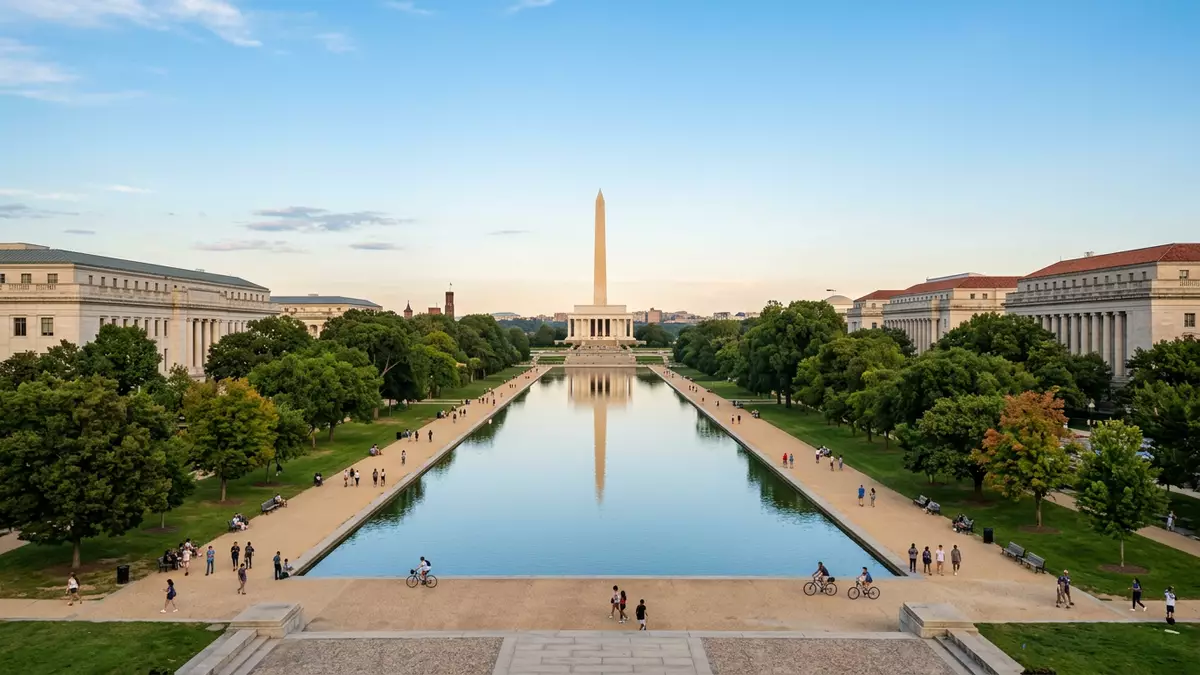
National Mall in Washington, D.C. is a broad strip of parkland that anchors the ceremonial core of the United States capital, running between the United States Capitol and the Lincoln Memorial in a long, carefully framed green axis. It brings together major monuments, museums and government buildings in one continuous landscape, turning a sequence of lawns, tree lines and water features into a single civic space shaped over more than two centuries.
A long east–west corridor of lawn and monuments
The core of National Mall extends westward from the United States Capitol grounds towards the Washington Monument and on to the Lincoln Memorial, forming an elongated open corridor flanked by federal buildings and museums on both sides.extends westward from the United States Capitol The Mall’s primary axis between the Capitol and the Lincoln Memorial measures about 3 km (1.9 miles), giving it a scale more akin to an outdoor civic room than a conventional city park.between the Capitol and the Washington Monument and the Lincoln Memorial Along this axis, the Washington Monument rises as a tall marble obelisk, while the reflecting pool and the steps of the Lincoln Memorial anchor the western end.
Within the central portion between Constitution Avenue to the north and Independence Avenue to the south, the Mall is structured as a sequence of long grass panels separated by cross streets and paths.a landscaped grass lawn extending one mile west from the U.S. Capitol to the Washington Monument Rows of trees line the edges, framing a clear vista along the length of the space and creating a strong visual connection between the Capitol dome, the monument and the distant memorials. This simple geometry makes the Mall legible at a glance: lawn at the centre, trees as a frame, with major structures punctuating the horizon.
From L’Enfant’s “Grand Avenue” to a twentieth-century Mall
The origins of National Mall lie in the late eighteenth century, when Major Pierre Charles L’Enfant was commissioned in 1791 to design the new capital of the United States on the banks of the Potomac River.L’Enfant planned the Mall as a 400-foot wide Grand Avenue extending from the Capitol westward In L’Enfant’s plan, the Mall appeared as a broad “Grand Avenue”, running west from the Capitol towards a point near the river and intersecting the axis of the President’s House. Over the nineteenth century the area took on mixed uses, including gardens and transport infrastructure, before a more unified park landscape emerged under the influence of the McMillan Plan of 1901–02.
The McMillan Plan expanded and regularised the Mall, establishing the familiar open lawns and aligning future monuments along the extended axes of L’Enfant’s city.the National Mall between First and 14th streets encompasses 134 acres Through this process, National Mall became the central gathering ground for major national memorials, many of them commemorating conflicts and presidents from the nineteenth and twentieth centuries. The continuity between L’Enfant’s avenue and the later parkland is still visible in the straight alignment and the way the space links institutional buildings with open ground.
A landscape of memorials, museums and vistas
National Mall and the adjacent memorial parks now contain more than a dozen units of the National Park System and a dense array of monuments and memorials.includes more than a dozen units of the National Park System The Washington Monument, completed in the 1880s, stands as a tall marble obelisk dedicated to George Washington and marks the point where the east–west axis of the Mall meets the north–south axis leading towards the White House and Jefferson Memorial.built in honour of George Washington and finished in 1884 To the west, the Lincoln Memorial forms a grand colonnaded structure overlooking a reflecting pool, while war memorials and presidential monuments occupy sites around the edges.
On the north and south sides of the central lawns, museums and cultural institutions stand in a regular sequence, giving National Mall a distinctive blend of open landscape and monumental architecture.lined to the north and south by several museums and federal office buildings The careful spacing of buildings preserves long sight-lines along and across the Mall, so that views of the Capitol, Washington Monument and Lincoln Memorial remain present even when standing amid the trees or near a museum entrance. This interplay between broad vistas and close-up encounters with individual structures is a defining feature of a visit.
Visiting National Mall: what travellers from Western Europe should know
- National Mall lies in central Washington, D.C., stretching between the United States Capitol on the east side and the Lincoln Memorial on the west, with the Washington Monument near its midpoint.
- The terrain consists mainly of level lawns, paved paths and broad tree-lined walkways, with gentle gradients; reaching memorials at the western end involves additional walking around the reflecting pool.
- The Mall is served by Washington, D.C.’s public transport network, including metro stations and bus routes in the streets that border Constitution Avenue to the north and Independence Avenue to the south.
- The official language is English and the currency is the United States dollar.
- Entry requirements depend on your nationality; UK travellers can check the FCDO travel advice at gov.uk/foreign-travel-advice, Irish travellers the Department of Foreign Affairs at ireland.ie.
Searching for National Mall on social platforms
These links open searches for National Mall on each platform.
Frequently asked questions about National Mall
Where is National Mall located in Washington, D.C.?
National Mall occupies a central band of parkland between the United States Capitol and the Lincoln Memorial, bordered by Constitution and Independence Avenues and surrounded by federal buildings and museums.
What can visitors expect when walking along National Mall?
Visitors encounter long lawns, rows of trees, paved paths and a sequence of monuments and museums, with clear views along the axis linking the Capitol, Washington Monument and Lincoln Memorial.
What makes National Mall distinctive among urban park landscapes?
Its combination of a straight ceremonial axis, major national memorials and cultural institutions within a single continuous green space gives National Mall a character that is closely tied to the layout of Washington, D.C. and the history of the United States capital.


