
Navagio and the shipwreck beneath Zakynthos’ limestone cliffs
Published on 09/23/2026 at 17:07 | Editorial responsibility: Rafael Müller, Editor-in-Chief AD HOC NEWS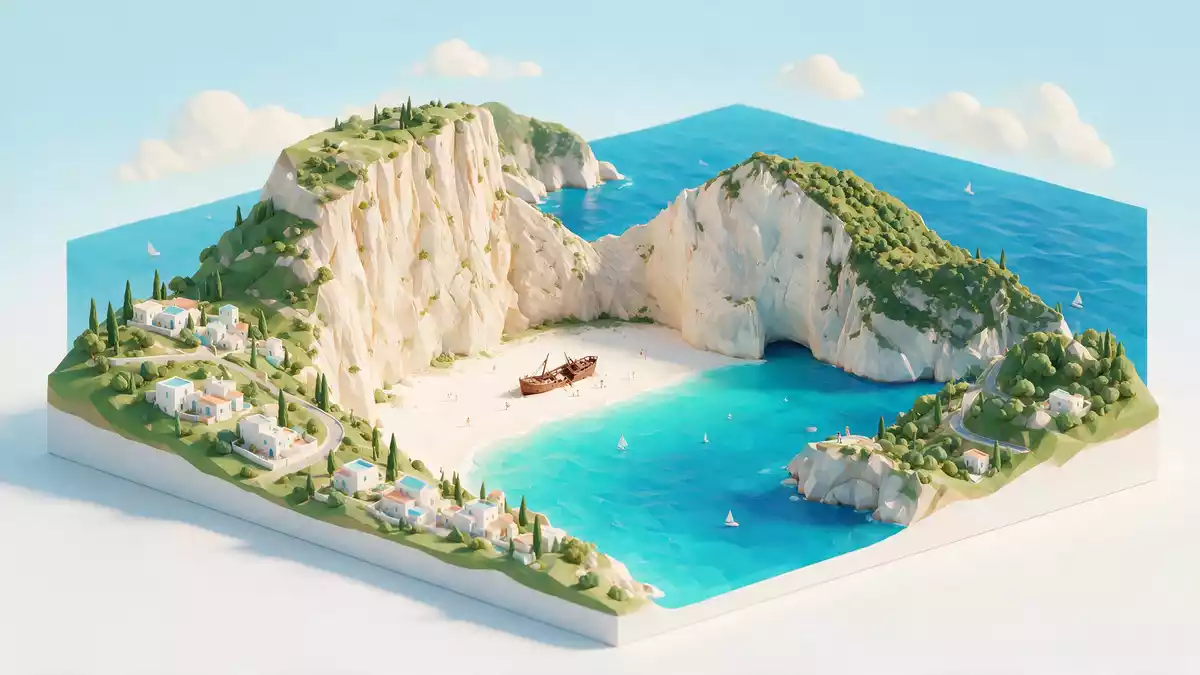
Navagio is a small cove on the north-west coast of Zakynthos, where the rusting hull of the MV Panagiotis lies on pale pebbles beneath steep limestone cliffs. The ship gives the beach its modern name, Navagio, the Greek word for “shipwreck”, while the enclosed shore remains a striking landscape in its own right.
Navagio: a cove framed by white limestone
The beach occupies an exposed inlet on Zakynthos, an Ionian island belonging to Greece. Its shore is made of light-coloured pebbles, and the cove opens towards the Ionian Sea between high limestone walls. From above, the beach appears as a narrow strip set against a broad sweep of pale rock.
The cliffs form the dominant feature of the landward side. Their exposed faces show the limestone formations found along the rugged north-west coast of Zakynthos, while the sea at the mouth of the cove contrasts with the light rock and the darker metal of the wreck. Navagio’s coastal setting places the beach among the Ionian Islands.
The MV Panagiotis and the name Navagio
The ship stranded at the cove in October 1980 after running aground in difficult weather. It was a small cargo vessel named MV Panagiotis, and its remains have stayed on the beach since the incident. The ship’s earlier names include Saint Bedan, Meropi and Xaris.
The beach was known as Agios Georgios before the wreck became its defining feature. The maritime story has also produced accounts of contraband cargo, but the details are disputed and do not alter the visible fact: a weathered freighter rests on the shore beneath the cliffs. The 1980 stranding connects the place’s name with the vessel that remains there.
Two views of the same landscape
Navagio can be understood from the water or from the cliffs above it. A boat approaches the cove from the Ionian Sea, revealing the beach, wreck and enclosing rock as a single composition. The landward viewpoint looks down across the entire inlet and places the ship within the geometry of the bay.
The contrast is precise: the wreck is a manufactured object with a recognisable hull, while the surrounding cliffs are natural limestone surfaces shaped by geological processes. The pale pebbles continue beneath the ship, and the open sea appears beyond the narrow entrance. Navagio’s limestone cliffs rise above the cove and define its compact scale.
The beach therefore has two connected identities. It is a coastal landform on Zakynthos, and it is also the resting place of a twentieth-century cargo ship. The visible relationship between those elements gives Navagio its distinctive character without requiring a separate monument or constructed landmark.
Visiting Navagio: what travellers from Western Europe should know
- Navagio lies on the north-west coast of Zakynthos, facing the Ionian Sea. The beach is reached by boat from ports and harbours on the island’s coast, while the clifftop viewpoint is approached over land.
- The shore consists of pale pebbles, and the surrounding limestone cliffs are steep. The approach by sea and the elevated viewpoint present different views of the same cove.
- The official language is Greek and the currency is the euro.
- Navagio is associated with the MV Panagiotis, Agios Georgios and the white limestone coast of north-western Zakynthos.
Searching for Navagio on social platforms
These links open searches for Navagio on each platform.
Frequently asked questions about Navagio
Where is Navagio?
Navagio is on the north-west coast of Zakynthos, an island in the Ionian Sea belonging to Greece. The cove faces the open sea and is enclosed by high limestone cliffs.
What can visitors expect at Navagio?
Visitors encounter a pale pebble shore, steep rock walls and the rusting remains of the MV Panagiotis. The cove can be viewed from the sea or from the cliffs above.
What makes Navagio distinctive?
Navagio combines a natural limestone cove with a cargo ship stranded there in 1980. The relationship between the wreck, pebbles, sea and cliffs defines the landscape.


