
Nine Arch Bridge in Ella and its stone arches above the jungle
Published on 09/14/2026 at 13:15 | Editorial responsibility: Rafael Müller, Editor-in-Chief AD HOC NEWS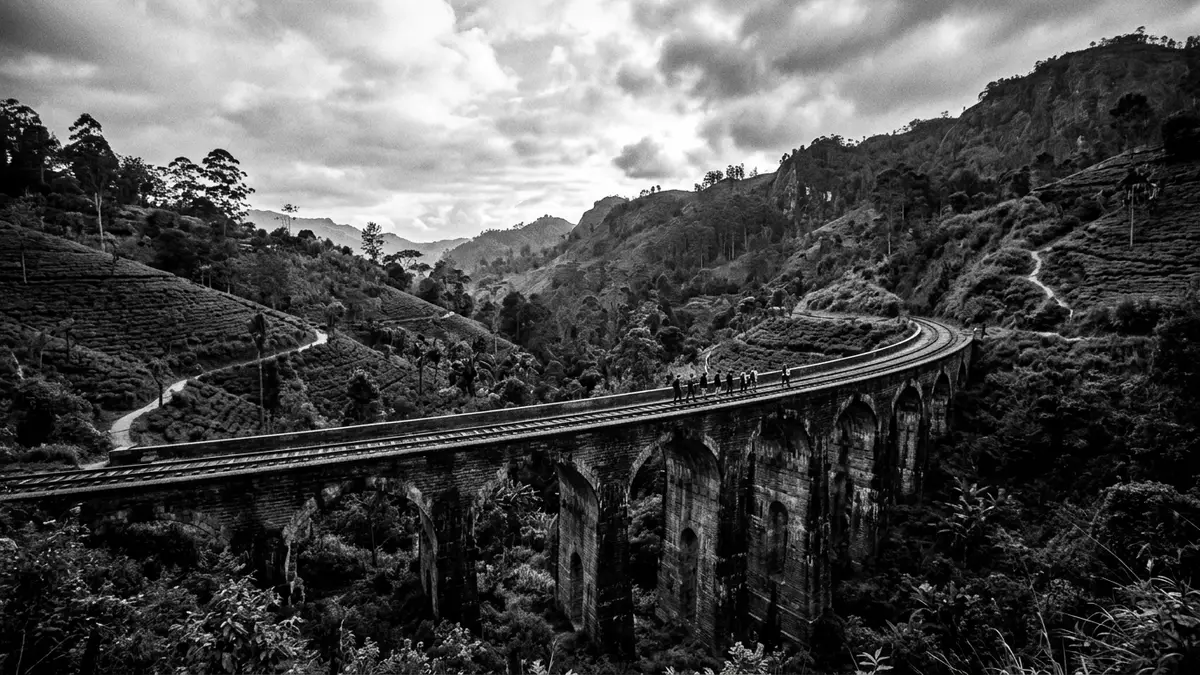
Nine Arch Bridge near Ella in Sri Lanka carries the island’s upcountry railway across a jungle valley on a series of stone arches that form a sweeping curve through the hills. Completed in the early twentieth century during British colonial rule, it stands as a substantial masonry viaduct within the Central Highlands and continues to serve the line between Ella and Demodara.
A stone viaduct on the upcountry railway
Nine Arch Bridge forms part of the hill-country section of the railway that climbs inland from the coastal plains towards Badulla, linking the stations of Ella and Demodara with a masonry viaduct over a forested ravine.The bridge in Ella is widely described as a notable example of colonial-era railway construction in Sri Lanka, built during the period when the country was administered as British Ceylon.Colonial-era railway construction
The viaduct carries the single railway track over a measured length close to 91 m (around 300 ft), with the deck standing about 24 m (roughly 80 ft) above the valley floor, figures that appear consistently in engineering and travel descriptions.Length and height around 91 m and 24 m The bridge stands at an elevation in the highlands recorded at around 3,100 ft above sea level, placing it within the cooler interior landscape rather than the coastal belt.Highland setting above sea level
Nine arches of brick, stone and cement
The structure takes its name from the sequence of nine masonry arches that support the deck, each arch springing from solid piers built of brick, stone and cement that have weathered into earthy tones against the surrounding greenery.Nine arches of stone and brick Descriptions of the bridge emphasise that it was constructed without structural steel in its main body, relying instead on masonry and concrete for strength, a feature that distinguishes it among railway bridges in Sri Lanka.Constructed without structural steel
The deck follows a gentle horizontal curve as it crosses the valley, aligning with the railway’s route through the hills and adding a visible sweep to the line of arches.Curved alignment of the bridge Locally the bridge is known in Sinhala as “Ahas Namaye Palama” or “Bridge of Nine Skies”, a name linked to the way the arches frame patches of sky when viewed from below along the valley floor.Local name Ahas Namaye Palama With its combination of masonry arches, curved alignment and forested backdrop, the viaduct offers clear views of both the engineering and the surrounding landscape from track level and from paths along the slopes.
Construction in the early twentieth century
Nine Arch Bridge belongs to the early twentieth-century expansion of the upcountry railway under the colonial administration of British Ceylon, a programme that extended the line from Bandarawela towards Badulla and required substantial structures at points where the terrain fell away into steep valleys.Expansion of the upcountry railway Construction of the bridge is described in engineering accounts as taking place in the 1910s, with completion recorded for 1919 and the viaduct brought into service in 1921 as part of the operational railway line.Completion in 1919 and commissioning in 1921
Technical descriptions identify Harold Cuthbert Marwood of the Railway Construction Department as the engineer responsible for the designs and for the work on the section of line that includes the bridge, under the approval of Chief Construction Engineer M. Cole Bowen and within a wider project that involved Ceylonese engineer D. J. Wimalasurendra on the upcountry railway programme.Marwood, Bowen and Wimalasurendra The structure was built at Gotuwala between Ella and Demodara by local labour under British supervision, using brick and stone throughout the arches and piers and concrete in key parts of the construction.Built at Gotuwala between Ella and Demodara
Visiting Nine Arch Bridge: what travellers from Western Europe should know
- Nine Arch Bridge lies in the hill-country around Ella in south-central Sri Lanka, on the railway line towards Demodara in the Central Highlands.
- The approaches to the bridge involve walking on uneven earth paths and slopes in a forested valley, with some sections on compacted soil and rock.
- The surrounding terrain includes jungle-covered hillsides and tea country, and views from near the track look out across the valley and surrounding plantations.
- The official language is Sinhala and the currency is the Sri Lankan rupee.
- Entry requirements depend on your nationality; UK travellers can check the FCDO travel advice at gov.uk/foreign-travel-advice, Irish travellers the Department of Foreign Affairs at ireland.ie.
Searching for Nine Arch Bridge on social platforms
These links open searches for Nine Arch Bridge on each platform.
Frequently asked questions about Nine Arch Bridge
Where is Nine Arch Bridge located?
Nine Arch Bridge is situated near the town of Ella in Sri Lanka’s Central Highlands, on the upcountry railway line between Ella and Demodara.
What can visitors expect at Nine Arch Bridge?
Visitors encounter a masonry railway viaduct with nine arches spanning a jungle valley, with paths along the slopes giving views of trains crossing the curved bridge.
What makes Nine Arch Bridge distinctive?
The bridge is distinctive for its nine brick and stone arches, its curved alignment over a forested ravine, and its early twentieth-century construction without structural steel in the main body.


