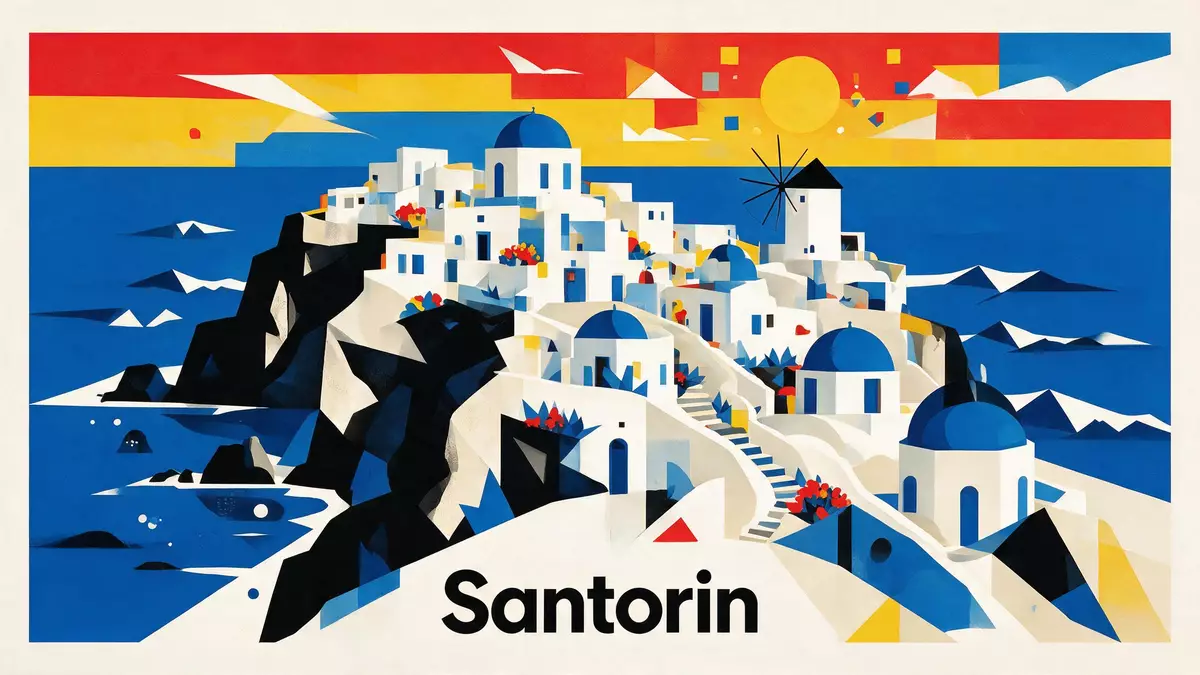
Oia’s whitewashed cliffside lanes above Santorin
Published on 08/11/2026 at 15:09 | Editorial responsibility: Rafael Müller, Editor-in-Chief AD HOC NEWS
Oia is the cliffside village on Santorin where whitewashed houses, churches and lanes follow the edge of the caldera. It sits on the northwestern tip of the island, in Greece, and its built fabric is closely tied to the volcanic landscape.
White houses above the caldera edge
The settlement is known for its compact houses carved into the slope, painted white with blue accents and flat roofs. Many buildings step down the cliff in terraces, with narrow lanes, small steps and doorways facing the sea.
The volcanic setting gives Oia its strong visual identity. Dark rock walls, pale plaster and the open water beyond form a sharp contrast that is visible from the lanes, the church terraces and the ridge above the caldera.
Churches, domes and former sea caves
Among Oia’s most recognisable features are its small churches with blue domes and bell towers. Some houses and store rooms take the form of cave dwellings cut into the soft volcanic rock, a traditional type found across Santorin.
The village layout is narrow and uneven, with passages that open to viewpoints and steps that run between layers of homes. That mix of built surfaces and exposed cliff gives Oia its particular character, especially in the older quarter.
A village shaped by island life
Oia belongs to the long history of settlement on Santorin, where stone, plaster and volcanic slopes shaped everyday building practice. The village has kept a human scale, even though its profile is widely associated with the island itself.
Visitors usually come for the walking routes, the views across the caldera and the dense cluster of houses on the ridge. The place works as both a living settlement and a landscape of architecture, where the village form is inseparable from the cliff.
Visiting Oia: what travellers from Western Europe should know
- The village is reached from Santorin’s main roads by bus, taxi or car, with walking paths linking parts of the cliff edge.
- Admission arrangements and opening hours are set by the site's operator and change with the season; the official website is the only binding source.
- Late afternoon and early evening bring the strongest light on the white facades, while quieter lanes open up earlier in the day.
- Steep steps, uneven paving and sloping lanes are part of the village fabric, so comfortable shoes matter.
- Greek is the local language, and euros are used for payment in shops and cafés.
- Entry requirements depend on your nationality. UK travellers should check the FCDO travel advice at gov.uk/foreign-travel-advice; Irish travellers the Department of Foreign Affairs at ireland.ie; EU and EEA citizens their own national foreign ministry.
Searching for Oia on social platforms
These links open searches for Oia on each platform.
Frequently asked questions about Oia
Where is Oia?
Oia is on Santorin in Greece, at the northwestern edge of the island above the caldera. It forms one of the best-known settlements on the island’s rim.
What can a visitor expect?
Expect narrow lanes, steps, whitewashed buildings and cliffside views across the water. The village is compact, so walking is the main way to experience it.
What makes Oia distinctive?
Its combination of volcanic cliff, cave-like dwellings, churches and terraced houses gives Oia a clear profile. The settlement reads as both a village and an architectural landscape.