
Okavango Delta, where a river ends in desert
Published on 09/22/2026 at 20:43 | Editorial responsibility: Rafael Müller, Editor-in-Chief AD HOC NEWS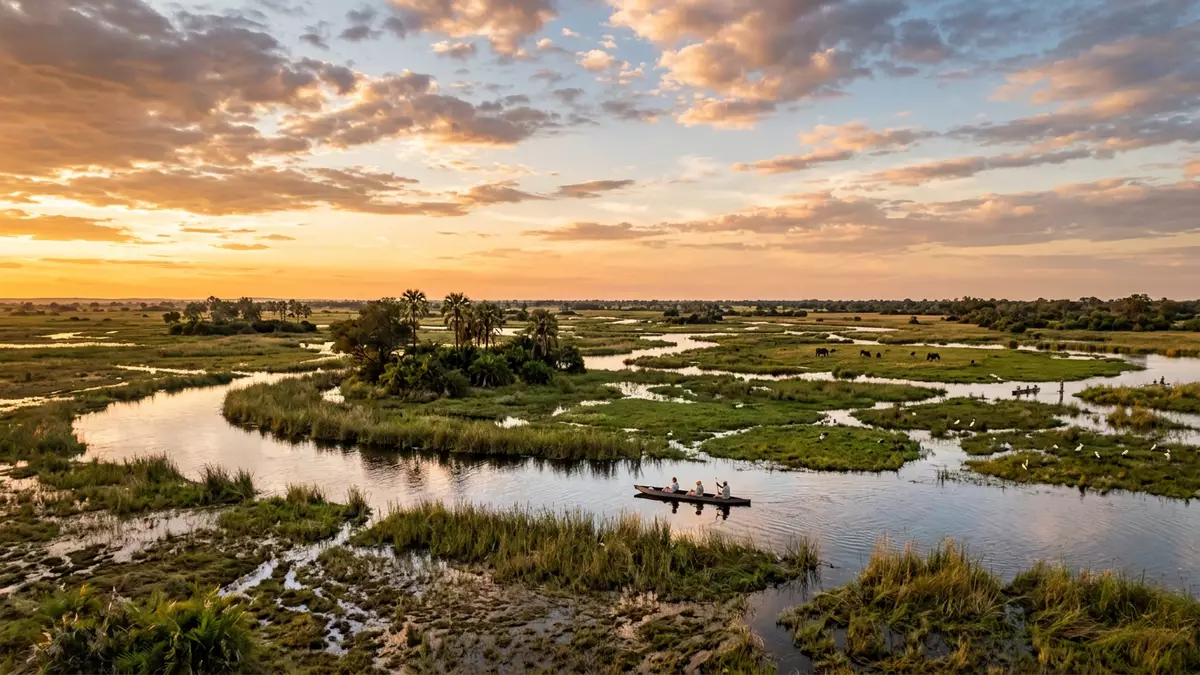
Okavango Delta is a vast inland wetland in north-western Botswana, where the Okavango River spreads across the Kalahari Basin instead of reaching the sea. Permanent marshes, seasonal floodplains, channels and islands form a landscape whose defining feature is water surrounded by desert.
Okavango Delta: a river dispersed across the Kalahari
The delta is a low-gradient alluvial fan, a broad deposit of sediment shaped by the river across the basin. Its waters disappear into Kalahari sands through evaporation and seepage, leaving no coastal outlet. The landscape is therefore a delta without a coastline, formed from channels that divide across a wide inland plain.
The Okavango River begins in the Angolan highlands and crosses the region before entering Botswana. In the delta, waterways connect permanent marshes with grasslands that flood seasonally. The precise extent of wet ground changes with the annual flood cycle, while the underlying fan remains a recognisable geographic form. UNESCO World Heritage property covers 2,023,590 hectares, with a buffer zone of 2,286,630 hectares.
Permanent marshes and seasonal floodplains
Okavango Delta contains permanent swamps alongside plains that receive floodwater at different points in the year. Open water, papyrus-lined channels, reed beds, lagoons, flooded grassland and dry islands sit within the same broad wetland system.
The flood pattern has an unusual seasonal rhythm. Water from the Angolan catchment reaches Botswana during the local dry season, when the surrounding Kalahari landscape is at its driest. This creates a changing mosaic of wet and dry habitats. Plants include grasses and water vegetation, while trees and shrubs occupy islands and firmer ground. annual flooding pattern is part of the delta’s ecological identity.
The wetland supports hippopotamuses, crocodiles, buffaloes, lions, cheetahs, elephants and antelope such as lechwe and impala. Birdlife includes fish eagles, storks and herons. The mixture of waterways, islands and floodplains provides several distinct habitats within the same regional landscape.
Maun and the living wetland landscape
Maun lies on the southern edge of the Okavango region and functions as the main urban gateway to the delta. From the town, travel into the wetland continues by road, light aircraft or water-based transport, depending on the destination and the character of the area being visited.
Water is not a single feature at Okavango Delta. It appears as a narrow channel between reeds, a broad floodplain, a lagoon, a seasonal sheet across grassland or a reflective surface beside an island. Land and water meet repeatedly across the alluvial fan, making the geography legible through changing vegetation and channel patterns.
The delta carries several layers of formal recognition. It became a Wetland of International Importance in 1996 and entered the UNESCO World Heritage List in 2014. The protected property is in Ngamiland, north-western Botswana, within the wider Okavango River Basin shared by Angola, Namibia and Botswana. wetland and heritage designations reflect the delta’s international status.
Visiting Okavango Delta: what travellers from Western Europe should know
- Okavango Delta lies in north-western Botswana, with Maun on its southern side. Maun Airport is the principal air gateway, and safari routes continue from town into the delta.
- Travel within the wetland may involve a four-wheel-drive vehicle, a light aircraft, a motorboat or a mokoro. A mokoro is a narrow dugout canoe used on shallow channels.
- The terrain combines water, reeds, mud, sand, grassland and islands. Routes can change with the flood cycle, and many areas are reached through waterways or unpaved tracks.
- The official language is English and the currency is the Botswana pula.
- Entry requirements depend on your nationality; UK travellers can check the FCDO travel advice at gov.uk/foreign-travel-advice, Irish travellers the Department of Foreign Affairs at ireland.ie.
Searching for Okavango Delta on social platforms
These links open searches for Okavango Delta on each platform.Frequently asked questions about Okavango Delta
Where is Okavango Delta?
Okavango Delta is in north-western Botswana, within the Kalahari Basin. Maun lies on its southern edge and is the principal town associated with access to the wetland.
What can travellers expect during a visit?
Visits can include journeys by four-wheel-drive vehicle, light aircraft, motorboat or mokoro. The landscape includes channels, lagoons, reeds, floodplains, islands and wildlife habitats.
What makes Okavango Delta distinctive?
Its river water spreads across an inland basin without reaching the sea. Permanent marshes and seasonal floodplains create a large wetland surrounded by the dry Kalahari landscape.


