
Old Trafford, Manchester’s theatre of football history
Published on 09/17/2026 at 21:26 | Editorial responsibility: Rafael Müller, Editor-in-Chief AD HOC NEWS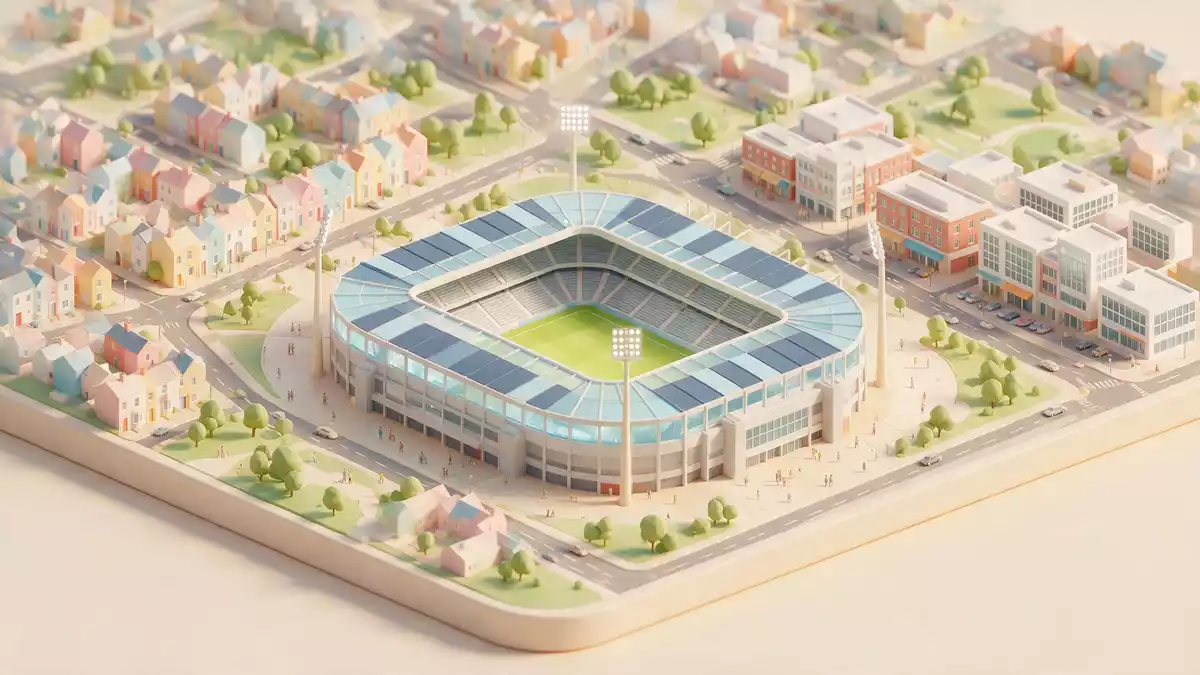
Old Trafford in Manchester is a football stadium where more than a century of architecture and match history can be read in terraces, stands and red seating. Opened in 1910 as the new home of Manchester United, it has grown from an early twentieth-century ground into one of the largest club stadiums in England, yet the pitch at its centre still holds the same rectangular field of play.
From Archibald Leitch’s early stadium to a rebuilt ground
Old Trafford was laid out in the years 1909 and 1910 under the supervision of Scottish architect Archibald Leitch, a specialist in football grounds whose work also appears at Goodison Park and Ibrox.Archibald Leitch The stadium officially opened on 19 February 1910, when Manchester United faced Liverpool in the first match at the new ground.opened on 19 February 1910 At that time Old Trafford consisted of a covered stand on one side and open terraces around the rest of the pitch, creating a bowl of standing spectators around a grass field.
The early Old Trafford had an initial capacity of around 80,000 spectators, making it one of the largest club stadiums in Britain in the years before the First World War.capacity of 80,000 spectators Bombing during the Second World War severely damaged the ground in March 1941, and Manchester United spent several seasons sharing Maine Road, the stadium of local rivals Manchester City, while Old Trafford was reconstructed.heavily damaged by a German bombing raid When the rebuilt stadium reopened on 24 August 1949, it returned as the club’s home with new structures but the same site beside Trafford Park.
World cups, European finals and growing stands
Through the second half of the twentieth century and into the twenty-first, Old Trafford has hosted international tournaments and major club fixtures that give the ground its global football profile. It staged matches during the 1966 FIFA World Cup in England, bringing national team football to the terraces in Trafford.1966 World Cup In 2003, the stadium was selected as the venue for the UEFA Champions League final between AC Milan and Juventus, a match that added a European title decider to its history of league fixtures and FA Cup ties.Champions League final in 2003
To accommodate larger seated crowds, Old Trafford has seen successive phases of expansion, particularly from the 1990s onwards. The conversion to an all-seater stadium and the addition of second tiers to the East and West Stands raised capacity significantly, and later infill structures in the corners beside the North Stand brought the number of seats to over 75,000.current capacity at Old Trafford is 75,454 The pitch dimensions of 105 m by 68 m (344 ft by 223 ft) follow international standards, so visiting supporters from Western Europe find a familiar playing area framed by towering stands and floodlight masts.pitch dimensions 105m x 68m
The Theatre of Dreams on Sir Matt Busby Way
Old Trafford stands in the borough of Trafford, just south-west of central Manchester, reached along Sir Matt Busby Way from the surrounding streets. The stadium’s enduring nickname, “The Theatre of Dreams”, is associated with Bobby Charlton, whose playing career with Manchester United and England links the ground with mid-twentieth-century football success.Theatre of Dreams On match days, the red and white colours of the club are visible across banners, seating and shirts, while statues and memorials around the exterior mark figures from the club’s history.
Since 2011 the large stand on the north side of the pitch has carried the name Sir Alex Ferguson Stand, honouring the manager whose years in charge brought league titles and European trophies to Manchester United.Sir Alex Ferguson Stand Around the outside of Old Trafford, brick and concrete structures frame approach routes, turnstiles and concourses, while inside the seating rises in tiers that give views down across the grass playing surface. For visitors, the combination of early twentieth-century origins, post-war rebuilding and later enlargements makes the stadium a layered piece of football architecture as well as a place to watch matches.
Visiting Old Trafford: what travellers from Western Europe should know
- Old Trafford stands in Trafford, south-west of Manchester city centre, and is reached by local rail and tram services as well as roads serving Sir Matt Busby Way.
- The stadium interior is arranged across several tiers of seating, and accessing higher levels involves climbing staircases or using concourse routes around the stands.
- Outside the ground, the area around Sir Matt Busby Way includes club facilities, statues and a megastore, giving visitors named points of interest beyond the pitch itself.
- The official language is English and the currency is the pound sterling.
Searching for Old Trafford on social platforms
These links open searches for Old Trafford on each platform.
Frequently asked questions about Old Trafford
Where is Old Trafford located?
Old Trafford is a football stadium in the borough of Trafford, just outside central Manchester in north-west England.
What can visitors expect on a visit to Old Trafford?
Visitors encounter a large football ground with tiered stands, statues and club facilities around Sir Matt Busby Way, centred on a full-sized grass pitch.
What makes Old Trafford distinctive among football stadiums?
Its combination of Archibald Leitch’s early twentieth-century design, wartime reconstruction, European finals and Manchester United’s long tenancy gives Old Trafford a layered football heritage.


