
Osun-Osogbo Sacred Grove: forest, river and sacred art in Osogbo
Published on 08/14/2026 at 14:55 | Editorial responsibility: Rafael Müller, Editor-in-Chief AD HOC NEWS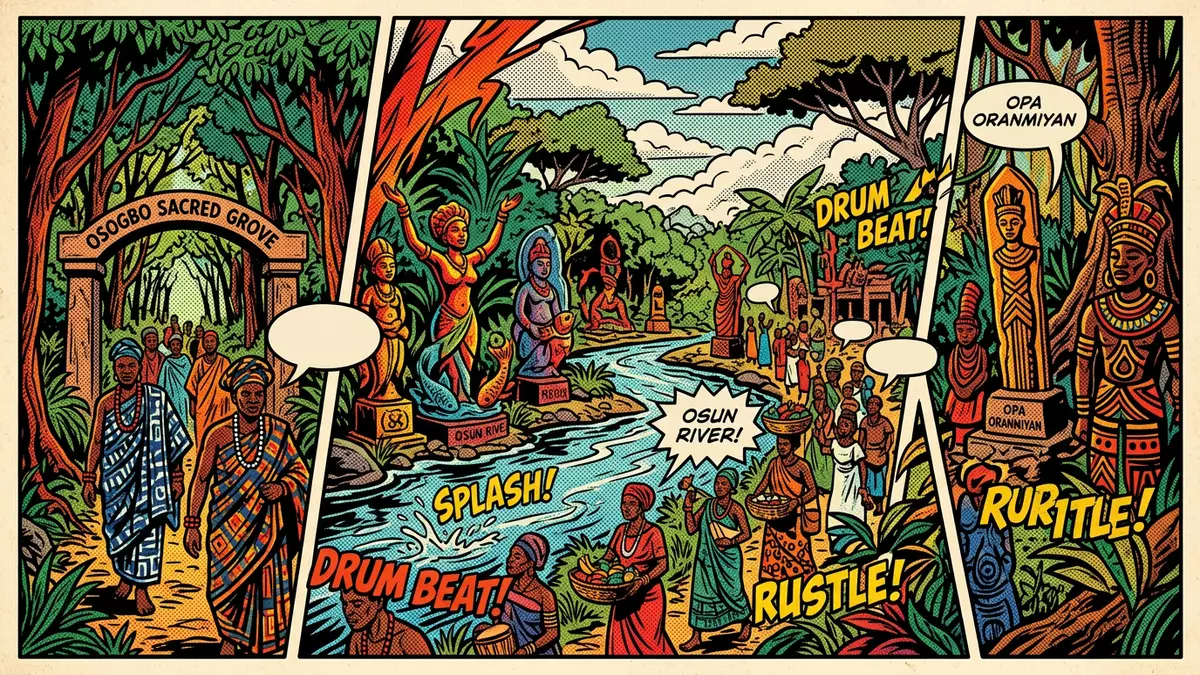
On the outskirts of Osogbo in south-western Nigeria, Osun-Osogbo Sacred Grove brings together dense riverine forest, Yoruba spirituality and monumental contemporary shrine art in a single landscape. The grove follows the course of the Osun River and has been formally recognised as a UNESCO World Heritage Site since 2005, reflecting its role as a major sanctuary in Yoruba religious life and its status as one of the last sizeable sacred forests associated with a Nigerian city.
Forest sanctuary along the Osun River
Osun-Osogbo Sacred Grove lies beside the Osun River on the edge of Osogbo, the capital of Osun State in south-western Nigeria. The protected area covers around 75 hectares (185 acres) of enclosed forest, with an additional buffer zone of several dozen hectares surrounding the core, and it is described in UNESCO documentation as a cultural landscape where undisturbed woodland and ritual structures coexist.covers around 75 hectares Within this ring-fenced forest the Osun River meanders through trees, clearings and shrine compounds, providing the axis along which paths and sacred spaces are arranged.
The grove is characterised by high forest typical of humid southern Nigeria, with broad-canopied trees, undergrowth and occasional open glades where shrines and sculptures stand. It represents one of the last remnants of primary high forest associated with a Yoruba urban centre, and its continued protection has preserved habitats for birds, small mammals and diverse plant species alongside the ritual structures.one of the last remnants of primary high forest Moving through the grove, visitors encounter a sequence of clearings, river banks and shaded paths that frame altars, shrines and sculptural ensembles dedicated to different deities.
Sacred site of Osun and Yoruba religious life
Osun-Osogbo Sacred Grove is dedicated to Osun, the Yoruba goddess of fertility, and functions as a major centre of traditional Yoruba religion.dedicated to Osun, the Yoruba goddess of fertility Altars and shrines along the river banks and within the forest honour Osun herself and other deities from the Yoruba pantheon, reflecting a long history of ritual practice associated with water, fertility and the protection of the town. Osogbo, which is generally dated to a foundation around four centuries ago, has long been linked to the grove through oral traditions that connect the town’s origin stories to the Osun River and the deity’s favour.foundation around four centuries ago
Within the grove, dozens of shrines, pavilions and sculptural groups mark sites of regular worship and occasional major ceremonies. Documentation linked to the site notes more than forty shrines and sculptures in honour of Osun and other West African deities, creating a landscape where religion is expressed through architecture and art as much as through ritual performance.more than forty shrines and sculptures The grove’s recognition as a World Heritage Site under cultural criteria (ii), (iii) and (vi) highlights both its continuing religious significance and its role as a repository of Yoruba cultural memory.
New Sacred Art Movement and monumental sculptures
Alongside its older shrines and altars, Osun-Osogbo Sacred Grove is closely associated with a twentieth-century flowering of sacred art linked to the Austrian-born artist Susanne Wenger and a group of Yoruba artists sometimes referred to as the New Sacred Art Movement.Susanne Wenger and a group of Yoruba artists From the mid-twentieth century Wenger and local collaborators created large-scale sculptures and architectural forms within the grove, using materials such as concrete, metal and carved wood to give physical presence to deities, myths and ritual spaces.
These works, integrated into the forest and along the river, contributed to the grove’s preservation and have become central to its visual identity. Monumental sculptural ensembles frame pathways, river crossings and shrine courtyards, often combining abstracted human and animal forms with symbolic patterns drawn from Yoruba cosmology.monumental sculptural ensembles The result is a landscape where contemporary sacred art and older ritual spaces stand together beneath the forest canopy, giving visitors a sense of how creative practice and religious observance intertwine in the grove.
Visiting Osun-Osogbo Sacred Grove: what travellers from Western Europe should know
- Osun-Osogbo Sacred Grove lies on the outskirts of Osogbo in Osun State in south-western Nigeria, reached from the town by road following the course of the Osun River.
- Within the grove, paths between shrines and river banks can involve uneven ground, roots and occasional steps, so visitors move along forest tracks rather than paved streets.
- In Nigeria the official language is English and the currency is the Nigerian naira.
- Entry requirements depend on your nationality; UK travellers can check the FCDO travel advice at gov.uk/foreign-travel-advice, Irish travellers the Department of Foreign Affairs at ireland.ie.
Searching for Osun-Osogbo Sacred Grove on social platforms
These links open searches for Osun-Osogbo Sacred Grove on each platform.
Frequently asked questions about Osun-Osogbo Sacred Grove
Where is Osun-Osogbo Sacred Grove located?
Osun-Osogbo Sacred Grove lies along the Osun River on the outskirts of Osogbo in Osun State in south-western Nigeria, in forest just beyond the town.
What can visitors expect during a visit?
Visitors encounter enclosed forest with river banks, shrines, altars and monumental sculptures, linked by earthen paths that weave between trees and sacred spaces.
What makes Osun-Osogbo Sacred Grove distinctive?
The grove combines a sizeable protected forest, an active centre of Yoruba religious practice dedicated to Osun and a notable body of twentieth-century sacred sculpture integrated into the landscape.


