
Osun-Osogbo Sacred Grove: forest, river and Yoruba spirituality
Published on 09/18/2026 at 18:52 | Editorial responsibility: Rafael Müller, Editor-in-Chief AD HOC NEWS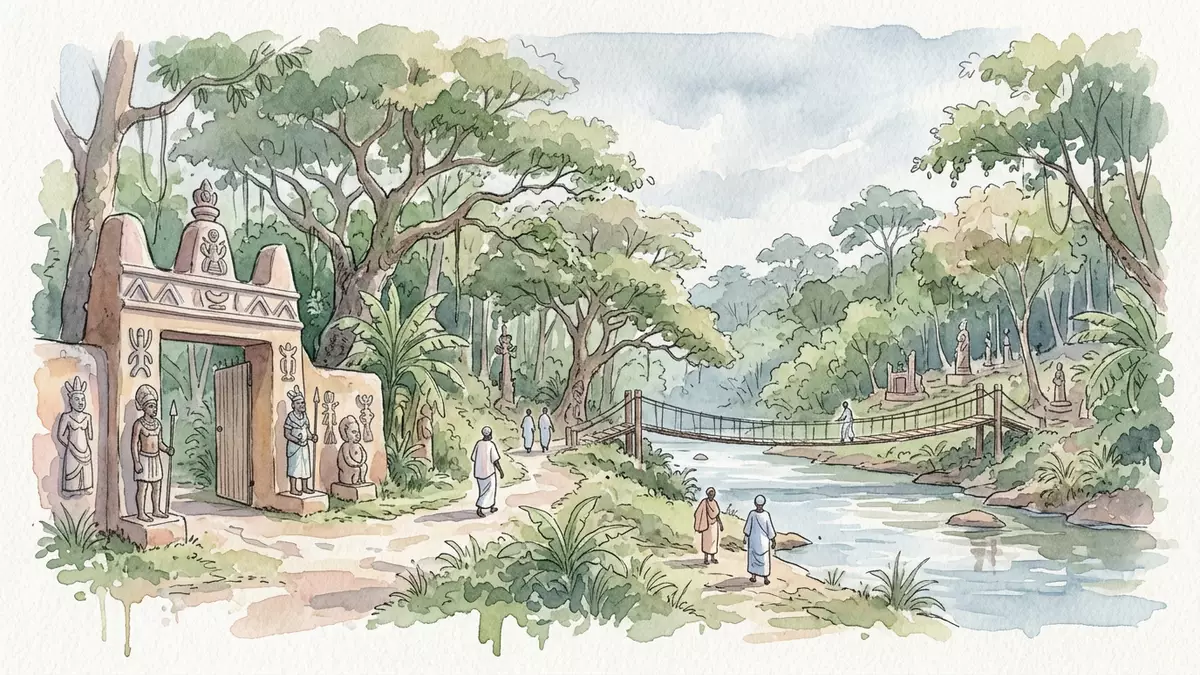
Osun-Osogbo Sacred Grove on the outskirts of Osogbo in south-west Nigeria is a dense forest sanctuary where the Osun River winds past shrines, sculptures and ritual spaces dedicated to the Yoruba goddess Osun.dense forest sanctuary Recognised in 2005 as a UNESCO World Heritage Site for its cultural significance, the grove preserves a rare combination of undisturbed woodland and an active spiritual landscape.inscribed as a UNESCO World Heritage Site in 2005
Forest, river and sacred landscape
The Osun-Osogbo Sacred Grove covers about 75 ha (around 190 acres) of primary forest along the banks of the Osun River, forming a continuous canopy above winding paths.covering about 75 hectares The woodland is described as a largely undisturbed area of high forest, with mature trees and an understorey that supports a rich variety of plant species, including many used in Yoruba medicinal practice.undisturbed primary forest along the banks of the Osun river
Flowing through the grove, the Osun River is central to the site’s identity, marking out clearings and sacred zones where shrines stand close to the water. The river bends around altars and pavilions, and paths cross it at selected points so that movement through the grove alternates between enclosed forest and open riverbank. Along the route, the composition of forest, river and built structures turns the woodland into a layered ritual landscape rather than a simple stand of trees.runs along the banks of the Osun River
Shrines, sculptures and Yoruba cosmology
The grove forms a continuous sequence of shrines and sanctuaries dedicated to Osun and other deities of the Yoruba pantheon, set among the trees and beside the river. Buildings range from enclosed shrines with altars to open platforms used for offerings and ceremonies, all integrated into the forest setting rather than separated from it.sanctuaries and shrines, sculptures and artworks Many structures are built in earth and stone, with carved panels and symbolic motifs that refer to river, fertility and protection.
Modern sculptures stand alongside older shrines, forming a broad collection of artworks that express Yoruba cosmology in physical form. Figures of deities, spirit beings and abstract forms line paths, cluster around clearings and mark processional routes, so that walking through the grove means passing constant visual reminders of stories and rituals embedded in the landscape.tangible expression of Yoruba divinatory and cosmological systems The combination of ritual buildings, sculptural ensembles and natural setting is one reason the grove is recognised internationally as a cultural landscape of outstanding universal value.cultural landscape of undisturbed forest
Osun-Osogbo Sacred Grove and Yoruba heritage
The grove lies just outside Osogbo, the capital of Osun State in south-west Nigeria, and is closely tied to the identity of Yoruba communities across the region.capital of Osun State in southwest Nigeria Dedicated to Osun, the goddess of fertility, the protected forest has been associated with worship and ritual for more than four centuries, and continues to serve as a pilgrimage centre where religious activities take place throughout the year.dedicated to Osun, the Yoruba goddess of fertility Its recognition on the World Heritage List in July 2005 marked Nigeria’s second inscription and highlighted the importance of Yoruba cultural landscapes in global heritage discussions.inscribed on the World Heritage List on 15th July, 2005
Within Yoruba tradition, sacred groves once existed near many settlements; Osun-Osogbo Sacred Grove stands out as a large surviving example where the relationship between people, ruler and deity is expressed in space and ritual. The forest shelters tangible heritage in the form of shrines and sculptures, and intangible heritage through ongoing ceremonies, offerings and processions linked to the Osun River and the surrounding woodland.repository of the fundamental values of the tangible and intangible cultural heritage
Visiting Osun-Osogbo Sacred Grove: what travellers from Western Europe should know
- The grove lies on the outskirts of Osogbo in Osun State in south-west Nigeria and is reached by road from the city, with approaches that lead towards forest entrances.
- Paths through the grove follow uneven woodland terrain, with natural surfaces, tree roots and gentle gradients; visiting the shrines and sculptures involves walking between clearings and riverbank areas.
- The official language is English and the currency is the Nigerian naira.
- Entry requirements depend on your nationality; UK travellers can check the FCDO travel advice at gov.uk/foreign-travel-advice, Irish travellers the Department of Foreign Affairs at ireland.ie.
Searching for Osun-Osogbo Sacred Grove on social platforms
These links open searches for Osun-Osogbo Sacred Grove on each platform.Frequently asked questions about Osun-Osogbo Sacred Grove
Where is Osun-Osogbo Sacred Grove located?
Osun-Osogbo Sacred Grove lies along the Osun River just outside Osogbo in Osun State in south-west Nigeria, in a protected forest area.
What should visitors expect during a visit?
A visit involves walking along forest paths beside the river, passing shrines, sanctuaries and sculptural installations that form an active Yoruba spiritual landscape.
What makes Osun-Osogbo Sacred Grove distinctive?
The grove combines primary forest, a sacred river, shrines and modern sculptures in one continuous cultural landscape recognised as a UNESCO World Heritage Site.


