
Palacio Real de Madrid and its stone court palace
Published on 08/19/2026 at 23:00 | Editorial responsibility: Rafael Müller, Editor-in-Chief AD HOC NEWS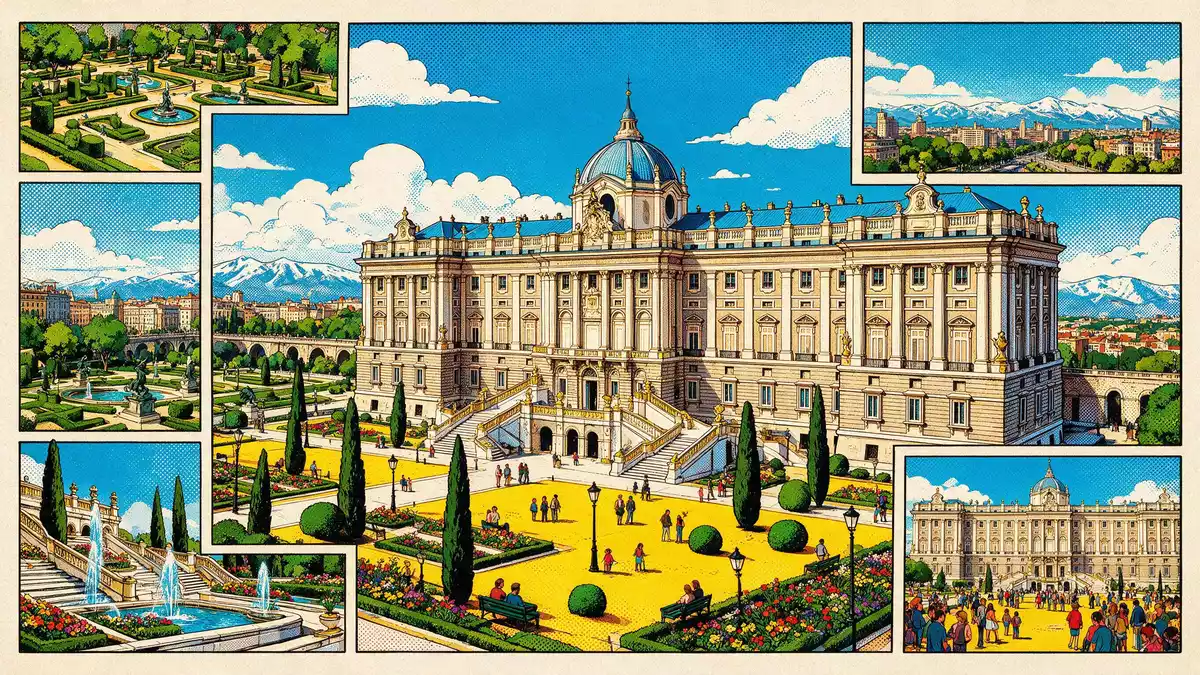
Palacio Real de Madrid rises in Madrid as a large royal palace of stone and brick, with a ceremonial role that is clear from its formal state interiors. Its 18th-century core, tied to Philip V and Juan Bautista Sacchetti, gives the building its lasting identity.
Baroque mass and classical order in central Madrid
The palace occupies a prominent central site in Madrid and forms part of the city’s historic royal landscape. Its long façades and courtyard plan create a broad, measured composition that reads as both palace and state stage.
Philip V set the royal project in motion after the old Alcázar burned in 1734, and the new palace was developed in the Bourbon period. Building work started in 1738 and the finished palace belongs to the middle of the eighteenth century.
Stone, brick and ceremonial rooms
The exterior is faced in pale masonry, while the palace interior contains rooms arranged for formal use and official display. The contrast between the heavy exterior mass and the ordered state rooms is one of the clearest features of the building.
Giovanni Battista Sacchetti is the name most closely associated with the project’s execution, alongside other Italian and Spanish figures who worked on the palace. Charles III gave the palace its enduring ceremonial importance through royal use and interior refinement.
The palace after the Bourbon rebuild
Palacio Real de Madrid is not a surviving medieval castle, but an 18th-century rebuild on a royal site with a longer history. That layered background gives the place depth without changing the palace’s own identity as a Baroque-and-Classical royal residence.
The name links it to the Spanish monarchy, yet the building itself is the main attraction: an urban palace with broad façades, formal rooms and a strong ceremonial character. Its scale and finish make it one of Madrid’s defining historic buildings.
Visiting Palacio Real de Madrid: what travellers from Western Europe should know
- The palace stands in central Madrid on Calle de Bailén, within reach of the Ópera area. The site is served by the Madrid Metro and city transport.
- The building is large and formal, with extensive interior rooms and long façades. Expect a palace rather than a compact townhouse.
- The surrounding streets and royal quarter place it close to other central landmarks. That makes it easy to combine with a walk through historic Madrid.
- The official language is Spanish and the currency is the euro.
Searching for Palacio Real de Madrid on social platforms
These links open searches for Palacio Real de Madrid on each platform.
Frequently asked questions about Palacio Real de Madrid
Where is Palacio Real de Madrid?
It stands in central Madrid on Calle de Bailén, close to the Ópera area. The palace belongs to the city’s royal and civic core.
What does a visit involve?
The palace presents a sequence of formal rooms, a strong stone exterior and an expansive urban presence. It feels like a ceremonial residence rather than a domestic house.
What makes it distinctive?
The combination of Bourbon patronage, Sacchetti’s involvement and the eighteenth-century rebuild gives it a clear historical identity. Its measured façades and state interiors define the place.


