
Palacio Real de Madrid and its stone monarchy above the Manzanares
Published on 09/18/2026 at 09:34 | Editorial responsibility: Rafael Müller, Editor-in-Chief AD HOC NEWS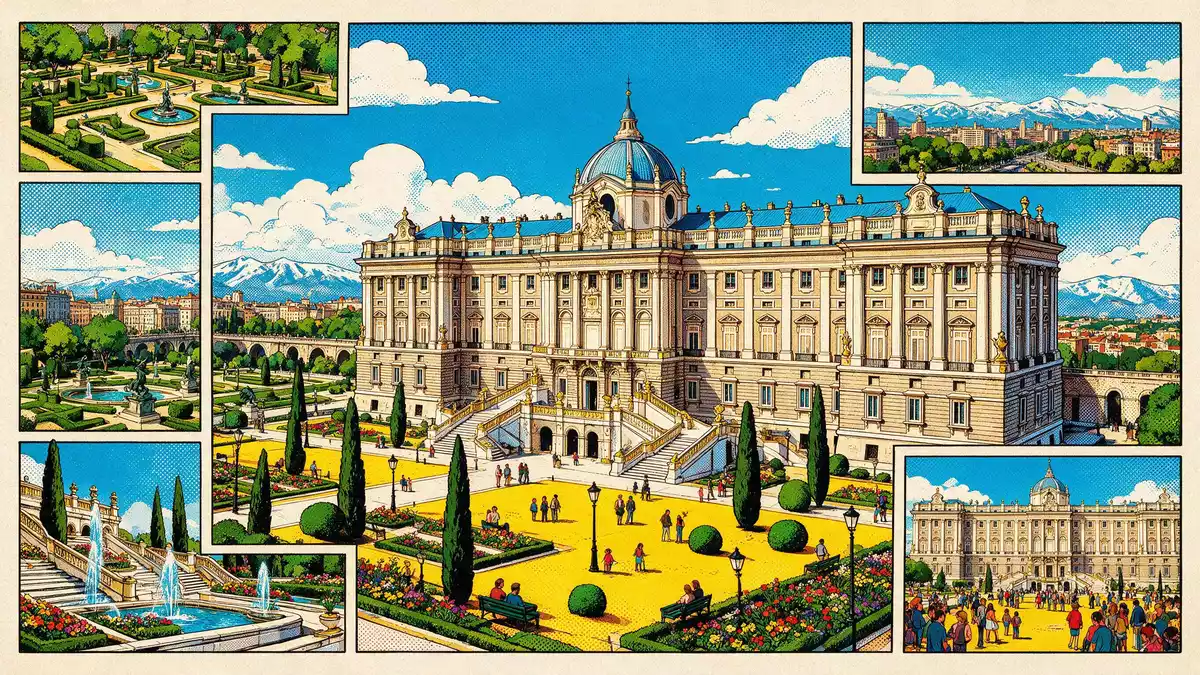
Palacio Real de Madrid stretches along Madrid’s western edge as an immense stone rectangle, raised above the Manzanares valley and facing the modern city across formal terraces. Built for the Bourbon dynasty in the eighteenth century, it replaced the Habsburg Alcázar destroyed by fire in 1734 and became Spain’s principal royal residence under Charles III.
A stone citadel for the Bourbon court
The story of Palacio Real de Madrid begins on a ridge first occupied by a Muslim fortress in the ninth century, guarded as an outpost for the Emir of Córdoba and later absorbed into the Kingdom of Castile.site first occupied by a 9th-century fortress That fortress evolved into the Royal Alcázar, the Habsburg palace that dominated Madrid until a catastrophic fire on 24 December 1734 cleared the platform above the river.Alcázar burned down in 1734
Philip V, the first Bourbon king of Spain, ordered a new palace on the same ground, commissioning Italian architect Filippo Juvarra to prepare a grand Baroque scheme.Philip V decided to construct a grand palace Juvarra’s plans were adapted and realised by Giovanni Battista Sacchetti, working with architects including Francesco Sabatini and Ventura Rodríguez, and construction proceeded from 1738 into the mid-eighteenth century.construction spanned from 1738 to 1755 The building was first occupied as a royal residence in 1764 by Charles III, who made Palacio Real de Madrid the ceremonial heart of the Spanish monarchy.
Baroque massing and Classical order in stone
From the plaza side, Palacio Real de Madrid reads as a regular block framed by repetitive bays, with a ground storey of rusticated granite and upper storeys in pale limestone that catch the high Castilian light.luminous limestone and rugged granite The architectural style blends Baroque ambition with Classical restraint: heavy corner pavilions and a strong cornice mark the edges, while evenly spaced columns and pilasters organise the façades into long horizontal runs.Baroque massing with Classical order
Behind the stone envelope lies an interior renowned for marble stairways, stucco ceilings and gilded woodwork, shaped over successive reigns from the eighteenth into the nineteenth century.blend of Baroque and Neoclassical styles State apartments, council chambers, a chapel and galleries are arranged along formal axes around courtyards, a sequence designed for processions and audiences rather than domestic intimacy.processional planning with courtyards and axes Although the Spanish royal family resides elsewhere, Palacio Real de Madrid functions as a ceremonial palace where rooms such as the main staircase and throne hall still host state occasions amid paintings by Velázquez, Goya and other court artists.decorated by artists such as Velázquez and Goya
A palace between cathedral, gardens and city
The palace occupies a dominant position above the Manzanares River, its western side descending in terraces towards wooded slopes and formal gardens, including the Sabatini Gardens named for architect Francesco Sabatini.gardens named in his honour To the south stands Almudena Cathedral, sharing the platform and setting up a dialogue between royal residence and episcopal seat along the same urban edge.
On the east, Plaza de la Armería and other open spaces connect Palacio Real de Madrid to Madrid’s historic centre, with broad paved approaches that emphasise the width of the main façade. The building’s footprint extends across roughly 135,000 m², making it one of Western Europe’s largest royal palaces by area and giving its outer walls a monumental, continuous presence above the older streets below.occupying an area of 135,000 square metres Within this shell, more than three thousand rooms form a dense architectural world, from richly decorated salons to armoury spaces that record Spain’s dynastic history.3,418 rooms across 135,000 m²
Visiting Palacio Real de Madrid: what travellers from Western Europe should know
- Palacio Real de Madrid stands on the western side of central Madrid, above the Manzanares valley, with approaches from streets such as Calle de Bailén.
- The palace complex rises on a high ridge with broad exterior stairways and large paved areas; visiting the state rooms involves walking through long corridors and spacious halls.
- The official language is Spanish and the currency is the euro.
Searching for Palacio Real de Madrid on social platforms
These links open searches for Palacio Real de Madrid on each platform.
Frequently asked questions about Palacio Real de Madrid
Where is Palacio Real de Madrid located?
Palacio Real de Madrid stands on a ridge above the Manzanares River on the western side of central Madrid, connected to the historic centre by plazas and streets.
What should visitors expect inside Palacio Real de Madrid?
Visitors encounter formal state rooms, grand stairways and long corridors arranged around courtyards, with interiors finished in marble, stucco and gilded wood.
What makes Palacio Real de Madrid distinctive among European palaces?
Its combination of Baroque massing, Classical façades and a vast stone footprint on the site of a former medieval fortress gives Palacio Real de Madrid a particular place in Spain’s dynastic story.


