
Palacio Real de Madrid on Madrid’s western ridge
Published on 09/21/2026 at 07:58 | Editorial responsibility: Rafael Müller, Editor-in-Chief AD HOC NEWS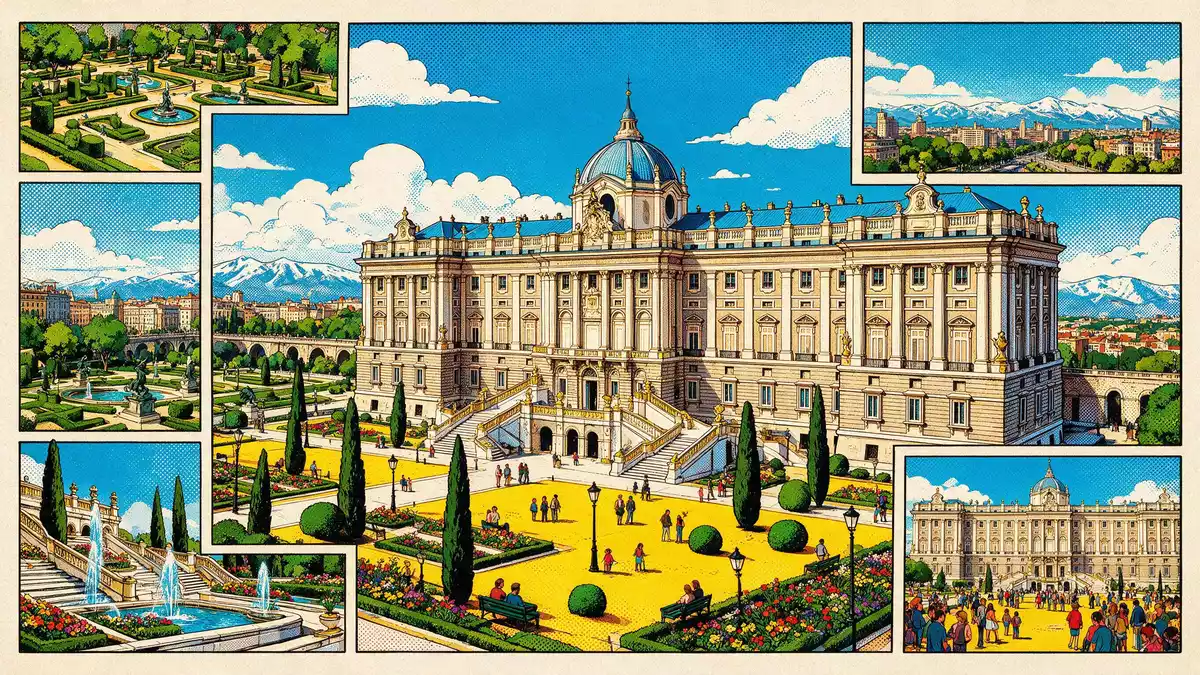
Palacio Real de Madrid stands on the western ridge of Madrid as a vast stone palace, aligned with the Manzanares valley and the surrounding formal gardens. Completed in the eighteenth century as a royal residence for the Spanish Bourbons, it remains the official palace of the Spanish monarch even though the royal family lives elsewhere.
A stone colossus above the Manzanares
The Royal Palace occupies a prominent site in the western part of central Madrid, close to the drop towards the Manzanares river and facing the Cathedral of Santa María la Real de la Almudena across its main forecourt.western part of central Madrid Its principal address is on Calle de Bailén, where the long elevation runs parallel to the ridge, while Plaza de Oriente forms a formal square on the eastern side between the palace and the opera house.Calle Bailén s/n
The building is constructed in limestone and granite, giving the façades a light upper storey above a more rugged base that responds to the underlying escarpment.luminous limestone and rugged granite In plan it forms an immense rectangle organised around courtyards, with long straight wings and corner blocks that underline its role as a palace rather than a single isolated block. The dimensions are substantial: the palace offers over 135,000 m2 (1,450,000 sq ft) of floor space and contains 3,418 rooms, making it the largest royal palace in Europe and one of the largest palaces in the world.over 135,000 m2 of floor space
From Alcázar site to Bourbon residence
The ground on which Palacio Real de Madrid stands has been occupied for many centuries, long before the present palace’s construction in the eighteenth century.site first occupied by a 9th-century Islamic fortress In the medieval period it housed a fortress and then the Alcázar of Madrid, which became the principal residence of the Spanish Habsburg monarchs in the sixteenth century.Alcázar of Madrid That earlier residence burned down in a devastating fire in 1734, clearing the way for a new palace on the same ridge.
King Philip V, the first Bourbon ruler of Spain, commissioned the Sicilian architect Filippo Juvarra to design the new palace in the 1730s, drawing on French and Italian precedents for a grand dynastic residence.Philip V commissioned Filippo Juvarra After Juvarra’s death, Giovanni Battista Sacchetti and Spanish architects adapted the project, and the palace was built largely in stone and brick between 1738 and 1764.building work started in 1738 and was completed in 1764 Charles III made the new palace his residence from 1764, and later monarchs such as Ferdinand VII and Alfonso XII remodelled parts of the interior as tastes and court ceremonial evolved.
State rooms, collections and gardens
Although Palacio Real de Madrid is the official residence of the Spanish monarch, the royal family lives in the Palacio de la Zarzuela on the outskirts of Madrid and the palace is used primarily for state ceremonies and formal receptions.used primarily for state ceremonies Large halls and richly decorated rooms form the ceremonial route, with spaces arranged in sequences that reflect eighteenth- and nineteenth-century court life.
The building also houses extensive collections and functions as a museum open to visitors on many days.open to the public as a museum To the north of the palace lie the Sabatini Gardens, laid out on terraces that step down towards the city and named after the Italian architect Francesco Sabatini, who worked on later phases of the complex.gardens named in his honour South-west of the palace, the Campo del Moro gardens descend towards the Manzanares and offer long views back to the palace’s stone façades.
Visiting Palacio Real de Madrid: what travellers from Western Europe should know
- Palacio Real de Madrid stands in the Palacio district of central Madrid, with its principal entrances on Calle de Bailén and the Plaza de Oriente near the Ópera metro station.
- The palace interior includes long enfilades of rooms and broad staircases; a visit involves walking across polished stone floors and up and down stair flights.
- The official language is Spanish and the currency is the euro.
Searching for Palacio Real de Madrid on social platforms
These links open searches for Palacio Real de Madrid on each platform.
Frequently asked questions about Palacio Real de Madrid
Where is Palacio Real de Madrid located within the city?
Palacio Real de Madrid stands on Calle de Bailén in the Palacio neighbourhood of central Madrid, close to Plaza de Oriente and overlooking the Manzanares valley.
What can visitors expect inside the palace?
Visitors encounter long sequences of ceremonial rooms, grand staircases and museum spaces displaying historic collections, all housed within extensive stone-built wings and courtyards.
What makes Palacio Real de Madrid distinctive among European palaces?
Its vast floor area, thousands of rooms and ridge-top position above the Manzanares river combine with its role as Spain’s official royal palace to give it particular prominence.


