
Palafitos de Chiloe, wooden stilt houses along Castro’s tide
Published on 08/25/2026 at 21:45 | Editorial responsibility: Rafael Müller, Editor-in-Chief AD HOC NEWS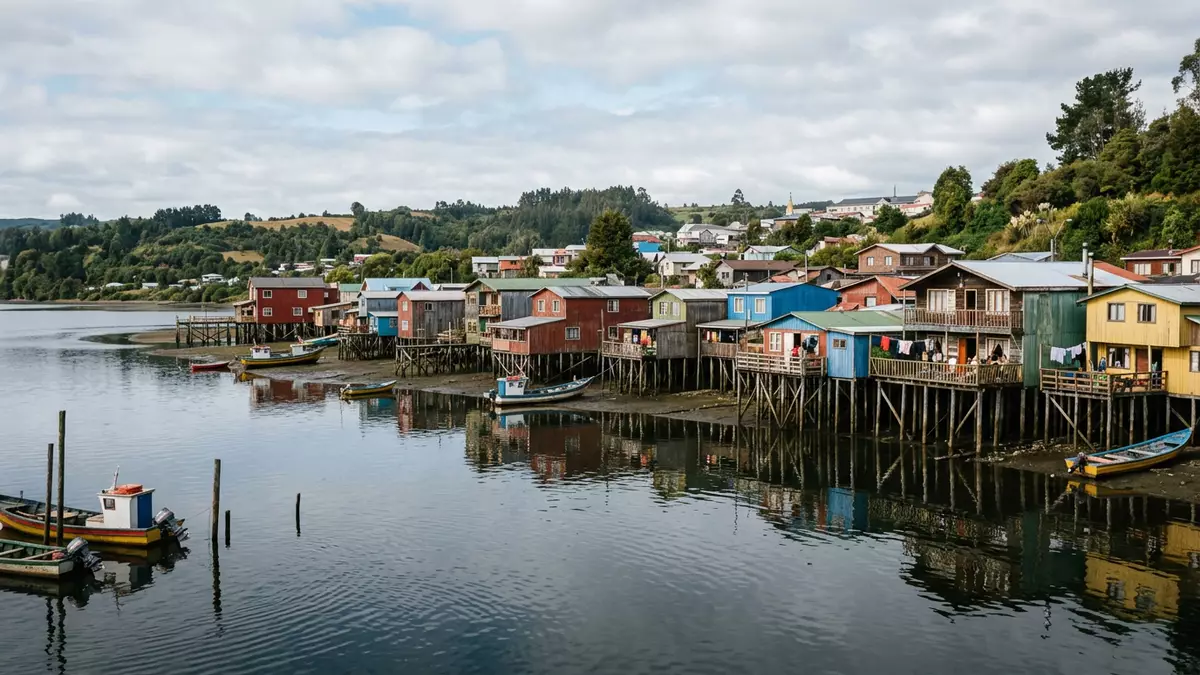
In Castro, the capital of the Chiloe archipelago in southern Chile, the Palafitos de Chiloe form rows of wooden stilt houses that step directly into the tidal waterfront. Their timber frames rise on piles planted in the mudflats, giving each house two faces: one to the street and another to the inlet, where boats once clustered under the verandas.
Wooden houses suspended between land and sea
The Palafitos de Chiloe are built of native woods, with piles driven into the seabed and façades clad in boards and wooden tiles that resist the damp coastal climate.Architecture of the palafitos of Castro Many houses present a street frontage linked by narrow bridges or walkways, while their rear frontage opens onto the canal as a terrace-like platform above the water.Palafitos en la isla de Chiloe
This dual orientation gives the houses an unusual profile along the shore, with colourful façades raised on tall timber piles and the rhythm of balconies and small decks repeating along the bay.The Chiloe architecture: the palafitos in Castro At high tide, the piles stand submerged and the houses appear to float; at low tide, the mudflats emerge beneath them and the bridge-like structure becomes more visible.
A nineteenth-century waterfront shaped by fishing life
Palafito construction on Chiloe gained strength in the late nineteenth century, when rural families and fishing communities moved towards Castro’s shoreline in search of space close to the water.Los palafitos de Castro The houses offered direct access to the tidal channels, with the lower level used for fishing work and the upper terrace serving as an outdoor patio above the boats.Los palafitos de Chiloé - Chile Para Niños
Castro holds the largest concentration of these stilt houses on the Chiloe archipelago, and the groups along the waterfront became part of a wider pattern of mixed wooden architecture shaped by indigenous Huilliche traditions and Spanish colonial building methods.Castro palafitos on the waterfront The palafitos are now recognised as an element of Chilote architectural heritage and remain woven into the everyday fabric of the city’s bayside neighbourhoods.Palafitos de Chiloé: arquitectura patrimonial
Neighbourhoods along Pedro Montt and Gamboa
The Palafitos de Chiloe are most visibly grouped along the Pedro Montt sector of Castro’s waterfront and in the Gamboa neighbourhood, where rows of stilt houses line the river mouth and city bay.Pedro Montt and Gamboa neighbourhoods From the opposite bank of the Gamboa river, visitors can see a continuous band of wooden houses raised above their piles, with small boats moored below some of them.Stilt houses in Castro on the Chiloe archipelago
Along Pedro Montt Street, another group of palafitos follows the curve of the shoreline, creating a sequence of façades that mark the change between the urban grid and the inlet.See Chile's palafitos: Castro, Chiloe Island These waterfront districts form a distinctive edge to Castro, where compact houses, timber structures and the tidal range share the same narrow strip of land and water.
Visiting Palafitos de Chiloe: what travellers from Western Europe should know
- Castro lies on the Isla Grande de Chiloe in southern Chile, and the palafitos line parts of its waterfront, notably around the Pedro Montt sector and the Gamboa river.
- The palafito neighbourhoods sit on sloping streets that drop towards the shoreline and boardwalks; approaches may involve steep gradients and narrow wooden walkways above the intertidal zone.
- Castro is reached overland and by ferry from mainland Chile, with buses and road connections linking it to Puerto Montt and other centres in the Los Lagos Region.
- The official language is Spanish and the currency is the Chilean peso.
- Entry requirements depend on your nationality; UK travellers can check the FCDO travel advice at gov.uk/foreign-travel-advice, Irish travellers the Department of Foreign Affairs at ireland.ie.
Searching for Palafitos de Chiloe on social platforms
These links open searches for Palafitos de Chiloe on each platform.
Frequently asked questions about Palafitos de Chiloe
Where are the Palafitos de Chiloe located?
The Palafitos de Chiloe stand along parts of the waterfront of Castro, on the Isla Grande de Chiloe in southern Chile, especially around Pedro Montt and Gamboa.
What should visitors expect when walking through the palafito districts?
Visitors encounter compact wooden houses raised on piles above tidal channels, with steep streets, narrow walkways and changing views of the stilt structures between high and low tide.
What makes the Palafitos de Chiloe distinctive among Chilean coastal settlements?
The palafitos combine nineteenth-century wooden architecture, tidal waterfront living and a dual frontage towards street and sea, forming a characteristic bayside neighbourhood in Castro.


