
Palais Bahia and the courtyards of Marrakesch
Published on 09/23/2026 at 23:53 | Editorial responsibility: Rafael Müller, Editor-in-Chief AD HOC NEWS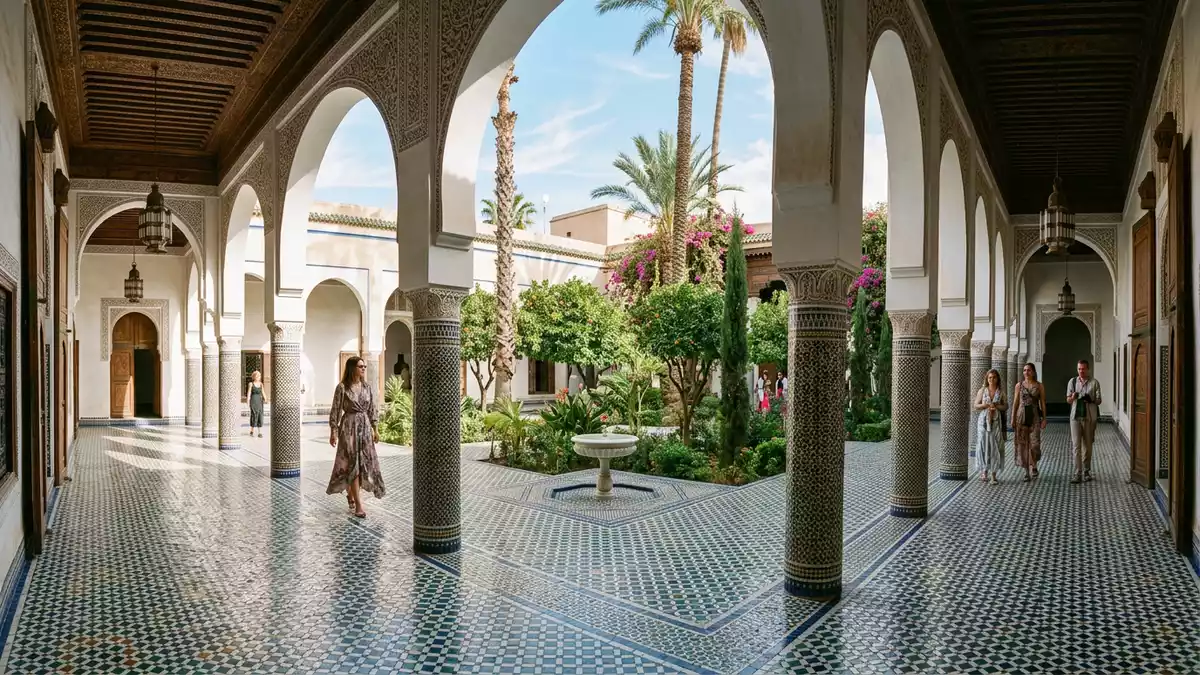
Palais Bahia is a nineteenth-century palace in Marrakesch where courtyards, gardens and reception rooms form a sequence of enclosed spaces. Its architecture brings together carved wood, painted cedar, stucco, zellij tiles, marble and stained glass. The complex began under Si Moussa in the 1860s and reached its completed form after Ba Ahmed’s expansion between 1894 and 1900.
Palais Bahia: a palace arranged through courtyards
The palace is not a single monumental block. It is an extended ensemble of courtyards, riads, gardens, salons, service buildings and connecting passages. A courtyard may open towards planted space, while a decorated room leads into another enclosed section of the residence.
This arrangement gives Palais Bahia its architectural character. The eye moves between tiled floors, white stucco, painted ceilings and shaded arcades. The rooms vary in scale and decoration, while the courtyards provide the principal pauses within the complex. The palace covers about 8 hectares, making its layout a substantial part of its identity.
Si Moussa, Ba Ahmed and the nineteenth century
The first phase began under Si Moussa, a grand vizier of the Alawi court, during the 1860s. His son, Si Ba Ahmed ibn Musa, enlarged the residence between 1894 and 1900 while serving as grand vizier to Sultan Moulay Abdelaziz. The two construction phases account for the palace’s extended plan and varied spaces.
The principal expansion was completed in 1900. Its history belongs to the political world of the Alawi sultanate and to the late nineteenth-century development of Moroccan court architecture. the palace’s construction history records the roles of Si Moussa and Ba Ahmed across these two phases.
Materials, craftsmanship and the Medina setting
Palais Bahia combines Moroccan and Moorish architectural forms with an exceptionally varied decorative vocabulary. Zellij covers parts of the floors and lower walls, while carved and painted wood appears in ceilings, doors and screens. Stucco work adds relief to walls and arches, and coloured glass brings another material into the rooms.
Marble, moucharabieh screens, wood carving and painted surfaces appear across the courtyards and salons. The palace stands in the Medina of Marrakesch, the historic city enclosed by its ochre walls. The Medina has held UNESCO World Heritage status since 1985, placing Palais Bahia within a protected urban and architectural setting. the palace’s decorative details include zellij, stucco, carved wood and reception rooms.
Visiting Palais Bahia: what travellers from Western Europe should know
- Palais Bahia lies in the Medina of Marrakesch, south-east of the old city centre. It is reached through the historic streets around Riad Zitoun Jdid.
- The complex contains tiled courtyards, planted gardens, salons and narrow connecting passages. Some areas involve uneven stone surfaces and changes between open courtyards and enclosed rooms.
- The official language is Arabic and the currency is the Moroccan dirham.
- Entry requirements depend on your nationality; UK travellers can check the FCDO travel advice at gov.uk/foreign-travel-advice, Irish travellers the Department of Foreign Affairs at ireland.ie.
Searching for Palais Bahia on social platforms
These links open searches for Palais Bahia on each platform.Frequently asked questions about Palais Bahia
Where is Palais Bahia?
Palais Bahia is in the Medina of Marrakesch, Morocco, in the historic centre south-east of the main old-city spaces.
What can visitors expect at Palais Bahia?
The palace contains courtyards, gardens, salons, arcades and decorated rooms linked across an extended nineteenth-century residence.
What makes Palais Bahia distinctive?
Its distinctive character comes from the combination of a large courtyard-based plan and detailed Moroccan craftsmanship in zellij, stucco, wood, marble and stained glass.


