
Palais Bahia in Marrakesch and its courtyards of light
Published on 09/21/2026 at 21:28 | Editorial responsibility: Rafael Müller, Editor-in-Chief AD HOC NEWS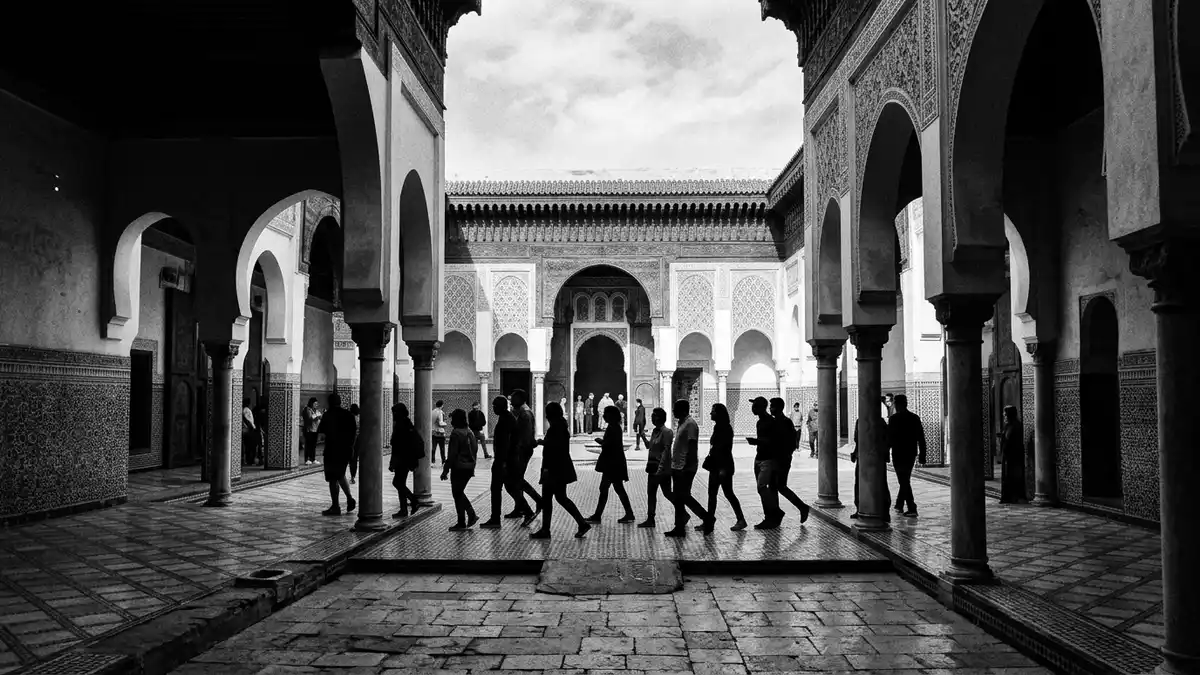
Palais Bahia in Marrakesch is a late nineteenth-century palace complex where rooms, courtyards and gardens are arranged as a sequence rather than a single monumental block. Set within the medina, it brings together Islamic and Moorish architecture in a layout that carries visitors from shaded riads to open reception courts in a matter of steps, and its ornamented surfaces show how power and craftsmanship met under the Alaouite dynasty in Morocco at the end of the nineteenth century.
A nineteenth-century vizier’s palace in the Marrakesch medina
Palais Bahia stands in the southern part of the old city of Marrakesch and is associated with the Alaouite sultans who ruled Morocco in the nineteenth century.Bahia Palace The palace is firmly tied to two grand viziers from that period: Si Moussa, who began the residence in the 1860s, and his son Ba Ahmed ibn Musa, who transformed and enlarged it in the 1890s.commissioned between 1859 and 1873 and completed by 1900 The overall complex belongs to the Moorish, or Islamic, architectural tradition of Morocco and is part of the wider historic fabric of the Marrakesch medina recognised on the UNESCO World Heritage List.masterpieces within the Medina of Marrakesh
The palace developed in phases. The earliest residential core, sometimes referred to as Dar Si Moussa, dates to the 1860s under Si Moussa, who served as grand vizier to Sultan Muhammad ibn Abd al-Rahman, while the large ceremonial expansion took place between 1894 and 1900 when Ba Ahmed held office under Sultan Moulay Abdelaziz.the garden chambers carry an inscription dating them to 1866–1867 By the time work finished around 1900, Palais Bahia extended across several hectares of interconnected houses, halls and gardens which had been amalgamated into a single palace. The name “Bahia” is commonly linked to the Arabic idea of brilliance or beauty, and it anchors the palace within a broader culture of named residences in Morocco.B?hiya, la belle, la brillante
Courtyards, riads and the play between architecture and garden
One of the defining features of Palais Bahia is the way built and planted spaces interlock. The complex is made up of a series of courtyards, riads and gardens tied to salons and residential suites, rather than a single central hall. The site covers an area measured in hectares, with Andalusian-style gardens and planted chambers occupying a significant portion of its footprint.built in two phases over an area of 8 hectares Within that extent, the palace includes a large riad garden, northern and southern courtyards, and more enclosed spaces, each with its own planting, paving and water features.
The materials and ornament follow a consistent Moroccan vocabulary. Floors and lower wall zones carry zellij tilework in geometric patterns, while stucco carving, painted cedar-wood ceilings and moucharabieh screens articulate transitions between interior and exterior.marble, moucharabieh, zellij, stained glass, wood carvings and stucco work Some of the principal ceremonial spaces open off the Cour d’Honneur, a wide paved courtyard framed by façades whose doors lead to reception rooms and domestic areas, while more intimate riads blend trees, shrubs and tiled paths around smaller chambers. Walking through the palace, the shift between enclosed salons and outdoor courts is frequent, and the alternation of surfaces is central to its character.
From vizier’s residence to cultural monument
Although Palais Bahia began as a private residence for Si Moussa and Ba Ahmed, its political role brought it into contact with wider Moroccan and later French authority. Ba Ahmed’s period of power spanned the closing years of the nineteenth century, during which the palace served not only as his household base but also as a setting for governance and reception.Ba Ahmed turned that house into the palace visitors walk through today In the early twentieth century, after the establishment of the French Protectorate, parts of Palais Bahia were used by the French Resident General in Marrakesch, reflecting the way the palace was integrated into colonial administration.In 1912, the palace underwent further renovation when it became the residence of the French Resident General
Following Moroccan independence in the twentieth century, the palace shifted from royal and administrative residence to the custody of the Moroccan Ministry of Culture, which restored and opened the complex to the public as a historical monument.used as a royal residence, until King Hassan II transferred it to the custody of the Moroccan Ministry of Culture Palais Bahia now functions as a museum and cultural site where the architectural language of the Alaouite period can be read in situ, from its large reception courts to its smaller private rooms. The palace’s place within the protected medina framework and its combination of residence, garden and ceremonial space make it a key example of Moroccan palatial architecture from the nineteenth century.
Visiting Palais Bahia: what travellers from Western Europe should know
- Palais Bahia lies in the medina of Marrakesch, south-east of the Jemaa el-Fna area, and is reached on foot or by road along streets such as Rue Riad Zitoun el Jdid.
- Inside the palace complex, access between courtyards and salons runs along paved paths and through rooms connected by steps, so movement involves frequent short level changes and passages.
- The climate in Marrakesch brings strong summer heat and milder winters, and the palace’s mixture of open courtyards and shaded interiors reflects those conditions in its built form.
- Palais Bahia stands close to other historic sites in the southern medina, including the Mellah district and the Saadian Tombs, which many visitors include in the same walking area.
- The official language is Arabic and the currency is the Moroccan dirham. Entry requirements depend on your nationality; UK travellers can check the FCDO travel advice at gov.uk/foreign-travel-advice, Irish travellers the Department of Foreign Affairs at ireland.ie.
Searching for Palais Bahia on social platforms
These links open searches for Palais Bahia on each platform.
Frequently asked questions about Palais Bahia
Where is Palais Bahia in Marrakesch?
Palais Bahia is located in the southern part of the Marrakesch medina, near Rue Riad Zitoun el Jdid and within walking distance of other historic quarters.
What can visitors expect inside Palais Bahia?
Visitors encounter a sequence of courtyards, riads, salons and gardens with extensive zellij tilework, carved stucco and painted wooden ceilings in the Moroccan tradition.
What makes Palais Bahia distinctive among Moroccan palaces?
Its late nineteenth-century layout, combining multiple houses into a single complex with large Andalusian gardens and richly decorated interiors, marks it as a key example of Alaouite-period architecture.


