
Palatul Parlamentului and Bukarest in monumental neoclassicism
Published on 09/19/2026 at 17:43 | Editorial responsibility: Rafael Müller, Editor-in-Chief AD HOC NEWS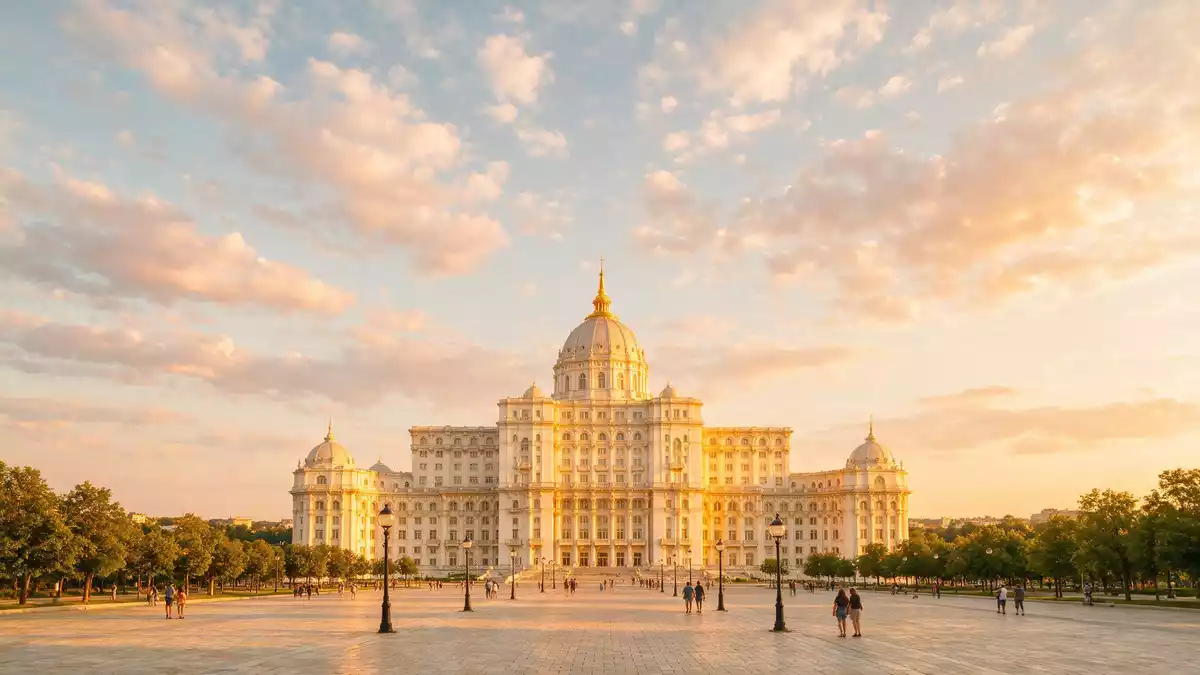
Palatul Parlamentului rises in Bukarest as a vast neoclassical mass with long façades and a heavy, ordered profile. The building is linked to Anca Petrescu and to construction that began in 1984.
A colossal neoclassical face in Bukarest
The building is known in English as the Palace of the Parliament, and its Romanian name, Palatul Parlamentului, remains the one used here. Its form is read most easily in the repeated windows, broad cornices and monumental symmetry that define the exterior.
The palace occupies a place in the city’s civic landscape that is impossible to miss in a street view. Its scale is part of its identity, and its dimensions are among the facts most closely attached to it, including a length of about 270 m (886 ft) and a width of about 240 m (787 ft).
Anca Petrescu and the late communist-era project
Anca Petrescu served as chief architect, working with a large team through a project that unfolded over more than a decade. The building belongs to the late communist period in Romania, with its beginnings tied to 1984 and its completion in 1997.
That chronology places Palatul Parlamentului among the most recognisable large state buildings of postwar Europe. Its architecture combines late neoclassical language with forms associated with socialist realism, a mixture visible in the severe fronts and ceremonial scale.
Inside, the building moves away from the restraint of the exterior into halls, galleries and meeting rooms finished in marble, wood panelling and textiles. The contrast between exterior mass and interior detail gives the palace its strongest architectural tension.
The palace as a working state building
Palatul Parlamentului remains a seat of Romanian public life and houses major parliamentary functions. Its current use is inseparable from its original civic scale, even when the building is read as a monument to an earlier political order.
The palace is also associated with large floor areas and a dense sequence of rooms rather than a single ceremonial chamber. That arrangement makes the building feel less like one hall and more like an enclosed district.
Its status as a major parliamentary complex gives the exterior more than architectural interest. The building is a record of late twentieth-century state ambition made visible in stone, symmetry and size.
Visiting Palatul Parlamentului: what travellers from Western Europe should know
- Palatul Parlamentului stands in central Bukarest, in the city’s civic zone. It is reached by the metro and by surface transport serving the area around Izvor and the nearby avenues.
- The building is large enough that its façades and interior sequences should be read as separate parts. The exterior presents broad masses; the interior contains halls, galleries and meeting rooms.
- The ground around the palace is level, with the building rising above the surrounding streets. Its scale is easier to understand from the open approaches than from a single corner.
- The palace is one of the clearest examples of monumental neoclassicism in Bukarest. The repeated windows, cornices and formal symmetry give it a severe, measured appearance.
- The official language is Romanian and the currency is the Romanian leu.
Searching for Palatul Parlamentului on social platforms
These links open searches for Palatul Parlamentului on each platform.
Frequently asked questions about Palatul Parlamentului
Where is Palatul Parlamentului?
Palatul Parlamentului stands in Bukarest, in the civic area close to the centre of the city. Its scale makes it visible from several approaches.
What does a visit feel like?
The experience is shaped by long façades outside and large rooms inside. Marble, wood panelling and formal symmetry define much of the building’s character.
What makes Palatul Parlamentului distinctive?
Its combination of size, neoclassical language and late communist-era origin sets it apart within Bukarest. The building also remains tied to Anca Petrescu and to the year 1984.


