
Palatul Parlamentului, Bucharest’s monumental parliament hill
Published on 08/17/2026 at 14:57 | Editorial responsibility: Rafael Müller, Editor-in-Chief AD HOC NEWS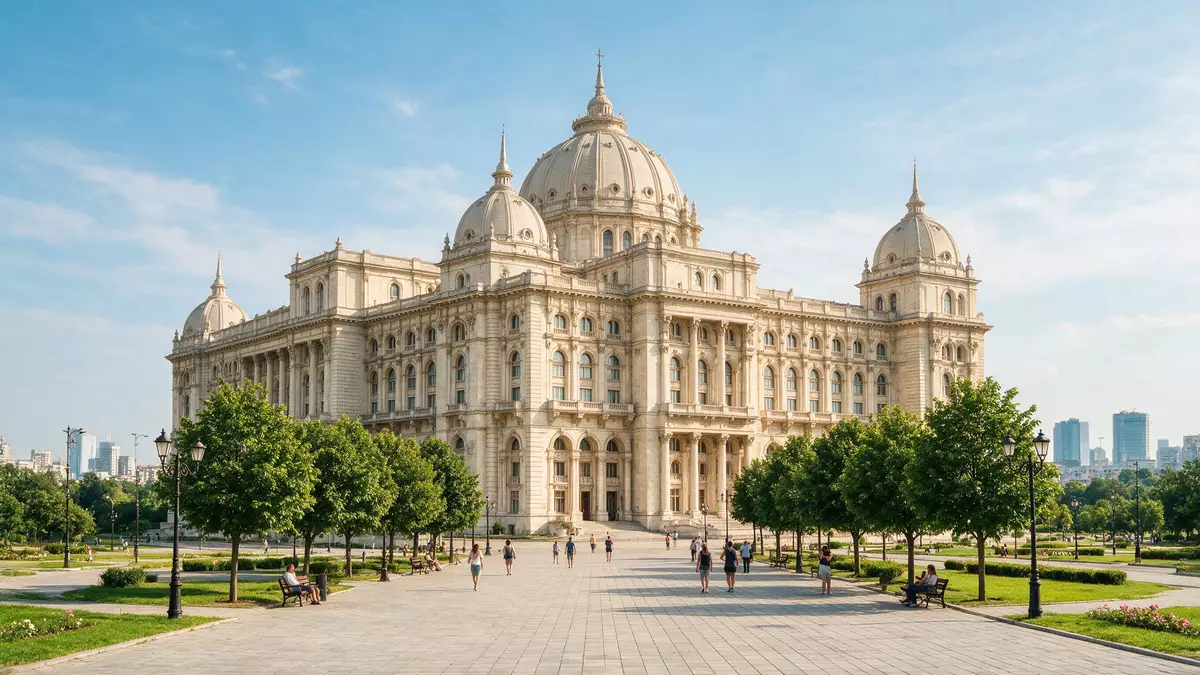
Palatul Parlamentului in Bukarest is a colossal neoclassical government building rising over Dealul Spirii, conceived in the 1980s under Nicolae Ceau?escu and housing Romania’s Parliament.
An outsized palace on Dealul Spirii
Seen from the surrounding streets of central Bukarest, Palatul Parlamentului stretches as a monumental rectangle above a broad terrace, aligned with the city’s wide boulevards and formal squares. The complex stands on Dealul Spirii, a low hill south-west of the old centre, its long façades looking across to Pia?a Constitu?iei and down towards the civic axis laid out in the same period.Dealul Spirii The building occupies a large plot flanked by Izvor Street and other arterial roads, and its sheer footprint makes it a dominant landmark on maps as well as in the skyline.
The structure reaches around 84 m (276 ft) above ground level and extends roughly 270 m (886 ft) along its main sides, with a width of about 245 m (804 ft).developed area and dimensions It has 12 storeys above ground and several underground levels descending to about 16 m (52 ft) below the hilltop, creating a mass of internal space that has made the palace one of the largest civilian administrative buildings in the world.
From “Casa Poporului” to parliamentary seat
Construction of Palatul Parlamentului began in 1984, in the late phase of Romania’s communist regime, under the leadership of Nicolae Ceau?escu.construction began in 1984 The original project carried the name “Casa Poporului”, the People’s House, and was intended as a central complex for state institutions of the Socialist Republic of Romania.Casa Poporului Work continued through the late 1980s, and although the overall shell and many interiors were completed, parts of the underground sections and some spaces remained unfinished.
After the change of political system at the end of 1989, the gigantic complex took on a new role as the seat of democratic institutions. It now houses the Chamber of Deputies, the Senate, the Legislative Council and the Constitutional Court of Romania, together with conference halls and exhibition spaces.major Romanian state institutions The project’s chief architect was Anca Petrescu, who coordinated a large team of designers through the 1980s, shaping the palace in a late interpretation of neoclassicism with monumental symmetry, heavy cornices and regimented rows of windows.architect Anca Petrescu
Materials, interiors and records
Palatul Parlamentului is constructed with an enormous quantity of Romanian-sourced materials, including extensive marble, wood, crystal and metalwork. Accounts of the building’s statistics mention around a million cubic metres of marble and thousands of tonnes of crystal used in chandeliers and decorative elements, together with large volumes of timber for wall panelling, doors and furniture.marble, crystal, steel and wood Inside, a network of halls, staircases and corridors leads to ceremonial rooms clad in these materials, with long vistas along gallery-like spaces.
The overall developed area is quoted at around 365,000 square metres, placing Palatul Parlamentului among the largest administrative buildings by floor space.365,000 square metres Guinness World Records listings refer to the palace as the heaviest building in the world and as one of the most expensive administrative constructions completed in the late twentieth century.Guinness World Records Alongside its legislative functions, the complex contains museum spaces, conference and exhibition halls that are used for public events, which means visitors encounter both state offices and cultural rooms behind the massive exterior.
Visiting Palatul Parlamentului: what travellers from Western Europe should know
- Palatul Parlamentului stands on Dealul Spirii in central Bukarest, with its main front facing Pia?a Constitu?iei and its official address on Izvor Street.
- Access to the interior on guided tours involves security checks and movement through corridors and staircases inside a very large building, so a visit includes extended walking on polished stone floors.
- The surrounding area is an urban plateau with broad roads and formal squares; the nearest metro stations and bus stops bring visitors to within a short walk of the palace terraces.
- Romania’s official language is Romanian and the national currency is the leu.
Searching for Palatul Parlamentului on social platforms
These links open searches for Palatul Parlamentului on each platform.
Frequently asked questions about Palatul Parlamentului
Where is Palatul Parlamentului located in Bukarest?
Palatul Parlamentului stands on Dealul Spirii in central Bukarest, with its address on Izvor Street opposite Pia?a Constitu?iei.
What can visitors expect inside Palatul Parlamentului?
Visitors on guided tours walk through vast marble-clad halls, staircases and corridors, visiting ceremonial rooms and exhibition spaces within a functioning parliamentary complex.
What makes Palatul Parlamentului distinctive among government buildings?
Its combination of late twentieth-century neoclassical style, immense floor area and Guinness-listed status as one of the heaviest administrative buildings gives it an exceptional scale and presence.


