
Palatul Parlamentului, Bukarest’s monumental Parliament palace
Published on 09/21/2026 at 08:08 | Editorial responsibility: Rafael Müller, Editor-in-Chief AD HOC NEWS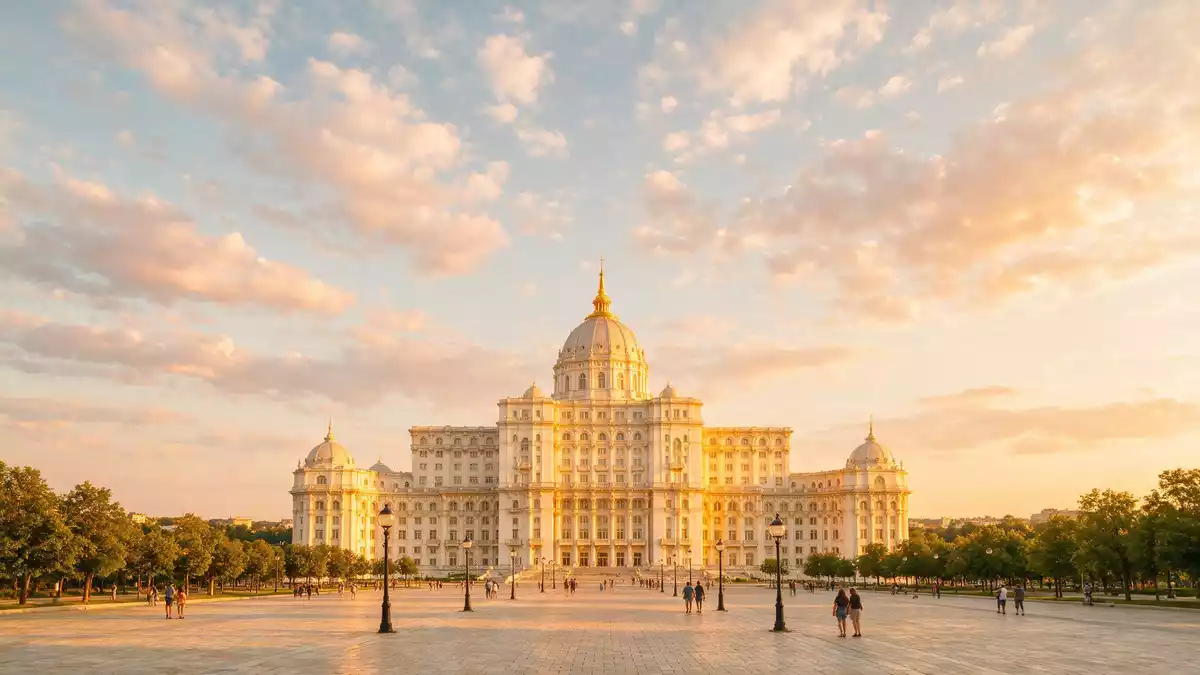
Palatul Parlamentului in Bukarest is an immense neoclassical government complex whose sheer scale and lavish interior detail make it one of Europe’s most striking political buildings. Rising above central Bukarest in Romania, it was conceived during the 1980s under the leadership of Nicolae Ceau?escu and has since become the seat of the Parliament of Romania, bringing a vast communist-era structure into the country’s democratic life.
A colossal administrative building in central Bukarest
Palatul Parlamentului stands in Sector 5 of Bukarest on a prominent rise west of the historic centre, facing Pia?a Constitu?iei and bordered by Izvor Park and major boulevards. The building’s footprint extends for around 270 m (886 ft) in length and 245 m (804 ft) in width, creating a regular block of stone that dominates the surrounding cityscape.Developed area and dimensions Its total developed area reaches about 365,000 m², with a height of roughly 84 m (276 ft) above ground level and additional subterranean levels extending to a depth of about 16 m (52 ft).Largest administrative building figures
The building’s regular outline and tiered facades produce a monumental presence when viewed from the broad square to its east. Long colonnaded fronts, repeated window bays and projecting porticoes emphasise its role as a state complex, while the elevated position above the surrounding streets underlines its status within the capital. Road approaches along Bulevardul Na?iunile Unite and neighbouring arteries frame extended views of the palace, making its mass a constant reference point in this part of Bukarest.
From Ceau?escu’s “People’s House” to Romania’s Parliament
Palatul Parlamentului began life in the 1980s under Romania’s communist regime, when Nicolae Ceau?escu ordered a gigantic new civic centre and government seat in Bukarest. The building was originally known as Casa Poporului, the “People’s House”, and it later acquired further names such as the House of the Republic before taking on its present designation as the Parliament palace.Names and 1980s conception Construction began around 1984, and large parts of the complex were already standing by the end of the decade, even though finishing work continued into the post-communist period.
Following the political changes of 1989, the vast complex acquired a different institutional life. Palatul Parlamentului now houses Romania’s Chamber of Deputies and Senate, together with other state bodies such as the Constitutional Court and the Legislative Council.Symbol of democracy housing key institutions This change of role brought a building conceived as a monument to a centralised regime into the country’s democratic framework. In addition to its parliamentary functions, parts of the palace host conference facilities and a national museum, giving public and cultural uses to sections that would otherwise remain purely administrative.
Marble, chandeliers and vast ceremonial halls
Behind Palatul Parlamentului’s stone facades lies a series of ceremonial interiors on a scale that matches the exterior shell. The building contains well over a thousand rooms distributed across multiple levels, including reception halls, grand staircases, conference chambers and extensive corridors linking the various wings.Number of rooms and interior features Many of these spaces are fitted out with Romanian marble, rich wood panelling and elaborate plasterwork, underscoring the palace’s role as a stage for official occasions.
The interior detail is particularly notable for its use of decorative materials in large quantities. Sources document around 2,800 chandeliers suspended throughout the building, with crystal, glass and metals used both in lighting and in wall and ceiling fixtures.Chandeliers, carpets and decorative materials Carpets extend over more than 220,000 m² of floor area, and leather and textiles appear in seating and wall coverings. Romanian timber and stone feature prominently, reflecting the policy during construction of sourcing materials from within the country.Romanian materials and quantities The result is an interior landscape of staircases, halls and meeting rooms in which repeated motifs and long sightlines convey the building’s ceremonial character.
Visiting Palatul Parlamentului: what travellers from Western Europe should know
- Palatul Parlamentului stands in central Bukarest’s Sector 5, west of the old town and directly across from Pia?a Constitu?iei, with Izvor Park along its northern side.
- The building occupies an elevated site above surrounding streets, and visits involve moving through long corridors, broad staircases and sizeable interior spaces.
- Palatul Parlamentului is reachable by Bukarest’s public transport network, with Izvor metro station and several bus routes serving the area around the palace.
- The official language in Romania is Romanian and the currency is the leu.
- Entry requirements depend on your nationality; UK travellers can check the FCDO travel advice at gov.uk/foreign-travel-advice, Irish travellers the Department of Foreign Affairs at ireland.ie.
Searching for Palatul Parlamentului on social platforms
These links open searches for Palatul Parlamentului on each platform.
Frequently asked questions about Palatul Parlamentului
Where is Palatul Parlamentului located in Bukarest?
Palatul Parlamentului stands in Sector 5 of Bukarest, on a rise facing Pia?a Constitu?iei and bordering Izvor Park and major central boulevards.
What should visitors expect inside the building?
Visits lead through grand halls, staircases and meeting rooms fitted with Romanian marble, extensive carpets and numerous chandeliers, reflecting its ceremonial governmental role.
What makes Palatul Parlamentului distinctive among European government buildings?
Its combination of vast floor area, regular neoclassical massing and richly decorated interiors built in the late communist period give it a monumental character unusual in contemporary European capitals.


