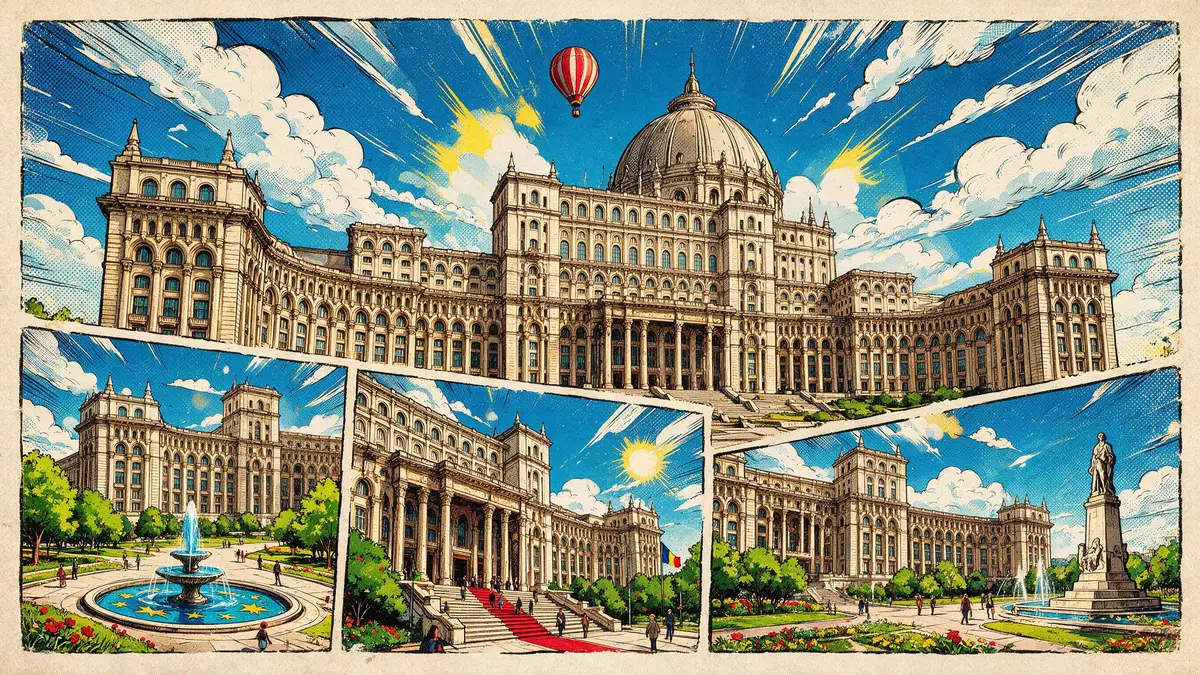
Palatul Parlamentului, Bukarest’s monumental seat of power
Published on 08/12/2026 at 14:22 | Editorial responsibility: Rafael Müller, Editor-in-Chief AD HOC NEWS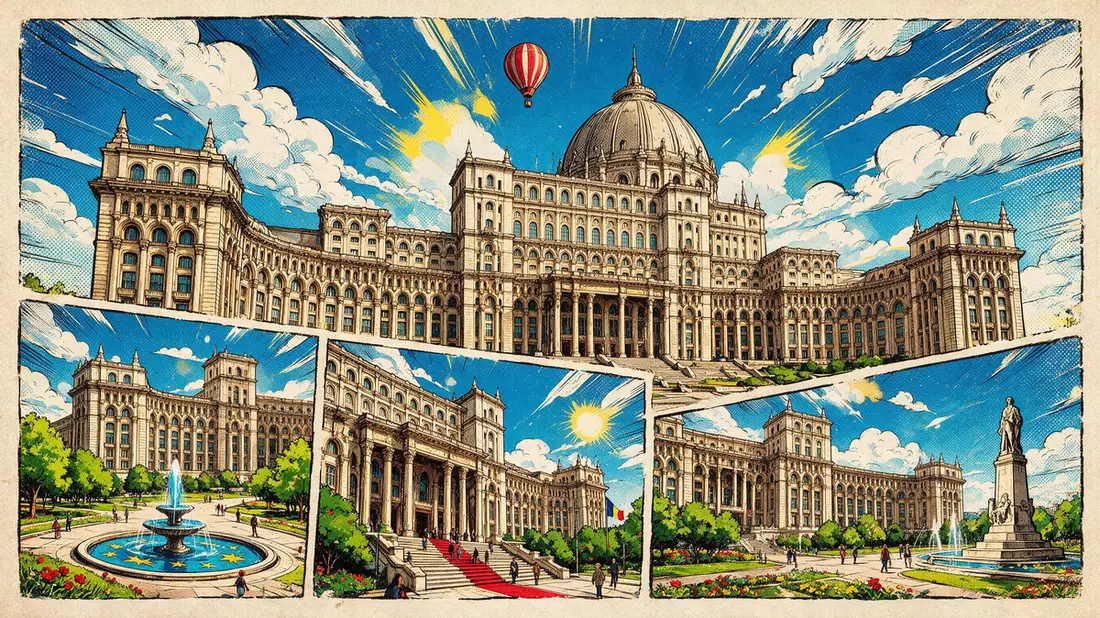
Palatul Parlamentului, known in English as the Palace of the Parliament, dominates Bukarest with a monumental neoclassical mass that serves as Romania’s parliamentary seat and civic showpiece. Conceived under Nicolae Ceau?escu in the 1980s and completed in the late twentieth century, it concentrates political power and spectacle into a single, vast building that is hard to grasp in one glance.Palace of the Parliament
A hill of stone above central Bukarest
Palatul Parlamentului stands on Dealul Spirii, a hill on the western side of central Bukarest that was reshaped to carry its bulk.Dealul Spirii in Bucharest From the lower streets the building rises in long terraces and stacked wings, forming a stepped profile that fills much of the skyline in this part of the city. The main facades run in straight lines across a broad platform, with wide stairways and access routes leading up from the surrounding boulevards.
The setting around the palace combines broad avenues and planned squares with surviving fragments of older neighbourhoods, so the approach passes from ordinary city blocks into a formal governmental district. Directly opposite the building lies Pia?a Constitu?iei, a vast open square that frames the main frontage of Palatul Parlamentului and underlines its function as a stage for state occasions.Constitution Square location Standing here, the palace’s length and height are clear, with rows of closely spaced windows and projecting balconies giving rhythm to otherwise massive walls.
From People’s House to parliamentary seat
The building was ordered by Nicolae Ceau?escu, the president of Communist Romania, as part of an ambitious civic centre laid out after an earthquake in 1977.People’s House project Construction officially began in June 1984, with the project drawing resources and attention from across the country.Construction start in 1984 In its original conception the building was named Casa Poporului, the People’s House, and also carried the title Casa Republicii, the House of the Republic, reflecting its role in the socialist state’s structure.Casa Poporului name
Chief architect Anca Petrescu, working with a large team of architects, oversaw the design and construction in forms that echo neoclassical and socialist realist traditions.Anca Petrescu as chief architect The structure rose through the 1980s and into the 1990s, with work stretching over more than a decade. After the 1989 revolution the building took on its present role as Romania’s parliamentary seat, housing the Chamber of Deputies and the Senate, together with institutions such as the Constitutional Court and various museums.Current parliamentary functions The shift from People’s House to Palatul Parlamentului is central to its identity, with the same walls now associated with a different political order.
Scale, style and interior detail
Palatul Parlamentului is counted among the largest administrative buildings in the world, with a footprint and internal volume that dwarfs surrounding structures.Largest administrative building claim Figures given for its size speak of hundreds of thousands of square metres of floor area laid out across multiple storeys above ground and several more underground.Dimensions and rooms The facades are organised in tiers, with repeated rows of columns, pilasters and window openings producing a rigorous symmetry along each elevation. Corner pavilions, projecting bays and central sections break the long lines into distinct blocks without diminishing the sense of mass.
The architectural style combines late interpretations of neoclassicism with elements associated with socialist realism, visible in the heavy mouldings, broad cornices and monumental staircases.Neoclassical and socreal style Inside, visitors encounter a succession of halls, galleries and meeting rooms where marble, wood panelling, textiles and detailed plasterwork line the surfaces. The repeated motifs across ceilings and walls, together with long enfilades of rooms, underline the building’s role as a ceremonial setting for official occasions. The sheer number of spaces means that guided routes only cover a fraction of the interior, while still conveying the density of decoration and the scale of state ambition embodied in the design.
Visiting Palatul Parlamentului: what travellers from Western Europe should know
- Palatul Parlamentului stands on Dealul Spirii in central Bukarest, west of the old city core, with main approaches from large boulevards and from Pia?a Constitu?iei.
- The approaches and interior tours involve long corridors and broad flights of steps, so visiting includes extended walking on polished stone floors and climbing staircases between levels.
- The building lies within Bukarest, where the official language is Romanian and the currency is the leu.
- Entry requirements depend on your nationality; UK travellers can check the FCDO travel advice at gov.uk/foreign-travel-advice, Irish travellers the Department of Foreign Affairs at ireland.ie.
Searching for Palatul Parlamentului on social platforms
These links open searches for Palatul Parlamentului on each platform.
Frequently asked questions about Palatul Parlamentului
Where is Palatul Parlamentului located?
Palatul Parlamentului stands on Dealul Spirii in central Bukarest, Romania, facing Pia?a Constitu?iei and forming part of the city’s planned civic centre.
What can visitors expect inside Palatul Parlamentului?
Visitors encounter a sequence of grand halls and corridors lined with marble, wood and decorative plasterwork, giving an insight into the ceremonial spaces used for official events.
What makes Palatul Parlamentului distinctive among European landmarks?
Its extraordinary size as an administrative building, together with its late neoclassical and socialist realist architecture and its origin as Casa Poporului under Nicolae Ceau?escu, make it distinctive.