
Palau de l'Almudaina, Palma’s royal stone palace
Published on 08/16/2026 at 14:50 | Editorial responsibility: Rafael Müller, Editor-in-Chief AD HOC NEWS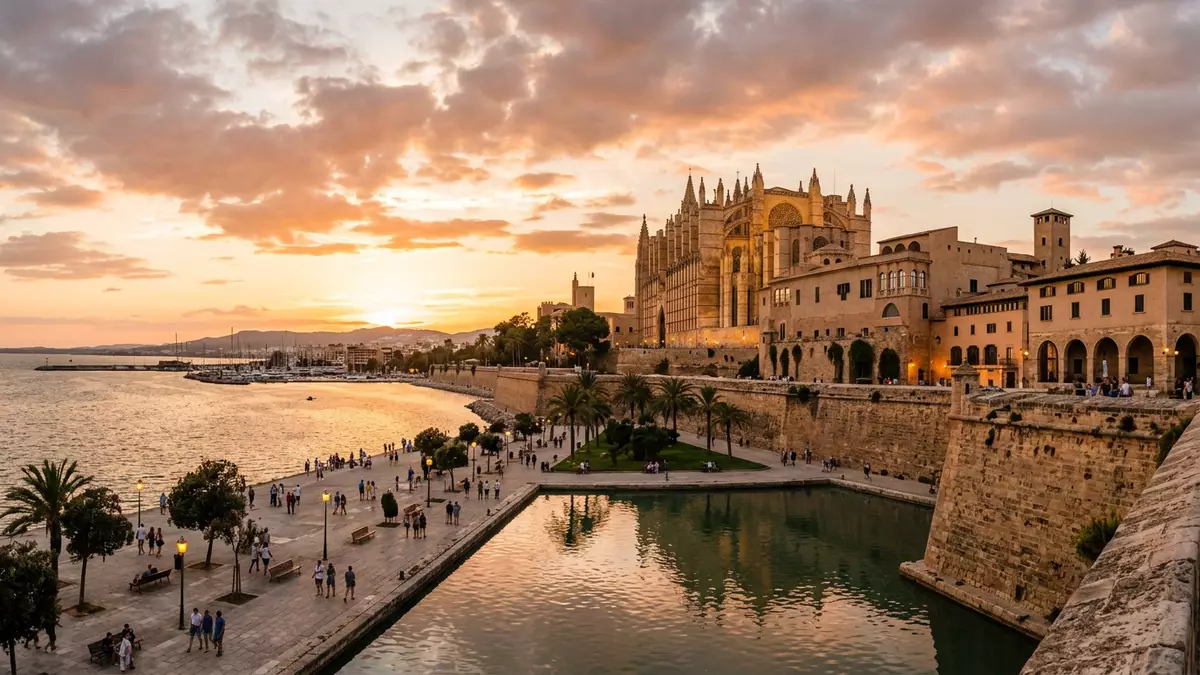
Palau de l'Almudaina in Palma is a royal palace of limestone and battlements, facing the waterfront beside the city’s cathedral and carrying centuries of Balearic history in its walls.
A royal palace beside the cathedral and the sea
Palau de l'Almudaina stands in the historic centre of Palma on the island of Mallorca, directly opposite the city’s cathedral and above the Parc de la Mar and harbour-front road.Royal Palace of La Almudaina The building forms a long stone front along the edge of the old town, with towers, crenellated parapets and a raised terrace looking out towards the Mediterranean. Its position makes it one of the defining silhouettes of Palma’s waterfront, with the palace and cathedral appearing almost as a single ensemble when seen from the sea.
The palace is one of the official residences of the Spanish royal family, used for receptions and formal occasions when the monarch is in Mallorca.Palma’s historic royal palace It occupies a plot that has served rulers for many eras, from Muslim governors to the kings of Mallorca and, later, representatives of the Crown of Aragon and of Spain.residence of monarchs and governors
From Muslim citadel to Gothic palace
The origins of Palau de l'Almudaina lie in an Islamic fort built when Mallorca formed part of the Caliphate of Córdoba, which replaced an earlier Roman stronghold on the site.Muslim citadel turned Majorcan palace After the conquest of Mallorca by Jaume I of Aragon in the thirteenth century, the complex was reshaped into a palace for the kings of Mallorca, with extensive rebuilding in a Gothic style. Jaume II of Mallorca ordered major works from 1281, with architect Pere Salvà overseeing a transformation that gave the fortress the outlines of a royal residence with ceremonial halls and chapels.Gothic palace by Pere Salvà
In the centuries after the kingdom of Mallorca was incorporated into the Crown of Aragon in the fourteenth century, Palau de l'Almudaina served as the seat of governors, viceroys and later military commanders for the islands.seat of governors and captains general Renaissance modifications in the sixteenth century under Philip II added new arrangements for royal audiences, including the Tinell hall adapted as a formal reception space, while other parts of the building housed the Capitainerie General of the Balearic Islands.
Inside Palau de l'Almudaina: stone halls, courtyards and views
The palace interior combines fortified architecture with ceremonial spaces, including stone-lined halls, royal chambers, chapels and enclosed courtyards laid out around arcades. Visitors walk through rooms furnished with tapestries, paintings and period furniture, reflecting different phases of the building’s use by the Crown.historic rooms and furnishings Windows and terraces on the seaward side frame views across Parc de la Mar and the bay, while inner spaces look onto cloister-like courts and the city streets behind.
Palau de l'Almudaina retains the outlines of a fortified palace, with towers rising above the surrounding lanes and an elevated platform carrying the main façade.originally an Islamic fort From the terrace and upper levels, the proximity of Palma Cathedral is striking, with the cathedral’s flying buttresses and tracery visible at close quarters and the two buildings sharing the same cliff-like drop towards the water’s edge. Together they form a continuous stone front that marks the transition between the medieval city and the sea.
Visiting Palau de l'Almudaina: what travellers from Western Europe should know
- Palau de l'Almudaina stands in Palma’s old town on Carrer del Palau Reial, opposite the cathedral and beside Parc de la Mar, reached along the waterfront road from the harbour.
- The approach from Plaça de la Reina and the cathedral involves a short walk with steps up to the palace terrace and further staircases inside the historic building.
- The official language is Spanish and the currency is the euro.
- The palace lies within the European Union. Entry requirements depend on your nationality; UK travellers can check the FCDO travel advice at gov.uk/foreign-travel-advice, Irish travellers the Department of Foreign Affairs at ireland.ie.
Searching for Palau de l'Almudaina on social platforms
These links open searches for Palau de l'Almudaina on each platform.
Frequently asked questions about Palau de l'Almudaina
Where is Palau de l'Almudaina located?
Palau de l'Almudaina is in Palma, the capital of Mallorca in Spain, on Carrer del Palau Reial beside the cathedral and overlooking Parc de la Mar.
What can visitors expect inside the palace?
Visitors encounter fortified stone architecture, ceremonial halls, chapels, furnished royal rooms and courtyards, together with elevated terraces offering views over Palma and the bay.
What makes Palau de l'Almudaina distinctive among Palma’s landmarks?
Its combination of Islamic and medieval origins, Gothic rebuilding under Jaume II and its continuing role as an official royal residence set the palace apart in Palma’s historic skyline.


