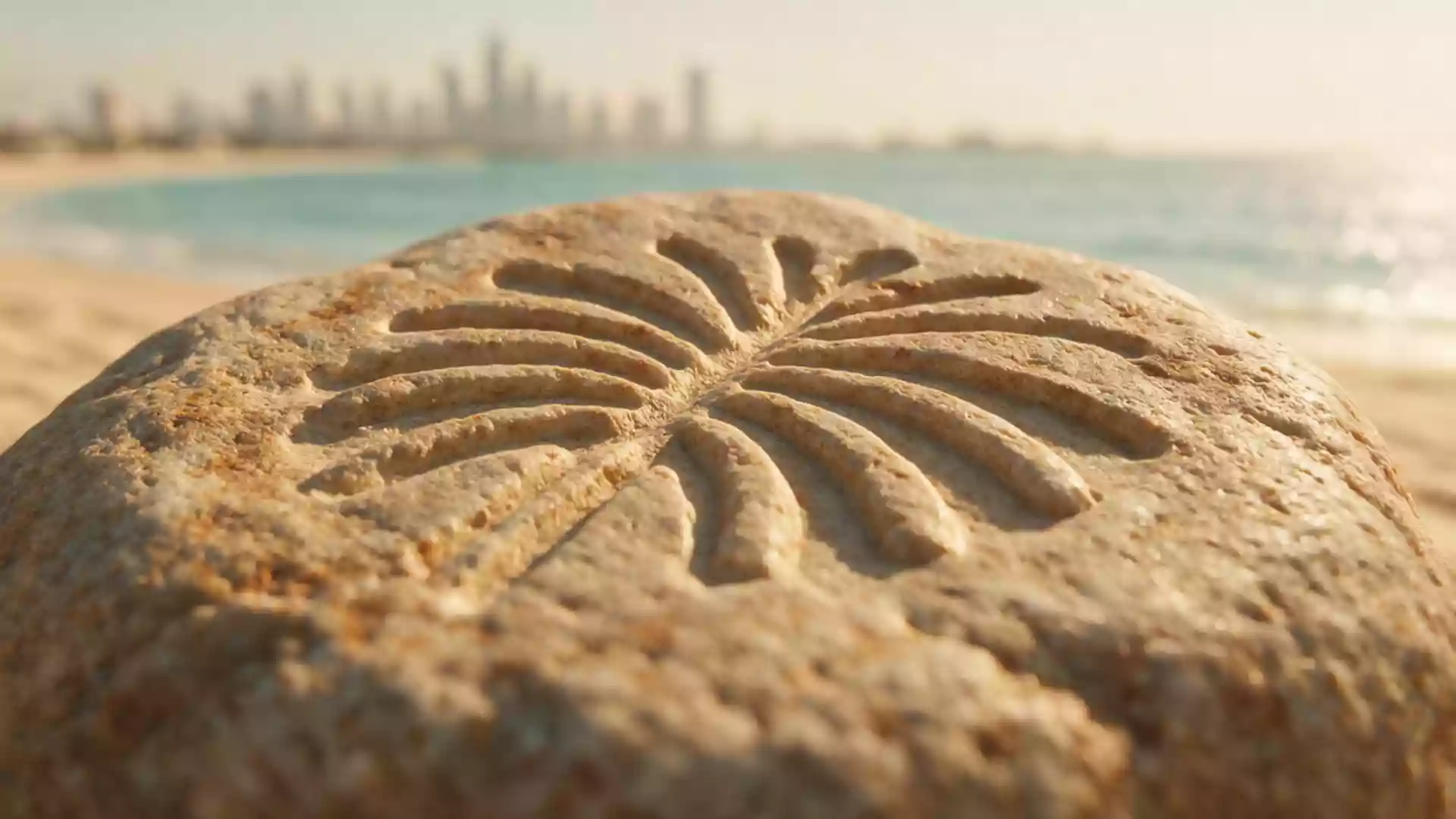
Palm Jumeirah, Dubai’s palm-shaped island of reclaimed land
Published on 08/17/2026 at 14:26 | Editorial responsibility: Rafael Müller, Editor-in-Chief AD HOC NEWS
Palm Jumeirah in Dubai is a vast man-made archipelago of reclaimed land that spreads into the Arabian Gulf in the distinctive outline of a stylised palm tree. Built in the early twenty-first century as part of the United Arab Emirates’ drive to expand Dubai’s coastline, it has become a major district of waterfront homes and hotels resting on sand and rock rather than natural islands.early twenty-first century
A palm tree drawn at the scale of a city
Seen from the air, Palm Jumeirah forms a clear palm motif: a central trunk reaches out from the Dubai shoreline, a ring-shaped breakwater forms the outer crescent, and between them lie residential fronds branching into the Gulf.trunk with 17 fronds The reclaimed footprint stretches for several kilometres offshore, turning a single coastal strip into an elaborate pattern of waterfront plots arranged along curving streets and shorelines.
The palm outline belongs to a wider group of schemes called the Palm Islands, conceived off the coast of Dubai as artificial archipelagos in the Persian Gulf.three artificial archipelagos Among them, Palm Jumeirah is the completed example, roughly five by five kilometres in extent, framed by the protective crescent that acts as a long sea wall.roughly five by five kilometres Residences line the fronds, larger apartment and villa developments occupy the trunk, and hotels and resorts stand on the crescent facing both the inner lagoon and the open gulf.
Engineering a new shoreline from sand and rock
The islands rest on foundations created entirely through land reclamation, using vast quantities of dredged sand and quarried rock placed with controlled accuracy into the planned palm form.land reclamation using sand and rock Marine works for Palm Jumeirah began in 2001 under the direction of the Dubai developer Nakheel, with design input from the US planning firm Helman Hurley Charvat Peacock (HHCP).Nakheel and HHCP involvement By the middle of that decade the basic landform and infrastructure were in place and building construction could proceed.work started in 2001
The crescent-shaped breakwater, over ten kilometres long, shields the interior basin from Gulf swells and seasonal winds, turning the water between crescent and trunk into a calmer lagoon edged by beaches and quays.crescent-shaped breakwater Beneath the water, a subsea road tunnel links the trunk to the crescent, while a bridge connects the base of the palm back to mainland Dubai.bridge and subsea tunnel The Palm Jumeirah Monorail runs along the spine of the trunk, providing an elevated rail route from the mainland to the crescent that passes above villas, apartment towers and landscaped plots.Palm Jumeirah Monorail
Waterfront living and resorts on the fronds and crescent
On the fronds, rows of shoreline villas have direct access to the inner waters of the lagoon, each plot backed by streets and fronted by beaches or quays.residences on the fronds The trunk gathers denser residential districts, with apartment complexes and mixed-use buildings lining broad boulevards, while the crescent carries resort hotels and leisure attractions facing both sides of the sea wall.site of private residences and hotels
Among the best-known properties on the crescent is Atlantis The Palm, a hotel and entertainment complex that anchors one end of the sea wall and fronts a large water park called Aquaventure.Aquaventure water park As the district has matured, Palm Jumeirah has gained a resident population measured in the tens of thousands and a cluster of landmark hotels, beach clubs and marinas arranged along its extended waterfront.population figure for 2022
Visiting Palm Jumeirah: what travellers from Western Europe should know
- Palm Jumeirah lies off the Jumeirah coastal area of Dubai in the United Arab Emirates, projecting several kilometres into the Arabian Gulf from the city’s shoreline.located on the Jumeirah coastal area
- The terrain consists of broad roadways, pavements and beach areas laid over low-lying reclaimed land, with long promenades and some stretches accessible only by crossing bridges or a subsea tunnel.
- The island is reached by road from mainland Dubai and by the Palm Jumeirah Monorail, which runs along the trunk between the base of the palm and the crescent.
- The official language is Arabic and the currency is the United Arab Emirates dirham.
- Entry requirements depend on your nationality; UK travellers can check the FCDO travel advice at gov.uk/foreign-travel-advice, Irish travellers the Department of Foreign Affairs at ireland.ie.
Searching for Palm Jumeirah on social platforms
These links open searches for Palm Jumeirah on each platform.
Frequently asked questions about Palm Jumeirah
Where is Palm Jumeirah?
Palm Jumeirah is an artificial archipelago of reclaimed land on the Persian Gulf off the Jumeirah district of Dubai in the United Arab Emirates.archipelago on the Persian Gulf
What should visitors expect on a visit?
Visitors encounter a large planned waterfront district with residential streets on the fronds, apartment and villa areas along the trunk, and resort hotels on the crescent, all connected by wide roads and the Palm Jumeirah Monorail.residential trunk and resort crescent
What makes Palm Jumeirah distinctive?
Palm Jumeirah is distinctive for its palm-tree outline drawn at urban scale, its construction as reclaimed land from sand and rock, and its long crescent-shaped breakwater that extends Dubai’s shoreline well beyond the original coast.palm outline and breakwater