Pamukkale’s white terraces and ancient hillside city
Published on 09/02/2026 at 15:31 | Editorial responsibility: Rafael Müller, Editor-in-Chief AD HOC NEWS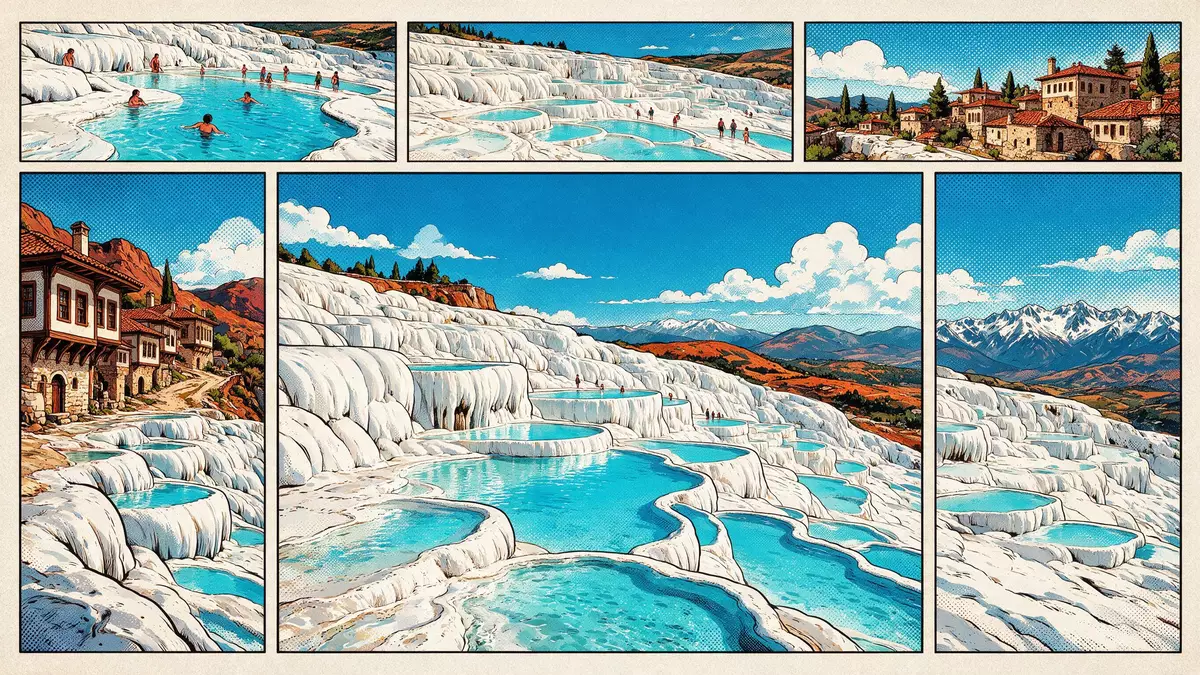
Pamukkale in Denizli Province in south-western Turkey is a hillside of white travertine above a broad river plain, with the ruins of ancient Hierapolis spread across its rim.The name Pamukkale means “cotton castle” in Turkish, a reference to the bright carbonate terraces that cover the slope.
A white hillside built by hot springs
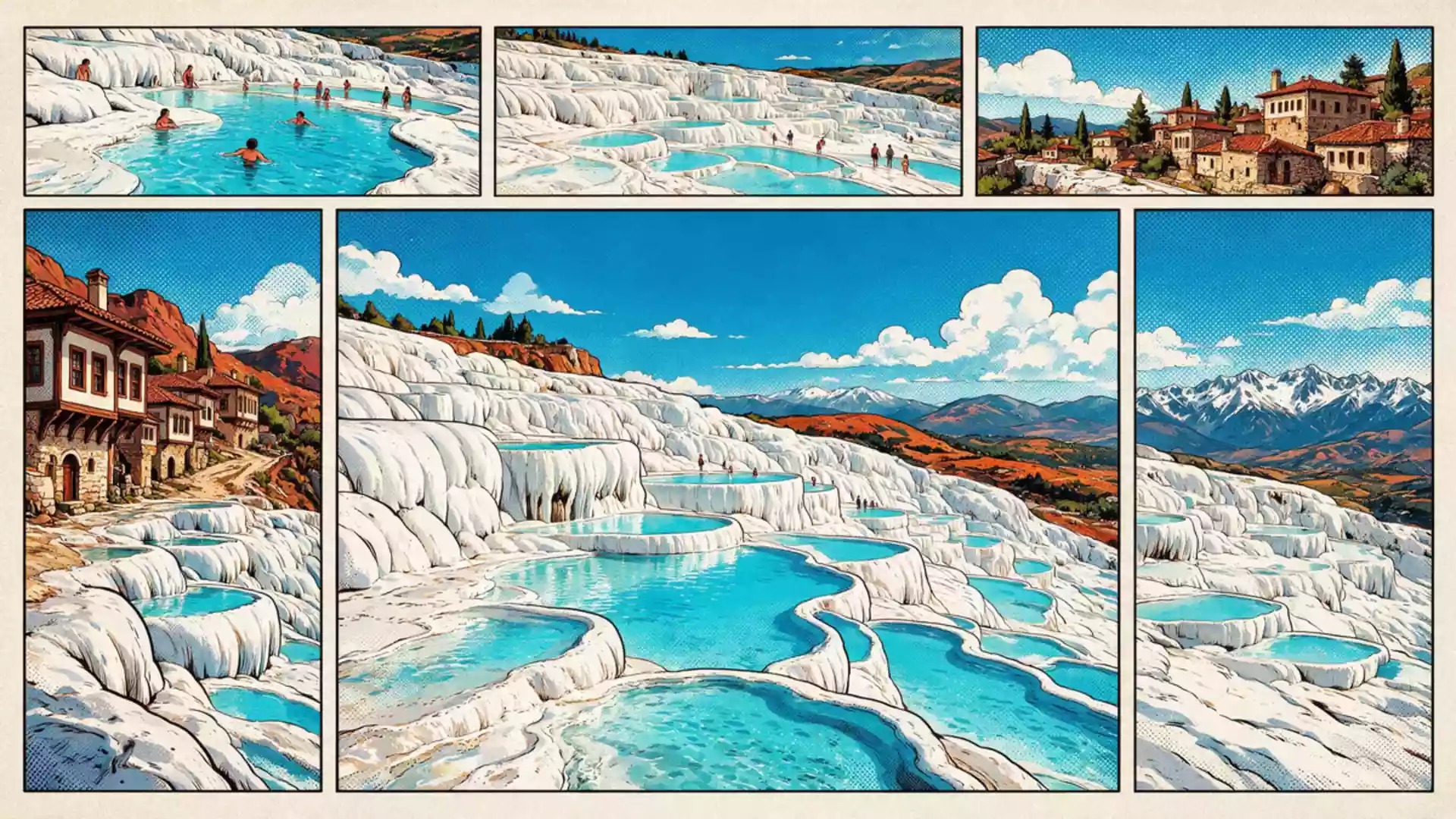
Pamukkale is a natural formation of travertine, a form of limestone created when calcium carbonate precipitates from mineral-rich spring water flowing over the ground.The terraces here formed from hot springs that deposit calcium carbonate as they cool and release carbon dioxide. Over time, the deposits have built stepped shelves that climb across the slope.
The travertine slopes line the northern side of the Çürüksu valley, a tributary of the Büyük Menderes river, with the white deposits standing above the surrounding plain.World Heritage documentation describes a cliff almost 200 m high where calcite-laden waters have created petrified waterfalls, terraced basins and mineral formations. From a distance, the whiteness of the terraces contrasts with the fields and towns of western Anatolia below.
Hierapolis on the edge of the terraces
On the upper edge of the travertine stands Hierapolis, a Graeco-Roman city that developed around the same hot springs that feed the terraces.Hierapolis was founded in the late second century BC under the Attalid kings of Pergamon as a thermal resort and cult centre, using the plateau above the white slope as its base. The city’s grid of streets, theatres and baths follows the gentle rise of the hillside.
The combined landscape of Hierapolis and the travertine terraces is recognised as a mixed cultural and natural World Heritage Site.The Hierapolis–Pamukkale property has been inscribed on the UNESCO World Heritage List since 1988 for both its geological formations and archaeological remains. Walking among the ruins means moving between stone-built structures and sudden views over the white slope below.
Travertine pools, cliffs and plateau
Seen from close quarters, the travertine forms shallow basins and ridges that step down the slope in successive bands, with mineral deposits creating rounded edges between them.Geological descriptions emphasise that the terraces consist largely of calcium carbonate, the same mineral found in limestone and marble. The contrast between the pale rock and any water held in the basins is one of the defining visual features of the site.
Satellite and geological surveys show the travertine plateau extending for several kilometres along the northern margin of the Denizli Basin.NASA’s Earth Observatory describes a Pamukkale plateau where calcite deposits cover around 12 square kilometres, with cliffs reaching around 200 m above the basin floor. From Hierapolis on the upper margin, the view takes in the white slope, the valley and the distant ridges of western Anatolia.
Visiting Pamukkale: what travellers from Western Europe should know
- Pamukkale lies in south-western Turkey near the city of Denizli, on the north side of the Çürüksu valley; intercity buses and regional trains serve Denizli.
- The travertine terraces rise on a hillside, and paths between them involve gradients and sections of uneven mineral surface underfoot.
- The ruins of Hierapolis spread across a plateau above the terraces, so exploring the archaeological area involves walking over open ground with some gentle slopes.
- The official language is Turkish and the currency is the Turkish lira. Entry requirements depend on your nationality; UK travellers can check the FCDO travel advice at gov.uk/foreign-travel-advice, Irish travellers the Department of Foreign Affairs at ireland.ie.
Searching for Pamukkale on social platforms
These links open searches for Pamukkale on each platform.
Frequently asked questions about Pamukkale
Where is Pamukkale?
Pamukkale is in Denizli Province in south-western Turkey, on the northern side of the Çürüksu valley above the broader basin of the Büyük Menderes river.
What should visitors expect on a visit?
A visit combines a white travertine hillside shaped by mineral springs with the archaeological remains of Hierapolis above, reached by paths that involve slopes and uneven ground.
What makes Pamukkale distinctive?
The site brings together extensive travertine terraces formed by calcium-rich hot springs and a Graeco-Roman city founded in the second century BC on the plateau above them.