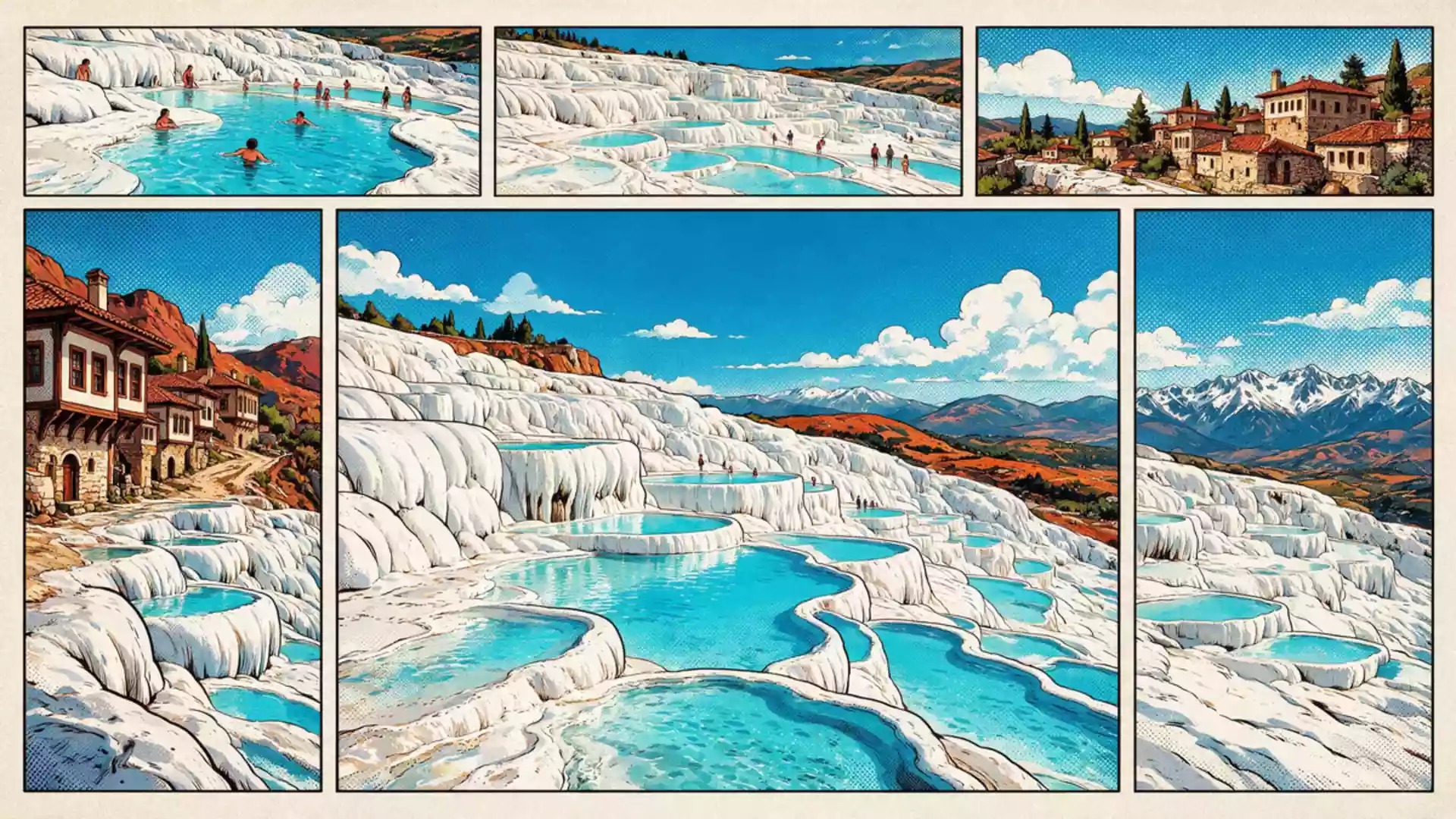
Pamukkale’s white terraces and ancient stone above Denizli
Published on 09/05/2026 at 11:32 | Editorial responsibility: Rafael Müller, Editor-in-Chief AD HOC NEWS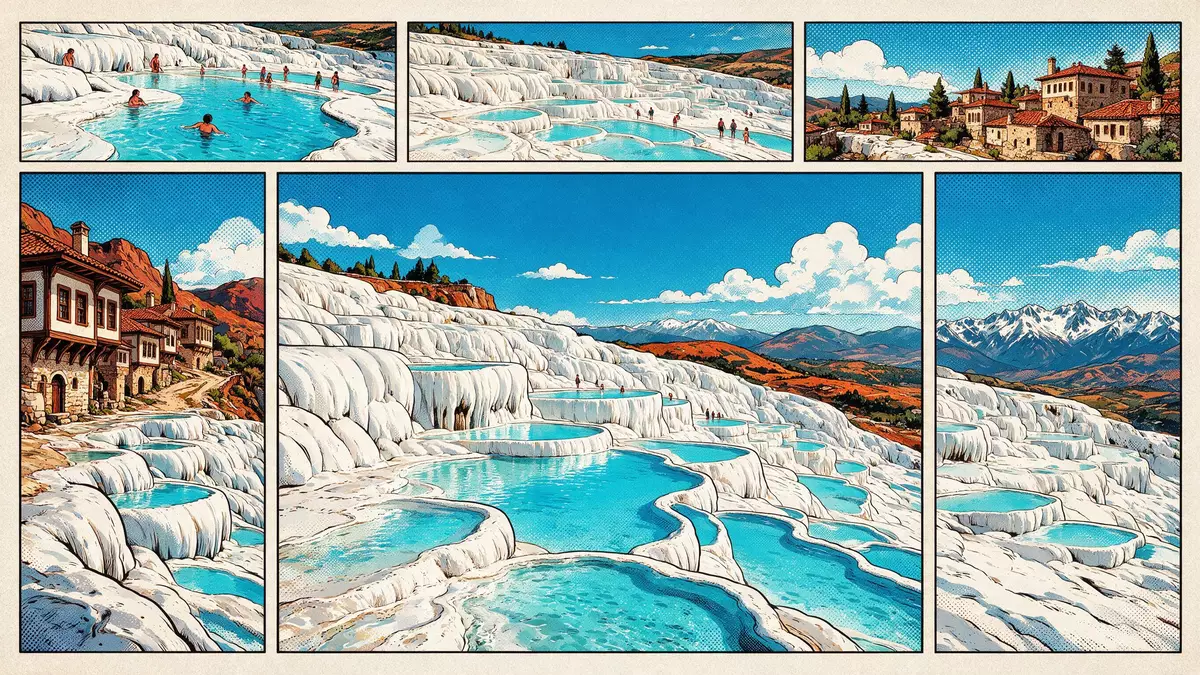
Pamukkale in Denizli Province in south?west Turkey is a hillside where bright white travertine terraces and the ruins of the ancient city of Hierapolis occupy the same broad slope.Hierapolis-Pamukkale is listed as a UNESCO World Heritage Site, recognising both the natural travertine formations and the Greco?Roman and Byzantine remains above them.Denizli Province, Turkey
White travertine terraces shaped by thermal water
The terraces that give Pamukkale its character are made of travertine, a sedimentary rock formed when calcium?rich thermal waters flow down the cliff and deposit calcium carbonate on the slope.travertine deposition Over many generations, this steady flow has built up a white crust that thickens into steps and shelves, creating a hillside of mineral forests, petrified cascades and terraced basins described in UNESCO’s listing.
The travertine band stretches for roughly 2,700 m (8,860 ft) along the slope and reaches several hundred metres in width, forming a prominent pale strip when seen from the plain below.about 2,700 metres long In places the cliff rises close to 200 m (660 ft) above the surrounding landscape, so the terraces read almost like a white curtain draped over a natural wall.660-foot-tall cliff The Turkish name Pamukkale translates as “cotton castle”, a reference to this bright, textured surface that resembles piled bales of cotton when viewed from a distance.meaning “cotton castle”
Hierapolis above the terraces
Above the travertine slope, on the plateau at the top of the cliff, lie the remains of Hierapolis, a city founded in the Hellenistic period and later rebuilt and expanded under the Roman Empire.Hierapolis Antik Kenti In archaeological literature the settlement is described as a “Holy City”, reflecting the concentration of temples and other religious structures identified there.“Holy City”
Visitors walking across the plateau pass substantial ruins from the Greco?Roman and Byzantine periods, including a well?preserved theatre, streets lined with fragments of colonnades and a necropolis with tombs extending across the northern outskirts of the ancient city.theatre and necropolis The stonework here shares the hill with the travertine: from many points in Hierapolis the white slope is visible below, while from the terraces the outlines of the theatre and city walls sit above the mineral formations, tying geology and built history into a single view.
A combined cultural and natural World Heritage landscape
Hierapolis-Pamukkale was inscribed on the UNESCO World Heritage List in 1988 as a property that combines cultural and natural values, with specific criteria recognising the travertine landscape and the city ruins.inscribed in 1988 The designated area extends over more than 1,000 hectares, taking in the terraces themselves, the thermal springs that feed them, the plateau and the archaeological remains of Hierapolis.spread across 1,077 hectares
UNESCO’s description emphasises the tight integration between the natural travertine formations and the urban fabric, noting mineral forests, petrified waterfalls and terraced basins on the slope alongside the theatre, the necropolis and other monuments from the Greco?Roman and Byzantine periods.Outstanding Universal Value The thermal springs that created the terraces also supported the city’s ancient spa culture, so the same hot water that built the white slopes was channelled into baths and pools in Hierapolis, reinforcing the link between landscape and urban life in this corner of Denizli.
Visiting Pamukkale: what travellers from Western Europe should know
- Pamukkale lies in Denizli Province in south?west Turkey, above the plain of the Cürüksu River, with the travertine hillside rising near the settlement that shares its name.
- The travertine terraces occupy a steep slope below the plateau of Hierapolis, so exploring the area involves walking across uneven mineral surfaces and moving between levels on paths and stairways.
- The ruins of Hierapolis stand on the plateau above the terraces, and reaching them from the travertine area involves an uphill approach on foot along routes across stone and soil.
- The official language is Turkish and the currency is the Turkish lira.
- Entry requirements depend on your nationality; UK travellers can check the FCDO travel advice at gov.uk/foreign-travel-advice, Irish travellers the Department of Foreign Affairs at ireland.ie.
Searching for Pamukkale on social platforms
These links open searches for Pamukkale on each platform.Frequently asked questions about Pamukkale
Where is Pamukkale?
Pamukkale is in Denizli Province in south?west Turkey, overlooking the plain near the Cürüksu River and close to the settlement that shares its name.
What can visitors expect on a visit to Pamukkale?
A visit combines walking across white travertine terraces on a steep slope with exploring the extensive ruins of the ancient city of Hierapolis on the plateau above.
What makes Pamukkale distinctive among Turkish landscapes?
Pamukkale is distinctive for its long band of bright travertine terraces formed by thermal springs and for the ancient Greco?Roman and Byzantine city that stands immediately above them.