
Panmunjom’s blue huts on Korea’s dividing line
Published on 09/19/2026 at 08:46 | Editorial responsibility: Rafael Müller, Editor-in-Chief AD HOC NEWS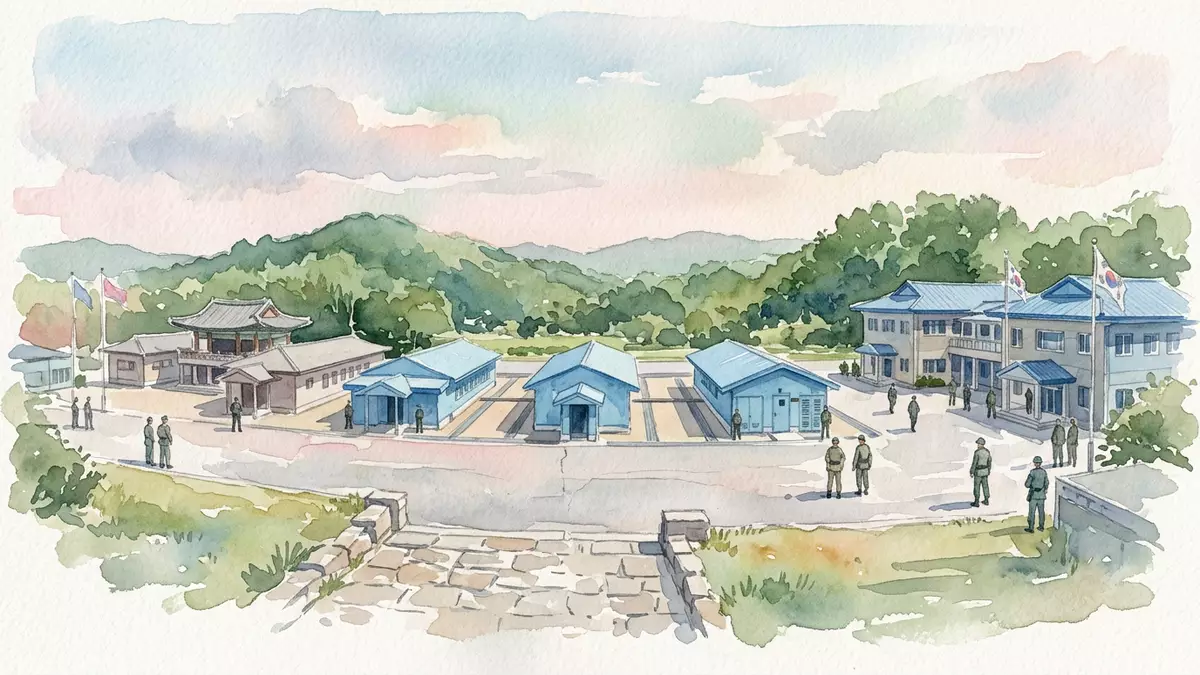
Panmunjom in South Korea is a small settlement in the Korean Demilitarised Zone where the armistice that halted the Korean War was signed on 27 July 1953, and where soldiers from North Korea and the United Nations Command still stand face to face across a visible border line. The area sits north of Seoul along the corridor towards Kaesong and is closely associated with the Joint Security Area, a compact cluster of official buildings and blue conference huts that straddle the Military Demarcation Line.
Panmunjom and the armistice that froze a war
Panmunjom began as a modest farming village on the road between Seoul and Kaesong, close to the 38th parallel that became the rough dividing line between North and South Korea after the Second World War.Panmunjom began as a modest farming village The name is used today not for a lived-in village but for the truce site in the Demilitarised Zone where military delegations meet. During the Korean War, representatives of the United Nations Command, the North Korean army and Chinese forces met here for armistice talks that stretched from the early 1950s until the signing of the Korean Armistice Agreement on 27 July 1953.armistice talks between 1951 and 1953
A specially constructed building at Panmunjom was used on the morning of 27 July 1953 when U.S. Army Lieutenant General William K. Harrison Jr. and North Korean General Nam Il signed multiple copies of the Korean Armistice Agreement, formally suspending open hostilities on the peninsula.the armistice signing at Panmunjom The agreement created a Demilitarised Zone around the new Military Demarcation Line and established the Military Armistice Commission with its headquarters near Panmunjom to supervise the ceasefire and discuss alleged violations.Military Armistice Commission headquarters near Panmunjom
The Joint Security Area and the blue conference huts
The part of Panmunjom that visitors most readily recognise is the Joint Security Area, a compact compound within the Demilitarised Zone where troops from North Korea and the United Nations Command stand in close proximity across the Military Demarcation Line.troops stand in direct proximity It lies a short distance south of the original village site, but the two are so closely linked that Panmunjom has become shorthand for the whole truce complex.Joint Security Area often referred to as Panmunjom Here a row of blue-painted conference huts straddles the border, their foundations set over the low concrete line that marks the Military Demarcation Line.
Inside these conference huts, meeting rooms are arranged so that a long table follows the border line, with chairs on each side assigned to the opposing delegations. Armistice meetings and negotiations have taken place in these rooms under the oversight of the Military Armistice Commission, giving the small buildings a significance far beyond their modest size.MAC still meets in the truce village Around the huts stand guard posts, flagpoles and official buildings for the United Nations Command and North Korean side, creating a compact but densely controlled landscape marked by boundary markers and clearly defined lines of movement.
A border landscape between Paju and Kaesong
Geographically, Panmunjom occupies a stretch of low ground in the centre of the Korean Peninsula, within the Demilitarised Zone between Gyeonggi Province in South Korea and the area around Kaesong in North Korea.Panmunjom near Paju and Kaesong The site lies north-northwest of Seoul along the corridor historically followed by the road and rail line towards Kaesong, close to the latitude of the 38th parallel that played a central role in the peninsula’s division.armistice talks resumed at Panmunjom northwest of Seoul The Demilitarised Zone itself forms a broad band across the peninsula, and Panmunjom occupies a point where this band coincides with long-standing transport routes.
Beyond the compact Joint Security Area and its conference huts, the surrounding terrain includes low hills, streams and the infrastructure that serves the military presence on both sides. The site of the original farming village lies near the western bank of a local stream and is now marked by the North Korea Peace Museum, preserving the room used for the armistice signing, while the current Joint Security Area stands slightly to the south. Together these elements create a layered border landscape where the remains of an ordinary rural settlement and the structures of Cold War diplomacy share the same ground.
Visiting Panmunjom: what travellers from Western Europe should know
- Panmunjom lies within the Korean Demilitarised Zone north of Seoul, in the border area between Paju in South Korea and Kaesong in North Korea, reached via organised transport from the South Korean side.
- The Joint Security Area is a controlled military compound with clearly marked boundaries, and any visit involves moving through structured routes that include steps, outdoor surfaces and short walks between buildings.
- The surroundings include low hills and open terrain within the Demilitarised Zone; conditions can range from bright sunshine to winter cold, and visitors spend time both outdoors and inside official buildings.
- The official language is Korean and the currency is the South Korean won; English is used in some briefings connected with organised visits from South Korea.
- Entry requirements depend on your nationality; UK travellers can check the FCDO travel advice at gov.uk/foreign-travel-advice, Irish travellers the Department of Foreign Affairs at ireland.ie.
Searching for Panmunjom on social platforms
These links open searches for Panmunjom on each platform.Frequently asked questions about Panmunjom
Where is Panmunjom?
Panmunjom is in the Korean Demilitarised Zone between South Korea and North Korea, north of Seoul in the border area near Paju and Kaesong.
What should visitors expect at Panmunjom?
Visitors encounter a controlled military environment centred on the Joint Security Area, with blue conference huts, guard posts and clearly marked boundary lines within the border zone.
What makes Panmunjom distinctive?
Panmunjom is distinctive as the site where the Korean War armistice was signed in 1953 and as the location where troops from both sides still face each other across a visible border line.


