
Pantheon and its perfect Roman dome in Rom
Published on 08/18/2026 at 14:56 | Editorial responsibility: Rafael Müller, Editor-in-Chief AD HOC NEWS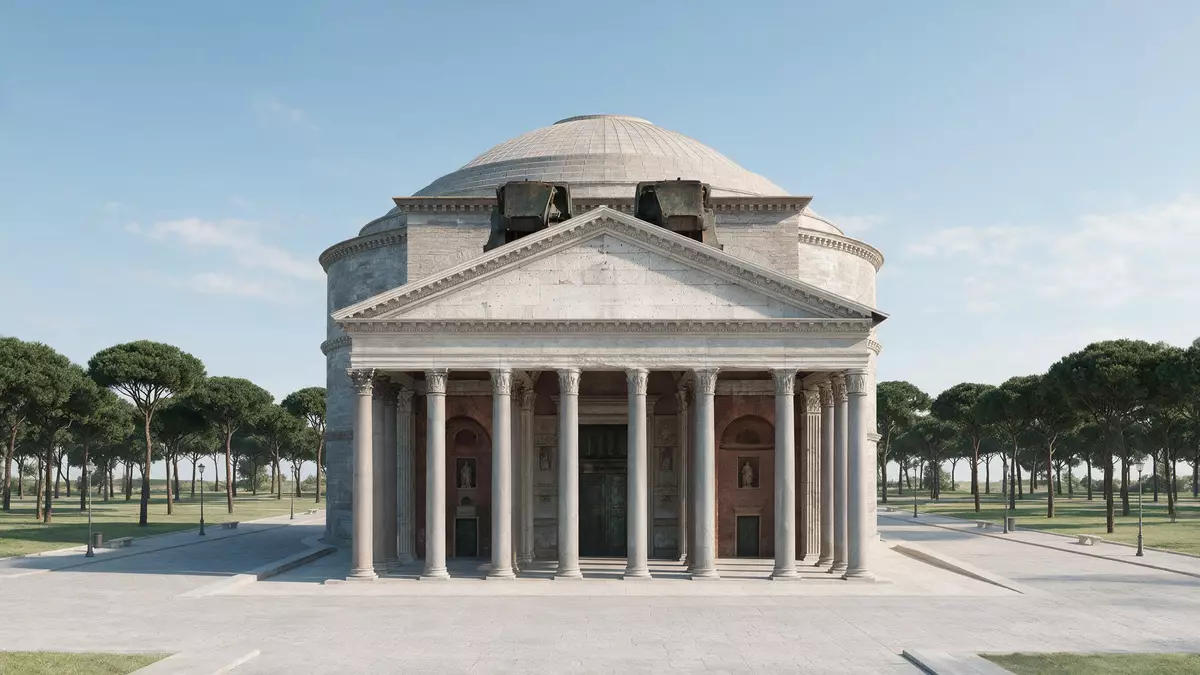
Pantheon in Rom brings together a traditional columned porch and a vast circular hall topped by a single concrete dome, creating one of the most recognisable interiors of ancient Rome. Built under Emperor Hadrian in the second century and consecrated as a Christian church in 609, it stands in the historic core of the Italian capital as both an ancient temple and a working basilica.
A temple, a church and a city landmark
Pantheon stands on Piazza della Rotonda in central Rom, surrounded by narrow streets and later palazzi that draw the city tightly around its outline.The building rises on the site of earlier temples commissioned by Marcus Vipsanius Agrippa under Augustus, which were damaged by fire before the current structure was erected in the second century CE.
The long inscription on the porch records Agrippa as the builder, yet the standing building dates from the reign of Emperor Hadrian, who completed the present rotunda and portico between about 118 and 128 CE.The Latin inscription naming Agrippa survives on the frieze above the columns, a reminder of the earlier temple whose footprint the later structure follows.
The geometry of the dome and rotunda
The interior of Pantheon is defined by a single, almost spherical space, where the height from the floor to the apex of the dome matches the internal diameter at about 43.3 m (142 ft), so a perfect sphere could be inscribed within the volume.The documented dimensions of the rotunda give the building its celebrated geometric clarity.
The dome itself is formed in unreinforced concrete resting on a thick drum, and remains the largest unreinforced concrete dome known from antiquity.The span of around 43.3 m in unreinforced concrete demonstrates Roman mastery of graded aggregate mixes and careful proportioning, while the internal coffering helps articulate the curve and reduce the weight of the structure.
From imperial Rome to Christian basilica
The original Pantheon on this site was commissioned by Marcus Vipsanius Agrippa in the late first century BCE as a temple dedicated to all the gods of Rome, reflecting the meaning of its Greek-derived name.Agrippa’s late first-century BCE construction established the temple’s role in the monumental landscape of Augustan Rome.
In 609, during the early Middle Ages, Pantheon was consecrated as a Christian church dedicated to Santa Maria ad Martyres, a change of use that helped preserve its structure through periods when many other ancient monuments were quarried or dismantled.The consecration as Santa Maria Rotonda in 609 established its dual identity as both an ancient Roman temple and a functioning basilica, and its interior later became the burial place of figures including the painter Raphael.
Visiting Pantheon: what travellers from Western Europe should know
- Pantheon stands on Piazza della Rotonda in the historic centre of Rom, a short walk from landmarks such as Piazza Navona and the Trevi Fountain.
- The approach involves crossing cobbled streets and stepping up onto the temple’s front platform, then passing between tall granite columns to reach the interior.
- Inside, the marble floor and slightly sloping surface can feel uneven underfoot, and the space is large enough that visitors may find themselves standing for extended periods while looking around.
- The official language is Italian and the currency is the euro.
- Entry requirements depend on your nationality; UK travellers can check the FCDO travel advice at gov.uk/foreign-travel-advice, Irish travellers the Department of Foreign Affairs at ireland.ie.
Searching for Pantheon on social platforms
These links open searches for Pantheon on each platform.
Frequently asked questions about Pantheon
Where is Pantheon in Rom?
Pantheon stands on Piazza della Rotonda in the historic centre of Rom, within walking distance of the Tiber and several other ancient and Baroque landmarks.
What should visitors expect inside Pantheon?
Visitors enter through the columned portico into a single, high circular hall where a coffered concrete dome spans above marble floors, altars and historic tombs.
What makes Pantheon distinctive among Roman buildings?
Pantheon combines a traditional temple front with a perfectly proportioned domed rotunda in unreinforced concrete, and it has remained in continuous religious use since its consecration in 609.


