
Parque nacional del Teide: Tenerife’s volcanic high plateau
Published on 09/18/2026 at 12:37 | Editorial responsibility: Rafael Müller, Editor-in-Chief AD HOC NEWS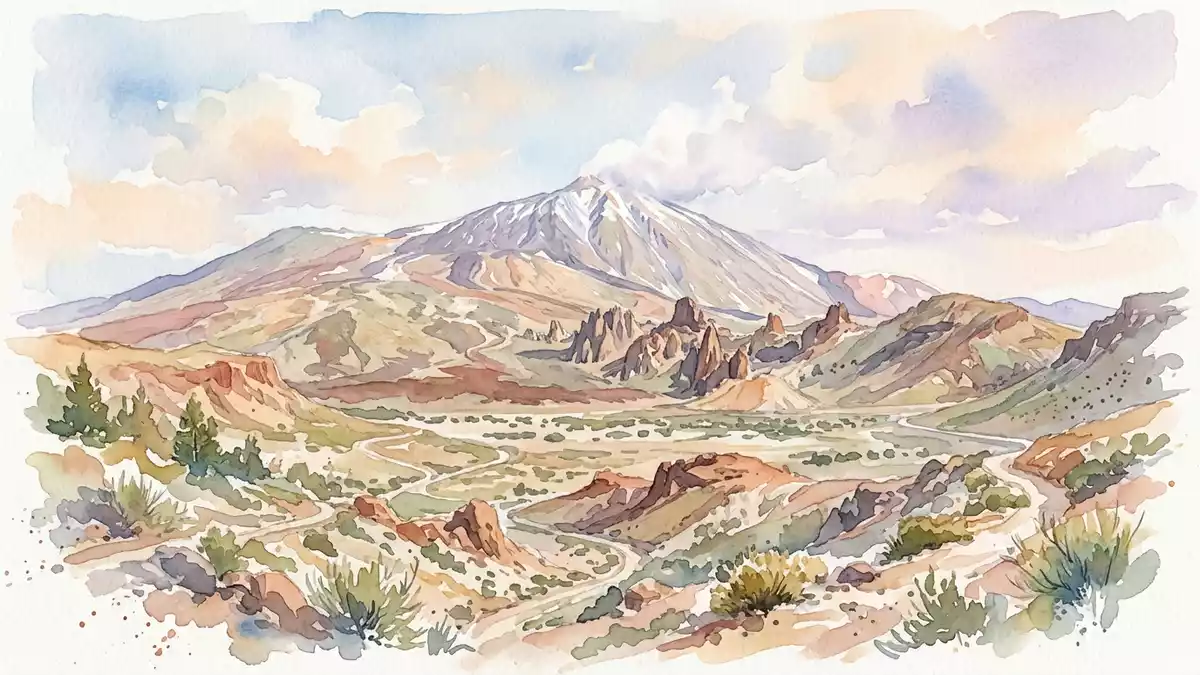
Parque nacional del Teide on Teneriffa is a high volcanic plateau wrapped around Mount Teide, the stratovolcano that rises as the highest peak on Spanish soil in the Canary Islands. The park sits in the centre of Tenerife and has been protected as a national park since 1954, later gaining UNESCO World Heritage status in 2007 for its volcanic landscape and geology.
A caldera plateau beneath Spain’s highest summit
Parque nacional del Teide occupies the upper part of Tenerife, centred on a broad volcanic depression known as the Las Cañadas caldera, with the main plateau lying above 2,000 m (6,562 ft) in elevation.Las Cañadas caldera From this basin rises the Teide–Pico Viejo volcanic complex, a stratovolcano system whose highest point on Teide reaches 3,718 m (12,198 ft), marking the summit of Spain.3,718 m summit The plateau unfurls as a wide, open terrain surrounded by cliffs and older crater walls, giving visitors extended views of the cone of Teide standing above the caldera floor.
The national park covers tens of thousands of hectares of volcanic ground, with the core protected zone recorded as around 18,990 ha under its UNESCO inscription.core protected zone Within this area, the plateau forms a mosaic of lava fields, domes, cones, and broken crater walls arranged around a central axis dominated by Teide and Pico Viejo.volcanic formations Large rock bastions such as La Fortaleza and other remnant walls mark the edge of the ancient caldera, emphasising how the modern landscape is built on much older eruptive structures.
Volcanic geology written in rock and lava
The lead experience of Parque nacional del Teide is geological: the terrain is almost entirely volcanic, with materials ranging from dark basalt to paler trachytes and phonolites exposed in different layers and landforms.volcanic materials Basalts are the most widespread rocks in the park, especially in older strata and in extensive lava flows descending from Teide and Pico Viejo, while more evolved lavas form lighter-coloured domes and cliffs.basalt lava flows This mixture of rock types makes the plateau a natural cross-section through Tenerife’s volcanic history, accessible from the road network that crosses the caldera.
Geomorphologically, Parque nacional del Teide is structured into platforms, cones, lava flows and depressions, all shaped by repeated eruptions and subsequent erosion.platforms and cones The Teide cone itself is a comparatively recent structure in geological terms and forms the highest point in Spain, standing above older remnants of volcanoes whose eroded walls frame the modern caldera.highest peak in Spain Across the plateau, weathering and fracturing have carved out distinctive rock pinnacles and crags, while wide lava fields and scattered volcanic cones show how eruptions have filled and refilled the basin over long periods.
Protected status and scientific landscape
Parque nacional del Teide was formally declared a national park in 1954, placing its high-altitude volcanic terrain under Spanish protection as part of the Canary Islands park network.national park since 1954 In 2007 it was inscribed as a UNESCO World Heritage Site, recognised under the natural criteria vii and viii for its scenic volcanic landscape and the geological processes it illustrates.UNESCO World Heritage Site The park has also received a European Diploma of Protected Areas, reflecting its significance within continental conservation frameworks.European Diploma of Protected Areas
The protected landscape of Parque nacional del Teide is used extensively as an outdoor laboratory for studying oceanic island volcanism and high-mountain ecosystems.natural laboratory Eruptive deposits, lava stratigraphy and varied volcanic structures, combined with the plateau’s mountain climate characterised by low rainfall and strong winds, provide conditions for research into both geological processes and specialised high-altitude flora.mountain climate For travellers, this scientific dimension is visible in the way trails, viewpoints and interpretive stops focus attention on rock formations, caldera walls and the Teide cone itself.
Visiting Parque nacional del Teide: what travellers from Western Europe should know
- Parque nacional del Teide lies in the centre of Tenerife in Spain’s Canary Islands and is reached by mountain roads crossing the Las Cañadas caldera from several coastal towns.
- The plateau is a high-altitude environment above 2,000 m (6,562 ft), with approaches over paved roads and paths that cross uneven volcanic ground and occasional stretches of loose rock.
- Mount Teide’s summit stands at 3,718 m (12,198 ft), so even lower viewpoints within the park involve noticeable elevation and exposure to strong sun and mountain weather.
- Within sight of the park lie other volcanic features of Tenerife, including the broader Teide massif and surrounding ridges that extend across the island’s central spine.
- The official language is Spanish and the currency is the euro.
Searching for Parque nacional del Teide on social platforms
These links open searches for Parque nacional del Teide on each platform.
Frequently asked questions about Parque nacional del Teide
Where is Parque nacional del Teide located?
Parque nacional del Teide is located in the central highlands of Tenerife in Spain’s Canary Islands, around the Teide–Pico Viejo volcanic complex and the Las Cañadas caldera.
What can visitors expect during a visit to the park?
Visitors encounter a high volcanic plateau with lava fields, crater walls, rock formations and views of Mount Teide’s cone, all within a protected mountain environment shaped by eruptions and erosion.
What makes Parque nacional del Teide distinctive among Spanish landscapes?
The park combines Spain’s highest summit with an extensive caldera plateau, varied volcanic rocks, and formal designations as a national park, UNESCO World Heritage Site and European Diploma area.


