
Parque Nacional Talampaya and the sandstone canyons of La Rioja
Published on 09/19/2026 at 11:34 | Editorial responsibility: Rafael Müller, Editor-in-Chief AD HOC NEWS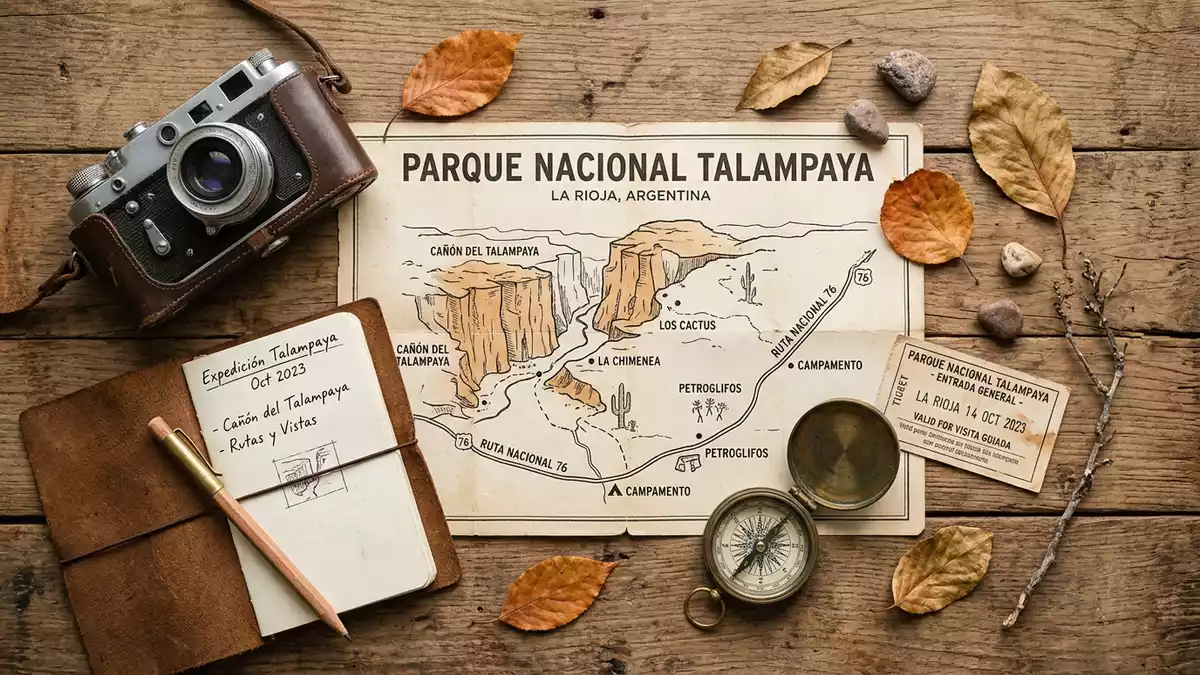
Parque Nacional Talampaya in La Rioja, Argentina, is a desert national park defined by sheer sandstone canyons, Triassic rock layers and wide open, rust-coloured plains. Established as a national park in 1997 and recognised as a UNESCO World Heritage Site in 2000, it protects both dramatic geology and important fossil and archaeological sites from deep prehistory and human settlement.
Sandstone canyons carved into the Triassic desert
The most striking feature of Parque Nacional Talampaya is the system of sandstone canyons where vertical walls rise from the desert floor in shades of red, orange and brown. In places the cliffs form almost continuous faces, broken by ledges and narrow recesses where sediment has weathered at different rates. These canyon corridors cut across the Talampaya River valley, framing stretches of sandy ground and sparse desert shrubs beneath the rock.
The rock itself belongs to Triassic formations that record river channels, floodplains and desert environments of the Mesozoic era, preserved here as stacked layers of sedimentary stone.Triassic environments of the Mesozoic era In some canyon sections, erosion has sculpted freestanding pillars, buttresses and narrow columns, where harder bands of rock resist weathering longer than the surrounding material. Wind and occasional water flows have scoured the bases of these formations, leaving smooth surfaces and scattered boulders where blocks have dropped away from the walls.
World Heritage protection for fossils and desert ecology
Beyond the canyon scenery, Parque Nacional Talampaya is protected for its combination of desert ecology and fossil-bearing rocks. The park covers over 213,000 hectares of the Monte de Sierras y Bolsones ecoregion, a belt of desert and semi-desert lying between sierras and enclosed basins in western Argentina.Monte de Sierras y Bolsones ecoregion Within this landscape, hardy shrubs, grasses and scattered trees line dry stream beds and occupy patches of deeper soil, while more exposed surfaces carry sparse vegetation adapted to heat, aridity and strong sunlight.
The Triassic rocks of Talampaya hold fossils of early vertebrates, including ancestors of mammals and remains linked with dinosaur lineages, together with impressions and fragments of ancient plants.fossils of vertebrates and plants These records helped support the park’s designation as a UNESCO World Heritage Site in 2000, shared with neighbouring Ischigualasto, because taken together the two protected areas preserve a broad sequence of Triassic rock that documents changes in environments and life through that period.UNESCO World Heritage Site in 2000 In addition, Talampaya contains archaeological traces such as petroglyphs and simple structures that mark human presence in this desert corridor over long spans of time.
From provincial reserve to national park in La Rioja
Talampaya was first protected as a provincial reserve in 1975, reflecting concern for both its geology and cultural heritage in western La Rioja Province.provincial reserve in 1975 In 1997 the Argentine Senate created Parque Nacional Talampaya through National Law 24,846, giving the area national park status and expanding formal protection over its canyons, desert plains and fossil sites.National Law 24.846 in 1997 Three years later UNESCO added Talampaya, together with Ischigualasto across the provincial border, to the World Heritage List as a natural site.
The park lies in the centre-west of La Rioja Province in departments such as Coronel Felipe Varela, with the administrative offices in the town of Villa Unión, a small settlement that serves as a base for visiting the surrounding desert.administrative offices in Villa Unión Within its boundary, the protected area extends across broad plains interrupted by low ranges and mesas, with the Talampaya River cutting through the sandstone to form the canyons that give the park its name.
Visiting Parque Nacional Talampaya: what travellers from Western Europe should know
- Parque Nacional Talampaya lies in the west of La Rioja Province in Argentina, reached overland from towns such as Villa Unión on roads that cross semi-desert terrain.
- Inside the park, the main canyon routes run over sandy and rocky ground, with uneven surfaces and stretches of walking between sandstone walls.
- The surrounding landscape is an arid plateau at altitude, where sun exposure is strong and shade is limited away from canyon walls and sparse trees.
- The official language is Spanish and the currency is the Argentine peso.
- Entry requirements depend on your nationality; UK travellers can check the FCDO travel advice at gov.uk/foreign-travel-advice, Irish travellers the Department of Foreign Affairs at ireland.ie.
Searching for Parque Nacional Talampaya on social platforms
These links open searches for Parque Nacional Talampaya on each platform.
Frequently asked questions about Parque Nacional Talampaya
Where is Parque Nacional Talampaya located?
Parque Nacional Talampaya is in the west of La Rioja Province in north-western Argentina, with administrative offices based in the nearby town of Villa Unión.
What can visitors expect to see in the park?
Visitors encounter tall sandstone canyon walls, desert plains with sparse vegetation and Triassic rock formations that preserve fossils and traces of ancient environments.
What makes Parque Nacional Talampaya distinctive?
The park stands out for its combination of towering red sandstone canyons, extensive desert landscapes and Triassic fossil sites recognised together as a UNESCO World Heritage natural area.


